Sapele Mahogany vs African Mahogany: Strength Guide
You’ll find Sapele and African mahogany differ significantly in density, hardness, and grain complexity.
Sapele is denser and harder, offering pronounced ribbon stripe figuring but demands sharper tools and care due to its interlocked grain.
African mahogany is lighter, more stable, and easier to machine, with a straighter, subtler grain.
It’s pricier but ideal for fine finishing and classic applications.
Exploring these contrasts further will help you pick the best wood for your project’s needs.
Key Takeaways
- Sapele (Entandrophragma cylindricum) is not a true mahogany, unlike African mahogany which primarily refers to Khaya species.
- Sapele has a darker, more decorative ribbon stripe grain and higher hardness (Janka ~1,410 lbf) than African mahogany.
- African mahogany features straighter grain, easier machinability, and superior dimensional stability compared to Sapele.
- Sapele is denser (~41.6 lbs/ft³) and more durable, ideal for high-traffic areas, while African mahogany suits fine furniture and interior trim.
- African mahogany typically costs more but offers easier finishing and less machining difficulty than the more affordable, harder Sapele.
Sapele Mahogany vs African Mahogany: Key Differences in Hardness, Grain, and Durability
| Comparison Factors | Sapele Mahogany | African Mahogany |
|---|---|---|
| Scientific Classification | Entandrophragma cylindricum | Khaya species |
| Wood Family | Meliaceae | Meliaceae |
| Wood Type | Tropical hardwood | Tropical hardwood |
| Average Density | Approximately 41.6 lb/ft³ (665 kg/m³) | Approximately 33.9 lb/ft³ (545 kg/m³) |
| Janka Hardness | Approximately 1,410 lbf | Approximately 800–1,200 lbf, depending on species |
| Heartwood Color | Pinkish brown to rich reddish brown | Pale pink to reddish brown |
| Grain Pattern | Interlocked grain with prominent ribbon stripes | Generally straighter, subtler grain |
| Decorative Appearance | Bold, figured grain, including ribbon stripe patterns | Classic, understated appearance |
| Dent Resistance | Higher resistance due to greater hardness | Moderate resistance, depending on species |
| Dimensional Stability | Moderate stability; careful moisture control is important | Article describes greater dimensional stability |
| Machining Difficulty | More demanding, with increased tearout potential | Generally easier to machine and shape |
| Carving Performance | Requires sharper tools and careful grain control | More suitable for detailed carving |
| Staining and Finishing | Attractive finish, though interlocked grain requires preparation | Generally easier finishing with proper surface preparation |
| Natural Durability | Moderate to good resistance to certain decay conditions | Moderate durability, varying by species |
| Outdoor Applications | Requires appropriate finishing and moisture protection | Requires appropriate finishing and moisture protection |
| Common Applications | Flooring, musical instruments, veneers, and decorative paneling | Furniture, cabinetry, doors, and interior trim |
| Typical Material Cost | Article describes lower relative cost | Article describes higher relative cost |
| Overall Recommendation | Best for wear resistance and decorative grain | Best for easier machining and classic woodworking |
What Are Sapele Mahogany and African Mahogany?

Sapele mahogany and African mahogany are distinct hardwoods often confused due to their similar appearance and shared family lineage.
Sapele and African mahogany are distinct hardwoods frequently mistaken because of their similar looks and related families.
Sapele, scientifically known as *Entandrophragma cylindricum*, belongs to the Meliaceae family but isn’t a true mahogany.
African mahogany is a trade name mainly applied to *Khaya* species, though sometimes loosely used for other African hardwoods.
You should note that while both are marketed in overlapping sectors like furniture and veneer, their botanical identities differ.
Sapele’s commercial use as a mahogany substitute is primarily visual, reflecting its resemblance rather than taxonomic relation.
African mahogany’s designation covers a broader range of species, adding to market confusion.
Understanding these distinctions helps you make informed choices in hardwood selection.
When choosing hardwoods, considering factors like material stability and resistance to moisture can be crucial for long-term durability.
Comparing Density and Hardness of Sapele and African Mahogany
When comparing these two woods, you’ll find that African mahogany generally offers lower density and hardness than Sapele. This affects their performance in various applications.
Sapele typically registers a Janka hardness of about 1,410 lbf, whereas African mahogany ranges between 800 and 1,200 lbf depending on the species.
With respect to density, Sapele averages around 41.6 lbs/ft³ (665 kg/m³), notably heavier than African mahogany’s 33.9 lbs/ft³ (545 kg/m³).
This higher density and hardness make Sapele more resistant to dents and wear, which is advantageous in flooring and high-traffic furniture.
Conversely, African mahogany’s lower density contributes to easier machining and handling but may reduce durability under heavy use.
Understanding these mechanical differences helps you select the right wood based on your project’s performance requirements. The Janka hardness rating is a key measure used to compare the resistance of woods like Sapele and African mahogany to denting and wear.
Color and Grain Differences: Sapele vs African Mahogany
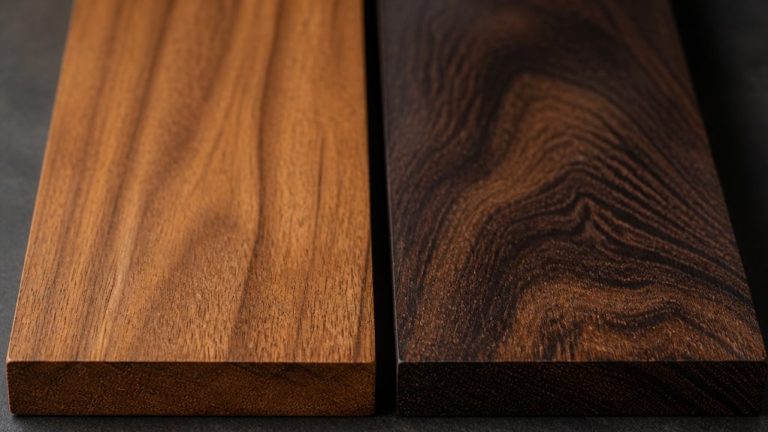
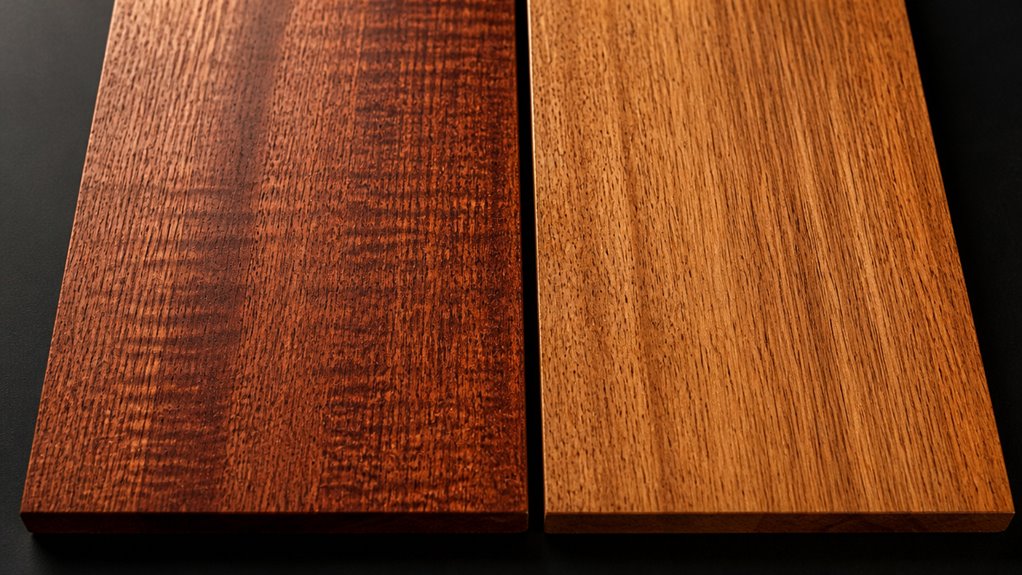
You’ll notice that Sapele’s heartwood ranges from pinkish brown to reddish brown. It often shows off a pronounced ribbon stripe figure when it’s quartersawn, which is pretty eye-catching!
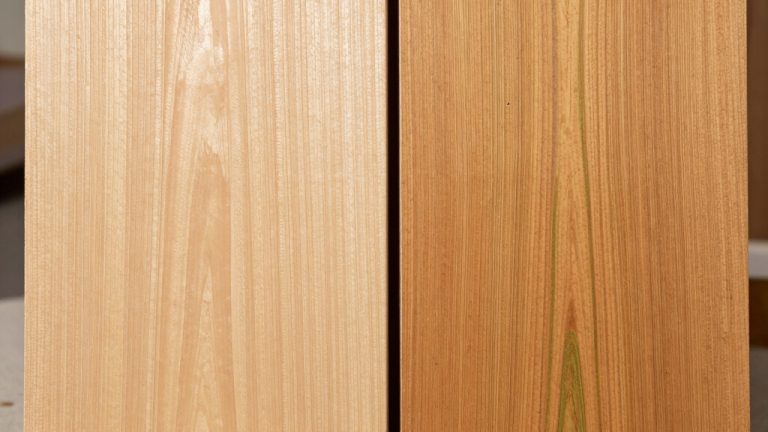
Now, on the other hand, African mahogany has its own charm. It varies from pale pink to deeper reddish brown, but it usually features a straighter, more subdued grain pattern.
Both woods offer distinct grain patterns that influence their aesthetic appeal and workability.
Heartwood Color Variation
Although both woods share a mahogany-like appearance, their heartwood color and grain patterns exhibit distinct characteristics that influence aesthetic choices.
You’ll find Sapele’s heartwood typically ranges from pinkish brown to reddish brown, darkening with age. African mahogany’s heartwood spans from pale pink to deeper reddish brown, also deepening over time. This variation affects how each wood complements different design schemes. Additionally, understanding the dimensional stability of wood species can help inform your choice based on the intended project’s functional requirements.
| Attribute | Sapele | African Mahogany |
|---|---|---|
| Heartwood Color | Pinkish brown to reddish brown | Pale pink to reddish brown |
| Aging Effect | Darkens noticeably | Darkens moderately |
| Visual Impact | Rich, vibrant tones | Softer, subtler hues |
| Typical Use Preference | Decorative, bold appearances | Classic, understated looks |
Knowing these details helps you select the best wood for your project’s visual impact.
Grain Pattern Characteristics
While both Sapele and African mahogany exhibit a mahogany-like appearance, their grain patterns differ markedly in structure and visual impact.
Sapele features an interlocked grain that produces a distinctive ribbon stripe figure when quartersawn. It also showcases pronounced pommele and quilted patterns, giving it a highly decorative and textured surface.
In contrast, African mahogany generally displays a straighter, more subdued grain with less dramatic figuring.
This difference affects both aesthetics and machinability. Sapele’s interlocked grain demands careful handling to avoid tearout, while African mahogany’s simpler grain allows easier shaping and finishing.
When choosing between them, consider whether you want the striking, complex grain of Sapele or the uniform, classic grain of African mahogany for your project’s visual emphasis.
Like the subtle grain and density differences between bur oak and white oak that influence finishing techniques, the grain structure in mahogany species similarly impacts workability and appearance, highlighting the importance of understanding grain morphology.
Which Wood Is Easier to Work With: Sapele or African Mahogany?
When it comes to working with wood, many people find African mahogany to be the easier option. Its straighter grain and softer texture make it a breeze to machine and carve. Plus, you’ll likely experience less tearout and wear on your tools, which is always a bonus.
On the flip side, Sapele can be a bit trickier. Its interlocked grain means you’ll need to handle it more carefully. If you’re not cautious, you might end up with splits, especially during the finishing process. It’s a good idea to pre-drill when working with Sapele to avoid any mishaps.
Both woods take stains and finishes beautifully, but Sapele’s complex grain can pose a challenge for fine surface work. In contrast, African mahogany tends to be more forgiving, making it a favorite for many woodworkers. So, if you’re looking for ease and convenience, African mahogany might just be the way to go! Additionally, understanding wood’s grain direction impact can help improve your handling and finishing results.
Machining Challenges
Frequently, woodworkers find African mahogany easier to machine compared to Sapele due to its straighter grain and more forgiving texture. When you work with African mahogany, expect smoother cuts and less tool wear since its lower density reduces resistance.
In contrast, Sapele’s interlocked grain pattern creates challenges like tearout and grain lifting, especially on flat-sawn surfaces. You’ll need sharper tools and slower feed rates to minimize damage. Pre-drilling becomes essential for thin sections to prevent splitting.
Additionally, Sapele’s higher Janka hardness (about 1,410 lbf) demands more power from your machinery and careful tool maintenance. While both woods glue and finish well, Sapele requires more attention during milling to avoid surface imperfections.
Understanding these nuances helps you plan machining operations effectively for each species. Similar to harder woods like maple, working with Sapele calls for sharper tools and more effort to achieve durable and precise results.
Finishing And Carving
When finishing and carving, African mahogany generally offers greater ease due to its straighter grain and softer texture. This allows for smoother cuts and finer detail work. Sapele’s interlocked grain makes carving more challenging, often requiring sharper tools and careful control to avoid tearout. Both woods finish well, but you’ll find African mahogany more forgiving on intricate surfaces. Understanding the impact of moisture content on wood hardness can further improve your finishing results.
| Aspect | African Mahogany | Sapele |
|---|---|---|
| Grain | Straighter, less interlocked | Interlocked, ribbon stripe |
| Texture | Softer | Harder, denser |
| Carving Ease | High | Moderate to difficult |
| Finishing Smoothness | Very smooth | Requires extra sanding |
| Detail Retention | Excellent | Good, but risk of tearout |
Choose African mahogany for precision carving and ease of finishing.
Durability and Resistance: How Sapele and African Mahogany Hold Up
Evaluating durability and resistance is crucial when selecting between Sapele and African mahogany for your project.
Sapele offers moderate stability but exhibits seasonal movement and a higher risk of distortion during seasoning, requiring careful moisture control.
It delivers moderate to good resistance against termites and fungi, making it suitable where strength and decay resistance are priorities.
African mahogany generally provides superior dimensional stability in service, reducing the risk of warping or shrinking over time.
It offers moderate durability, adequate for interior and protected exterior applications.
While both woods resist insect attack variably, Sapele’s higher density enhances its mechanical durability, benefiting high-traffic uses.
You’ll want to weigh these factors carefully, as Sapele trades ease of machining for better decay resistance, while African mahogany favors stability and consistent dimensional performance.
Proper moisture control and kiln-drying can significantly improve the durability of hardwoods in your project.
Typical Costs and Pricing for Sapele and African Mahogany
Although both Sapele and African mahogany offer attractive aesthetics and durability, their pricing structures differ considerably due to factors like availability, demand, and processing costs.
You’ll find Sapele typically costs about half to two-thirds as much as African mahogany. This price disparity arises because African mahogany species, particularly Khaya, are generally in higher demand and considered easier to work with, increasing their market value.
Sapele’s higher density and interlocked grain add machining complexity, slightly elevating processing expenses. However, its broader availability and faster growth temper costs.
When budgeting, expect African mahogany to command premium prices, reflecting its superior stability and ease of finishing.
Meanwhile, Sapele provides a more affordable alternative if you need hardness and a mahogany-like appearance without the higher price tag. It is important to consider that moisture content affects the mechanical properties and overall hardness, which can influence the performance and durability of both woods in flooring applications.
Best Uses: Sapele Mahogany vs African Mahogany
Selecting the ideal wood for your project hinges on understanding the distinct strengths of Sapele and African mahogany.
You’ll find Sapele best suited for applications demanding higher hardness and wear resistance, such as flooring, musical instruments, and high-traffic furniture.
Its Janka hardness of 1,410 lbf makes it a durable choice.
Its decorative ribbon stripe and figured grain make it ideal for veneers and decorative paneling where visual impact matters.
Conversely, African mahogany excels in projects prioritizing ease of machining and dimensional stability.
Use it for interior joinery, cabinets, doors, and trim where smoother carving and consistent seasonal performance are critical.
Its moderate durability suits protected interior or exterior use.
Knowing these differences helps you leverage each wood’s technical advantages effectively without compromise.
Choosing the Right Wood for Your Project
When choosing between Sapele and African mahogany for your project, consider the specific performance requirements and aesthetic goals you need to meet.
If hardness, durability, and a striking decorative grain are priorities, Sapele’s higher density (about 41.6 lbs/ft³) and interlocked ribbon stripe grain make it ideal, though machining demands increase.
Conversely, if dimensional stability and ease of workability matter more, African mahogany’s lower density (~33.9 lbs/ft³) and straighter grain offer better carving and milling performance with less risk of distortion.
Factor in that Sapele requires pre-drilling for thin stock and may show seasonal movement.
African mahogany balances moderate durability with simpler finishing.
Your choice hinges on whether you prioritize wear resistance and visual drama (Sapele) or smoother machining and stability (African mahogany).
Frequently Asked Questions About Sapele Mahogany and African Mahogany
Understanding the distinct characteristics of Sapele and African mahogany often raises practical questions about their suitability for various applications. You might wonder about hardness, appearance, or cost differences. Here’s a quick comparison to clarify:
| Feature | Sapele | African Mahogany |
|---|---|---|
| Hardness (Janka) | ~1,410 lbf | 800–1,200 lbf |
| Grain | Ribbon stripe, interlocked grain | Straighter, less figured |
| Stability | Moderate, prone to distortion | More dimensionally stable |
| Workability | Demanding due to grain | Easier to machine and carve |
| Typical Uses | Flooring, instruments, veneers | Furniture, cabinetry, trim |
If you prioritize durability and decorative grain, Sapele suits best. For easier machining and stability, African mahogany is preferable.
Frequently Asked Questions
Are Sapele and African Mahogany Sustainably Harvested?
You’ll find that both Sapele and African mahogany face sustainability challenges due to high demand and illegal logging in parts of Africa.
However, certified sources exist, including FSC-certified Sapele and Khaya, which guarantee responsible harvesting practices.
To support sustainability, you should verify certifications and source from suppliers committed to legal, well-managed forestry.
Without these measures, harvesting risks contribute to deforestation and biodiversity loss in their native regions.
Can Sapele and African Mahogany Be Used Outdoors Without Treatment?
You shouldn’t use either Sapele or African mahogany outdoors without treatment.
Both woods offer moderate durability and some resistance to decay and insects, but they’re not naturally weatherproof.
Untreated exposure to moisture and UV can cause warping, discoloration, and fungal attack.
To guarantee longevity outdoors, you’ll need proper sealing, finishes, or preservatives to protect them from moisture, sunlight, and biological degradation.
Regular maintenance is essential for outdoor use.
Do Sapele and African Mahogany Have Distinct Scents or Odors?
Like a subtle signature, both woods emit distinct odors.
You’ll notice Sapele has a mild, somewhat sweet, and slightly spicy scent when freshly cut, though it fades quickly.
African mahogany offers a faint, sweet, and earthy aroma, less pronounced but persistent.
These odors aren’t overpowering and usually disappear once the wood dries.
When you work with them, expect delicate, natural fragrances rather than strong or irritating smells.
What Are the Environmental Impacts of Harvesting These Woods?
You should know that harvesting both woods can contribute to deforestation and habitat loss if not managed sustainably.
Sapele and African mahogany come from tropical African forests, often targeted by illegal logging.
Responsible sourcing through certified programs like FSC helps reduce environmental impact.
Overharvesting risks biodiversity decline and soil degradation.
You must guarantee suppliers follow sustainable practices to minimize ecological damage and promote forest regeneration during your projects.
How Do Sapele and African Mahogany Compare in Terms of Allergenic Potential?
If you’re sensitive to wood dust, you’ll want to know both Sapele and African mahogany can be a bit challenging.
Sapele tends to produce dust that may cause mild respiratory or skin irritation due to its interlocked grain and natural oils.
African mahogany’s dust is generally less reactive but can still provoke allergic reactions in some individuals.
Always use proper dust extraction and protective gear when working with either wood to minimize risks.
Sapele Mahogany vs African Mahogany: Final Verdict
When choosing between Sapele and African Mahogany, consider your project’s specific needs: Sapele offers higher density and intricate grain, enhancing durability and aesthetics.
African Mahogany provides easier workability with a softer texture. Contrary to the belief that one outperforms the other universally, their strengths depend on application.
Sapele excels in structural uses, while African Mahogany suits detailed carving. Your choice should align with desired hardness, finish, and budget for best results.