Maple vs Beech Wood: Which Is Better?
When choosing between maple and beech wood, consider that maple offers superior hardness and wear resistance. It is ideal for heavy-use surfaces requiring dent resistance.
Beech, with moderate hardness and excellent bending ability, suits shaped or curved applications better.
Maple’s light, fine grain fits modern designs, while beech’s warm tone matches traditional styles.
Both need careful moisture management for durability and finishing.
If you want detailed guidance on their workability, appearance, and typical uses, keep exploring these factors.
Key Takeaways
- Maple is harder and more wear-resistant, making it ideal for heavy-use surfaces like gym floors and cutting boards.
- Beech is easier to bend and shape, suitable for furniture, tool handles, and bent wood parts.
- Maple has a light, uniform color with fine grain, offering a modern, clean look; beech has a warmer, pinkish hue and classic appearance.
- Maple requires careful moisture control and pre-sealing to avoid finishing issues; beech is less demanding but can raise grain after finishing.
- Maple is more expensive and widely available in North America; beech is commonly found in Europe and is generally less costly.
Maple vs Beech Wood: Key Differences in Hardness, Grain, Durability, and Workability
| Comparison Factors | Maple Wood (Hard Maple) | Beech Wood |
|---|---|---|
| Wood Classification | Hardwood | Hardwood |
| Janka Hardness | Approximately 1,450 lbf | Approximately 1,300 lbf |
| Dent Resistance | Higher resistance to surface indentation | Good resistance, but slightly softer |
| Surface Durability | Well suited to heavy-use surfaces | Suitable for furniture and general interior use |
| Natural Color | Pale cream to light reddish brown | Pale cream with warm pinkish tones |
| Grain Pattern | Fine, tight, generally straight grain | Straight, uniform, understated grain |
| Visual Appearance | Bright, clean, contemporary look | Warm, subtle, traditional appearance |
| Machining Performance | Machines cleanly, but sharp tools are important | Generally easy to machine and shape |
| Bending Capability | Less suitable for complex bending, according to the article | Excellent steam-bending characteristics |
| Wood Turning | Suitable for turning, but harder to shape | Well suited to turned and curved components |
| Staining Behavior | May develop blotchy staining without preparation | Generally more uniform staining, according to the article |
| Finishing Requirements | Careful sanding and conditioning may be needed | Light sanding after grain raising may be needed |
| Moisture Resistance | Poor natural decay resistance; moisture protection needed | Poor natural decay resistance; susceptible to movement |
| Outdoor Suitability | Not recommended for prolonged unprotected exposure | Not recommended for prolonged unprotected exposure |
| Common Applications | Gym flooring, cutting boards, worktops, and cabinetry | Chairs, furniture, cabinetry, and bentwood components |
| Regional Availability | Widely available in North America | Commonly available in Europe |
| Overall Recommendation | Choose for hardness, dent resistance, and bright finishes | Choose for bending, shaping, and traditional furniture |
Durability and Wear Resistance of Hard Maple vs Beech

When evaluating durability and wear resistance, you’ll often find hard maple outperforms beech due to its higher Janka hardness rating of approximately 1,450 lbf compared to beech’s 1,300 lbf.
This means maple can better resist denting and surface indentation under impact or sustained point loads.
Although beech is a hard hardwood with respectable durability, it tends to show wear more readily, especially in high-traffic or heavy-use applications.
If you need wood that resists scratching and denting for flooring, worktops, or gym surfaces, hard maple provides superior performance.
European beech’s hardness can sometimes approach maple’s, but consistency varies by source.
Additionally, finish quality and moisture content also play critical roles in the overall wear resistance of both species.
Color and Grain Differences in Maple and Beech Wood
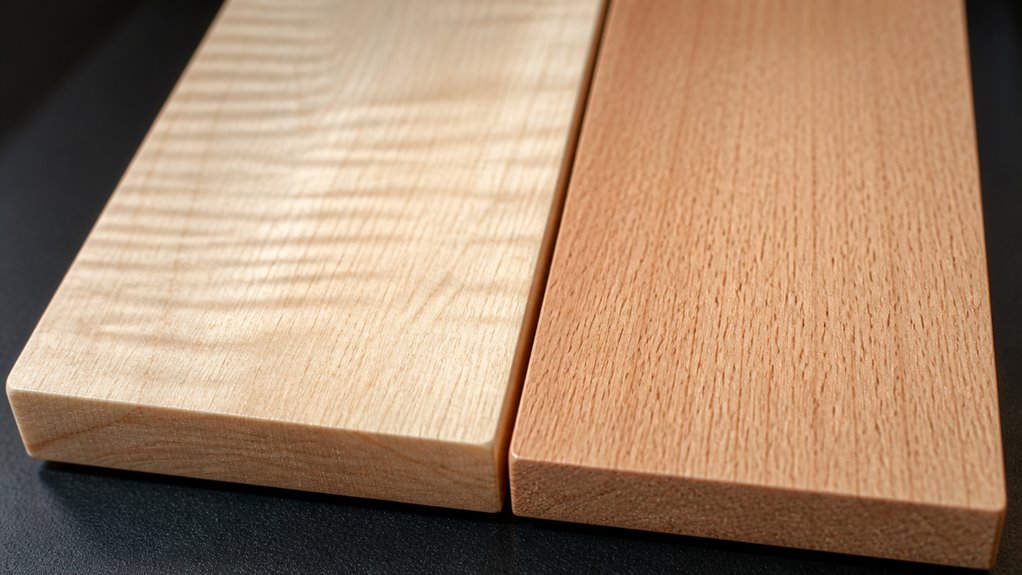
You’ll notice that maple has a light, uniform color that gives it a modern, clean appearance. Its fine, delicate grain really stands out.
On the other hand, beech tends to have a pale tone, but its grain is quite plain and even. This offers a more subtle, traditional look.
When selecting wood for flooring or furniture, considering the grain patterns and visual characteristics can help you choose the right wood to match your desired aesthetic.
Maple Color Characteristics
Maple exhibits a light, uniform color that lends itself well to bright, clean finishes, making it a preferred choice for modern aesthetics.
You’ll notice its pale cream to light reddish-brown hues maintain consistency across boards, allowing for seamless visual flow in applications like cabinetry and flooring.
The wood’s fine, delicate grain appears subtle yet refined, often showing tight, straight lines with occasional curly figure patterns, enhancing its appeal without overwhelming the surface.
This uniformity in color and grain facilitates even stain absorption and predictable finishing results, whether you opt for clear coats or tinted stains.
When selecting maple, you can expect a visually stable base that supports both natural and enhanced finishes.
This makes it ideal for projects demanding a bright, contemporary look with minimal color variation.
However, maple’s fine, tight grain can make staining challenging, often requiring conditioners to prevent blotchiness.
Beech Grain Patterns
Beech wood presents a pale, consistent color palette that closely rivals maple’s light tones. It often carries a slightly warmer, pinkish hue.
Its grain pattern is generally straight and uniform, producing a smooth, even texture that’s less pronounced than maple’s fine, delicate grain. You’ll notice beech’s grain is typically plain, lacking the distinctive figuring seen in some maple cuts.
This makes beech ideal for projects requiring a clean, subtle grain without visual distractions.
- Straight, uniform grain with minimal variation
- Pale color with a warm, pinkish undertone
- Smooth texture suitable for fine finishing
- Less pronounced grain compared to maple
- Consistent appearance ideal for traditional furniture
Beech grain’s predictability aids in machining and finishing precision. For added durability and a polished look, beech wood edges can benefit from carpet binding techniques.
Visual Appeal Comparison
The visual appeal of these hardwoods centers on their distinct color tones and grain characteristics, which influence both aesthetic outcomes and design choices.
Maple exhibits a light, uniform color with a fine, delicate grain, lending itself to clean, bright, and modern finishes. Its subtle grain pattern provides a smooth, consistent surface ideal for clear coatings or light stains.
In contrast, beech wood presents a pale, evenly toned appearance with a plain grain that offers a slightly warmer hue. Its grain is more straightforward and less pronounced than maple’s, often yielding an understated yet classic look.
When selecting between them, consider that maple’s lighter shade and refined grain suit contemporary designs, while beech’s consistent tone and simplicity complement traditional or utilitarian styles.
Maple’s fine, tight grain also enhances surface durability and stain penetration, contributing to its visual appeal and finish quality.
Workability and Finishing: Which Wood Is Easier?
When you’re working with wood, you might notice that maple machines really well. It’s pretty clean, but be careful—if you’re too aggressive with your tools, it can crack.
On the other hand, beech is a bit of a superstar when it comes to flattening and bending.
Now, both woods take finishes nicely, but if you want that perfect clear coating or stain, maple’s fine grain really shines.
But when it comes to tasks like turning and bending, beech takes the lead thanks to its extra flexibility and strength.
Maple’s fine grain texture also helps achieve a smooth finish, making it especially popular for projects requiring a polished appearance.
Tool Handling Characteristics
Maneuvering the tool handling characteristics of maple and beech wood requires understanding their distinct machining behaviors and finishing responses. When you work with maple, expect a hard surface that resists denting but may crack if stressed during cutting.
Beech, slightly softer, offers superior bending and turning capabilities, making it easier to shape by hand. Both woods plane smoothly, but beech responds better to flattening efforts.
Maple’s fine, uniform grain demands sharp tools to avoid tear-out, while beech tolerates slight dullness better without compromising edge quality.
Maple’s hardness (~1,450 lbf) demands precise tool control to prevent cracking. Beech machines cleanly with less risk of splitting.
Beech excels in hand flattening and shaping tasks. Maple requires sharper blades for smooth cuts. Both woods produce smooth surfaces suitable for detailed finishing.
Additionally, understanding wood hardness, such as oak’s Janka hardness values, can help gauge the relative resistance to denting and wear when choosing between hardwoods for tool work.
Finishing and Coating Ease
Achieving a flawless finish on maple demands sharp blades and careful handling due to its dense, fine grain and hardness of about 1,450 lbf on the Janka scale. You’ll need to sand progressively finer and apply a pre-sealer to avoid blotching, especially with stains.
Maple accepts clear coats exceptionally well, producing a smooth, glassy surface ideal for modern, light-colored finishes.
Beech, slightly softer at around 1,300 lbf, machines more uniformly and sands down smoothly, making it easier for hand finishing.
It readily takes stains and coatings but can raise its grain slightly, requiring a light re-sanding after the first coat.
Both woods respond well to oil, lacquer, and polyurethane finishes, but you’ll find beech slightly less demanding regarding surface preparation and fewer issues with uneven absorption during coating.
Additionally, managing moisture content properly is essential to maintain hardness and prevent defects during finishing.
Bending and Turning Ability
Frequently favored in woodworking for its flexibility, beech offers superior bending and turning capabilities compared to maple. When you work with beech, its uniform grain and moderate hardness let you shape curves and intricate forms with less risk of cracking.
Maple, while harder and more wear-resistant, tends to resist bending, making it less ideal for turned or bent parts. You’ll find beech easier to hand-flatten and shape on a lathe, providing smoother finishes on curved surfaces.
Beech’s fine, consistent grain improves bending without splintering. Maple’s higher hardness increases cracking risk when bent. Beech handles steam bending and lathe work more reliably.
Maple requires more careful moisture control to avoid fractures. Beech is preferred for furniture components demanding complex curves. Additionally, the presence and type of knots in the wood can influence workability and finishing quality, especially in bending and turning applications.
How Maple and Beech Handle Moisture and Outdoor Use?
Managing moisture exposure presents a significant challenge for both maple and beech woods, as neither species possesses natural rot resistance. If you expose either to damp or outdoor environments without proper sealing, you risk swelling, warping, and cracking.
Maple is particularly vulnerable in moist conditions and isn’t recommended for outdoor applications, especially where persistent humidity occurs. Beech also lacks weather resistance and tends to absorb more moisture, making it prone to dimensional instability and deformation if left unprotected.
To maintain structural integrity, you must apply high-quality sealants and perform regular maintenance on both woods. Additionally, beech’s higher movement with humidity means you’ll need to monitor and control environmental factors closely to avoid surface damage or distortion over time. Prolonged moisture exposure above 20%–28% moisture content significantly increases the risk of fungal decay in non-rot-resistant woods like maple and beech.
Common Uses for Hard Maple and Beech Wood
When selecting wood for your project, understanding the typical applications of hard maple and beech can guide you toward the best choice. Hard maple excels in wear resistance, making it ideal for surfaces exposed to heavy use. Beech’s strong bending and turning properties suit it well for shaped components.
Both woods serve well in furniture and flooring, but their specific strengths define their most suitable uses.
Consider these common applications:
- Hard maple: gym floors, bowling lanes, cutting boards, and durable worktops
- Beech: chairs, cabinetry, desks, and bent wood parts
- Both: flooring and veneers
- Beech: pallets and tool handles due to toughness and shock resistance
- Maple: kitchen surfaces where dent resistance is critical
Choose based on durability needs and forming complexity for precise results.
Cost, Availability, and Choosing Between Maple and Beech
Although both maple and beech offer excellent hardwood options, your choice will depend markedly on their cost and availability in your region.
Maple is widely available across North America but tends to be pricier due to its superior dent resistance.
Beech, commonly found in Europe, is often less expensive and excels in bending and turning applications.
When durability under impact matters, maple is preferable. For traditional furniture requiring shaping, beech is ideal.
| Criteria | Maple |
|---|---|
| Availability | North America, widely available |
| Cost | Higher, premium hardwood |
| Strength | Superior dent resistance |
| Best Use | Flooring, heavy wear surfaces |
| Criteria | Beech |
| Availability | Europe, commonly available |
| Cost | Lower, more affordable |
| Strength | Good bending and turning |
| Best Use | Furniture, turned components |
Frequently Asked Questions
Can Maple or Beech Wood Be Used for Musical Instruments?
You can use both maple and beech wood for musical instruments, but maple is preferred for its hardness, fine grain, and tonal clarity, especially in string instruments like violins and guitars.
Beech, while harder to work with for detailed shaping, offers good stability and smooth finish, making it suitable for components requiring bending or turning.
However, maple’s superior wear resistance and smoother finish often make it the better choice in high-quality instrument crafting.
Are Maple and Beech Woods Safe for Food Contact Surfaces?
You can safely use both maple and beech for food contact surfaces, as both are hard, dense hardwoods with minimal porosity that resist bacteria absorption.
Hard maple’s 1,450 lbf Janka hardness rating means it’s highly wear-resistant, reducing surface damage where microbes might hide.
Beech, slightly softer at 1,300 lbf, also performs well but requires proper sealing to prevent moisture ingress.
Always finish and maintain these woods to guarantee hygienic durability.
How Do Maple and Beech Woods Respond to Different Wood Stains?
You’ll find maple takes stains unevenly due to its fine, dense grain, often resulting in blotchy finishes unless preconditioned.
Beech accepts stains more uniformly, offering a consistent color because of its even texture.
Both woods finish well, but you’ll want to use a wood conditioner on maple to avoid patchiness.
Beech’s open grain allows for smoother absorption, making it easier to achieve an even tone with various stains.
What Are the Environmental Impacts of Harvesting Maple Versus Beech?
You’ll find that harvesting maple generally has a lower environmental impact in North America due to sustainable forestry practices and its abundance.
Beech, often sourced from European forests, may involve more risk of overharvesting in some regions, affecting biodiversity.
Both species require careful management to prevent habitat loss and soil degradation.
Do Maple and Beech Woods Have Any Natural Insect Resistance?
Neither maple nor beech woods have significant natural insect resistance.
If you’re relying on them for projects, you’ll need to apply protective treatments to prevent insect damage.
Both species lack inherent chemical defenses against wood-boring insects or termites, so untreated wood can be vulnerable.
You should consider additional finishes or preservatives, especially in environments prone to insect activity, to maintain durability and extend the lifespan of your wood products.
Maple vs Beech Wood: Making the Right Choice
When choosing between hard maple and beech, picture maple’s dense, pale grain standing resilient against beech’s warm, intricate patterns.
Maple excels in durability and moisture resistance, making it ideal for heavy-use or outdoor projects.
Beech offers smoother workability and a more affordable option for indoor furniture.
Your decision hinges on balancing strength with ease of finishing, and cost with aesthetic preference.
Ensure you select the wood that precisely fits your project’s demands.