
What Is a Trim Carpenter and What Do They Do?
You carefully measure, cut, and fit detailed trim components like baseboards, crown molding, and window casings to assure a seamless, structurally sound finish.
You rely on blueprints and precise tools to match profiles exactly, adjusting for site irregularities and material types such as wood or composite.
Your work demands exact alignment, flawless joints, and strict safety practices. Mastering these skills guarantees professional results, and there’s much more to understand about the tools and techniques involved.
Key Takeaways
- A trim carpenter specializes in installing detailed finish carpentry like moldings, baseboards, casings, and custom millwork with precision.
- They measure, cut, and fit trim components using blueprints and exact tools to ensure seamless, flawless installation.
- Their work involves materials such as wood, MDF, PVC, and composite products tailored for residential and commercial projects.
- Trim carpenters use specialized hand and power tools, including routers, saws, chisels, and nail guns for shaping and fastening.
- They interpret architectural drawings and coordinate with other trades to maintain design accuracy and structural integrity.
Trim Carpenter Job Site Responsibilities
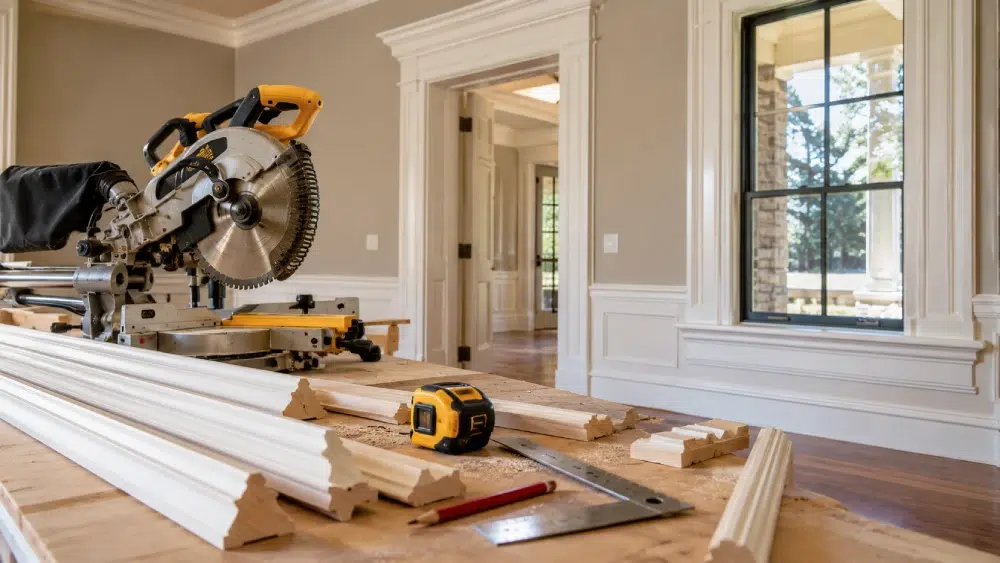
On a job site, a trim carpenter takes charge of measuring, cutting, and fitting trim components with exacting precision to guarantee seamless installation. You’ll rely on detailed blueprints, sketches, and supervisor instructions to match exact specifications.
A trim carpenter expertly measures, cuts, and fits trim pieces precisely, following detailed plans for flawless installation.
Your responsibilities include verifying alignment, level, and tight fit of each piece, ensuring compliance with building codes and project standards. You’ll use hand tools like chisels and planes alongside power tools such as routers and saws to achieve clean edges and flawless joints.
You handle fastening methods, including nails, screws, and adhesives, tailored to material and application. Maintaining a clean, safe work area is essential, as is coordinating with other trades to avoid damage.
Your role demands meticulous attention to detail, problem-solving for custom fits, and consistent quality checks throughout installation. Using a snapped chalk line ensures precise alignment and straight installation of trim components.
Common Trim Components Installed by Trim Carpenters
After mastering precise measuring, cutting, and fitting techniques, you’ll focus on installing a variety of trim components that define a space’s finished look. Your expertise ensures each piece fits flawlessly, enhancing both function and aesthetics.
Common trim components you’ll install include:
- Baseboards protect walls and add a clean junction between floor and wall.
- Crown molding creates elegant junctions between walls and ceilings with precise angles.
- Door and window casings frame openings, concealing gaps and providing a polished outline.
- Stair parts include handrails, balusters, and newel posts, ensuring safety and style.
Each element requires exact alignment, level installation, and tight joints to maintain architectural integrity and meet code standards. Your work transforms raw spaces into refined interiors. Choosing the correct nail gauge and length is crucial for securing trim components effectively without causing damage.
Materials and Tools Trim Carpenters Use
Mastering trim carpentry requires familiarity with a range of materials including wood, plastic, fiberglass, drywall, and composite products. Each material is selected for specific durability and aesthetic properties.
You use hardwoods like oak for strength and fine grain, and softwoods for ease of shaping. MDF or PVC is chosen for moisture resistance and cost-efficiency.
Your toolkit must include chisels, planes, routers, and jointers for shaping and smoothing. Power saws and drills enable precise cutting and fastening.
You rely on measuring tools such as levels, framing squares, and plumb bobs to guarantee alignment without cutting.
Fastening involves nails, screws, adhesives, and clamps, chosen based on material compatibility and load requirements.
For overhead or elevated work, ladders and scaffolding provide safe access. This selection of materials and tools guarantees your installations meet high standards of durability and finish quality.
Choosing the right fastening tools, such as pneumatic staplers or nailers, can significantly improve the efficiency and quality of your trim installations.
Measuring and Cutting for a Precise Fit
Achieving a precise fit starts with accurate measuring, which is vital for seamless trim installation. You must carefully assess each piece’s exact length, angle, and profile to avoid gaps or misalignment.
Precision begins with accurate measuring to ensure flawless trim installation without gaps or misalignment.
Follow these steps for precision:
- Use reliable measuring tools like a tape measure, combination square, and protractor to capture exact dimensions and angles.
- Mark cut lines clearly with a sharp pencil or marking knife on the material’s edge.
- Select the appropriate saw blade and cutting method, such as a miter saw for angled cuts or a table saw for straight cuts, to ensure clean edges.
- Double-check measurements and test-fit pieces before final installation to confirm accuracy.
This disciplined approach minimizes errors and guarantees crisp, professional results in your trim carpentry work. Using stop blocks and clamps can further enhance repeatability and precision during cutting.
Reading Blueprints and Drawings for Trim Installation
Because trim carpenters rely on exact specifications, reading blueprints and drawings accurately is essential for successful installation.
You’ll interpret detailed plans that specify dimensions, profiles, and placement of trim components like molding, casings, and baseboards.
Pay close attention to scale, symbols, and notes indicating material types and joinery methods.
Understanding section views and elevations helps you visualize trim contours and alignment relative to walls, doors, and windows.
Accurate interpretation assures cuts and fits correspond precisely to design intent, preventing costly rework.
Use your knowledge of architectural symbols and tolerances to verify measurements, identify critical junctions, and confirm fastening points.
Mastery of blueprints guides your layout, cutting, and installation processes, guaranteeing that the finish carpentry integrates seamlessly within the overall project framework.
Additionally, ensuring proper fastening and allowing for expansion gaps during installation helps maintain the durability and stability of trim components over time.
Differences Between Trim Carpenters and General Carpenters
A key distinction between trim carpenters and general carpenters lies in the scope and focus of their work.
While general carpenters handle broad structural tasks, you as a trim carpenter specialize in the finish details that define a space’s appearance. Your work demands precision and a detailed eye for aesthetics.
Trim carpenters focus on precise, detailed finish work that shapes the aesthetic appeal of a space.
Here are four critical differences you should note:
- Scope: General carpenters focus on framing and structural assembly. You concentrate on decorative trim and finish elements.
- Timing: General carpentry happens early. Trim carpentry occurs near project completion.
- Skillset: You require finer measurement and cutting skills tailored to visible components.
- Materials: You often work with delicate moldings and millwork. General carpenters handle rough lumber and framing materials.
Understanding these distinctions sharpens your role in delivering polished, professional finishes. Additionally, knowledge of proper staggering techniques can enhance your ability to achieve seamless and structurally sound flooring finishes.
Essential Skills for Trim Carpenters
To become a skilled trim carpenter, mastering precision measurement techniques is a must. You really want to ensure that your trim components fit perfectly, especially in those tight spaces. It’s all about getting those dimensions just right!
Reading blueprints accurately is another crucial skill. You’ll need to interpret angles and installation details with confidence. It can be tricky, but once you get the hang of it, it makes a world of difference in your projects.
And let’s not forget about tool control! Whether you’re using hand tools or power tools, being able to shape and secure those finish elements without damaging the materials is key. It takes practice, but with time, you’ll feel comfortable handling them like a pro.
Using tools with tool-free depth adjustment features can significantly improve precision and efficiency in finish carpentry work.
Precision Measurement Techniques
Mastering precision measurement techniques is critical for trim carpenters aiming to achieve flawless fit and finish in every installation. You must measure accurately to make certain components align seamlessly and avoid costly rework.
Use calibrated tools like steel tape measures, combination squares, and digital calipers for exact dimensions. Follow these steps for precision:
- Verify tool calibration before use to maintain accuracy.
- Measure multiple times, noting high and low points in surfaces.
- Record measurements clearly, distinguishing between inside and outside dimensions.
- Account for material thickness and cutting kerfs when marking cuts.
Blueprint Reading Skills
After making certain precise measurements, interpreting blueprints accurately becomes your next priority. You’ll analyze architectural drawings, focusing on detail views, elevations, and section cuts to understand trim placements and profiles.
Pay close attention to dimensions, notes, and symbols specifying molding types, material finishes, and installation sequences. You must cross-reference blueprints with shop drawings to verify consistency and resolve discrepancies before cutting or fitting.
Understanding scale and measurement units is essential for transferring plans to actual workpieces. You’ll also track changes or addendums issued during construction to maintain alignment with design intent.
Mastering blueprint reading enables you to execute installations precisely, avoid costly errors, and make certain trim components fit flawlessly within structural openings and adjacent elements. This ensures the project’s aesthetic and functional standards are maintained.
Additionally, being familiar with installation techniques and preparation steps from related trades can enhance your ability to coordinate trim work effectively within the overall construction process.
Hand and Power Tools
Handle and control a variety of hand and power tools with accuracy to achieve the fine detail and clean finishes essential in trim carpentry. You’ll rely on precision instruments such as chisels and planes for smooth shaping. Power tools like routers and miter saws enable consistent, intricate cuts. Mastery over these tools ensures tight joints and perfect alignment.
Focus on these four tool categories:
- Measuring and layout tools: levels, framing squares, and rules for exact dimensions.
- Cutting tools: miter saws, hand saws, and jigsaws for precise profiles.
- Shaping tools: routers and planes for detailed molding and finish.
- Fastening tools: nail guns, drills, and clamps to secure components cleanly.
Your skilled handling reduces errors and guarantees professional-quality trim installations. Choosing the right fastening method can also influence the durability and repairability of your trim work.
Typical Projects for Trim Carpenters
As a trim carpenter, you’ll often find yourself working on residential projects like installing baseboards, crown molding, and window casings. These tasks require some serious precision and a knack for making everything fit just right. It’s all about those sharp measurements!
Now, when you switch to commercial settings, things get a bit different. Finish carpentry there’s to follow stricter codes, plus you’ll need to work closely with other trades. Think about millwork and door frames—it’s all about teamwork!
And then there are those custom millwork projects. They really take your skills up a notch! You’ll be dealing with complex cuts and detailed joinery, all to craft unique decorative elements that make spaces truly stand out. It’s challenging but so rewarding!
Using the right tools, such as a variable speed spindle sander, can greatly improve the precision and smoothness of your finish work.
Residential Trim Installations
Trim carpenters play a crucial role in residential projects by installing detailed finish elements that enhance both function and aesthetics.
When working in homes, you precisely measure, cut, and fit materials like wood molding and trim to guarantee seamless installation.
Typical projects you handle include:
- Installing baseboards and crown molding with tight joints and consistent alignment.
- Fitting window and door casings to create clean connections between surfaces.
- Mounting stair components such as handrails, balusters, and newel posts with exact spacing and secure fastening.
- Crafting custom mantels and built-in millwork that complement interior design and meet structural demands.
Your expertise guarantees every element fits flawlessly, maintaining level, plumb, and square standards.
This results in a polished residential finish.
Commercial Finish Carpentry
Commercial finish carpentry projects demand meticulous attention to detail and adherence to strict building codes, especially when working on high-traffic areas like office lobbies, retail spaces, and hospitality interiors.
You’ll install precise baseboards, door and window casings, crown molding, and stair components, ensuring durability and aesthetic appeal under heavy use.
Your work must align perfectly with architectural plans and meet fire safety regulations, often requiring specialized fasteners and materials rated for commercial environments.
You’ll also verify plumb, level, and tight fits to prevent gaps or misalignments that could undermine appearance or code compliance.
Working with power tools and scaffolding, you’ll coordinate with project managers to maintain schedules and safety standards, delivering a polished finish that enhances the space’s professional atmosphere.
Custom Millwork Projects
Custom millwork projects demand exacting craftsmanship and a thorough understanding of intricate joinery, materials, and design specifications.
When tackling these projects, you’ll work on custom-built elements that enhance architectural appeal and function.
Typical tasks include:
- Fabricating and installing decorative crown moldings and wainscoting with precise miters and copes.
- Crafting built-in cabinetry and shelving tailored to spatial requirements.
- Constructing detailed window and door casings that align perfectly with wall surfaces.
- Designing and fitting bespoke mantels and paneling that complement interior aesthetics.
You’ll rely on advanced measuring techniques and high-quality materials.
Specialized tools like routers and jointers are essential for your work.
Accuracy in cutting and fitting guarantees seamless integration with existing structures.
You will maintain strict adherence to blueprints and design intent.
Your expertise transforms raw materials into refined, durable architectural details.
Repairing and Custom Fitting Trim Work
Repairing and fitting trim work requires meticulous attention to detail and exact measurements to guarantee seamless integration with existing structures.
You start by evaluating damaged or ill-fitting trim, carefully removing it without harming surrounding surfaces.
Precise measurement of gaps, angles, and lengths guarantees custom cuts match the original profiles perfectly.
Use specialized tools like coping saws and routers to shape joints that fit tightly, avoiding visible seams or misalignments.
When repairing, you select matching materials and finishes to maintain consistency.
Clamps, adhesives, and fasteners secure the trim firmly, while constant leveling and alignment checks prevent warping or unevenness.
Your ability to interpret blueprints and adjust for site-specific irregularities guarantees the final installation appears flawless and structurally sound.
Safety and Cleanliness Practices for Trim Carpenters
Consistently following safety protocols and maintaining a clean work environment are essential for trim carpenters to prevent accidents and guarantee quality results.
Strict adherence to safety and cleanliness is key for trim carpenters to ensure quality and prevent accidents.
You need to prioritize hazard identification and eliminate debris to reduce trip hazards and tool malfunctions.
Always wear personal protective equipment like safety glasses, hearing protection, and dust masks when operating power tools.
Proper tool maintenance and storage prevent damage and ensure precision.
Additionally, follow these four critical practices:
- Inspect ladders and scaffolding for stability before use.
- Keep walkways clear of scrap material and sawdust.
- Use dust extraction systems to minimize airborne particles.
- Store sharp tools securely to avoid injuries.
Adhering to these detailed safety and cleanliness standards enhances efficiency and delivers superior finish carpentry outcomes.
Frequently Asked Questions
How Long Does It Take to Become a Skilled Trim Carpenter?
It usually takes you about 3 to 5 years to become a skilled trim carpenter.
You’ll start by learning precise measuring, cutting, and fitting techniques.
Then master blueprint reading and finish carpentry tools.
Gaining hands-on experience with molding, casings, and cabinetry is vital.
Continuous practice sharpens your problem-solving and detail-oriented skills, enabling you to deliver polished, code-compliant trim work consistently.
Apprenticeships or vocational training speed up this learning process.
What Is the Average Salary of a Trim Carpenter?
You know what they say: “Measure twice, cut once.”
The average salary of a trim carpenter in the U.S. ranges from $40,000 to $65,000 annually, depending on experience and location.
Skilled carpenters with advanced precision and specialized finish work command higher wages, sometimes exceeding $70,000.
Your pay also reflects your ability to read blueprints accurately, execute detailed installations, and maintain strict adherence to building codes and safety standards.
Do Trim Carpenters Work Independently or on Teams?
You often work both independently and on teams as a trim carpenter.
When handling precise installations like molding or custom millwork, you might work solo to ensure detailed accuracy.
However, on larger projects or commercial sites, you collaborate closely with supervisors, project managers, and general carpenters to coordinate finish stages.
Your role requires clear communication and teamwork, especially when aligning trim work with other construction phases and meeting strict building codes.
What Certifications or Licenses Do Trim Carpenters Need?
You typically don’t need a specific license to work as a trim carpenter, but many states require a general contractor or specialty contractor license if you run your own business.
Certifications like OSHA safety training, NCCER carpentry credentials, or specialized millwork courses can boost your qualifications.
You’ll want to stay current with local building codes and safety regulations.
Completing apprenticeship programs helps guarantee your technical skills meet industry standards.
Can Trim Carpenters Specialize in Certain Types of Wood or Trim Styles?
Imagine you’re a violinist who only plays Stradivarius violins. Your expertise sharpens with that specific wood’s tone and grain.
Similarly, trim carpenters often specialize in certain woods like oak or cherry, mastering their unique density and grain. They also focus on specific finishing needs.
You might also concentrate on Victorian or modern trim styles, honing precise molding profiles and installation techniques. This specialization lets you deliver flawless, tailored finishes that meet exact architectural demands.
When Should You Hire a Trim Carpenter?
As a trim carpenter, you’re the artisan who sculpts the final brushstrokes on a building’s canvas.
With precision measuring and expert cutting, you fit each piece like a puzzle, turning raw materials into flawless architectural details.
Your mastery in reading blueprints guides your hands, while your safety practices keep the site sharp and secure.
In every project, you’re shaping the space’s character, where craftsmanship meets technical skill to create lasting beauty.