Poured Concrete Retaining Wall vs Block for Homes
When choosing between poured concrete and block retaining walls, consider your project’s scale and site conditions.
Poured concrete offers superior strength, durability, and frost resistance, ideal for tall or complex walls. However, it costs more and needs specialized installation.
Block walls are more affordable and easier to install. They suit moderate heights with simpler soils.
Drainage and maintenance differ, affecting long-term performance. Understanding these factors will help clarify which wall type fits your specific needs and environment.
Key Takeaways
- Poured concrete walls offer superior strength and durability, ideal for heights over 10 feet and challenging soil conditions.
- Concrete block walls are more cost-effective for small, low-height walls up to 6 feet with simpler installation and easier repairs.
- Poured concrete requires specialized labor, formwork, and reinforcement, while block walls involve stacking modular units with mortar.
- Drainage in poured walls uses weep holes; block walls rely on joint gaps, with poured concrete better for high water table sites.
- Poured concrete provides seamless finishes and frost resistance, whereas block walls offer modular design flexibility for curves and terraces.
Poured Concrete Retaining Wall vs Block Comparison: Strength, Cost, and Lifespan
| Comparison Point | Poured Concrete Retaining Wall | Block Retaining Wall | Best Choice |
|---|---|---|---|
| Strength | Offers superior lateral strength with a seamless structure | Strong for moderate loads but has joints between units | Poured concrete for high-load walls |
| Wall Height | Better for tall walls over 10 feet and complex projects | Best for smaller or moderate walls, often up to 6 feet | Poured concrete for taller structures |
| Installation | Requires formwork, steel reinforcement, and skilled labor | Uses stacked blocks with mortar or interlocking systems | Block for simpler installation |
| Cost | Higher upfront cost due to labor and materials | Usually more budget-friendly for small projects | Block for lower initial cost |
| Durability | Can last 50 to 75+ years with proper installation | Often lasts 40 to 60+ years with maintenance | Poured concrete for longer lifespan |
| Drainage Needs | Uses weep holes and careful backfill design | Uses joint gaps and drainage behind blocks | Both need proper drainage |
| Maintenance | Needs crack inspection and occasional sealing | May need joint repair or re-leveling over time | Poured concrete for lower upkeep |
| Design Flexibility | Creates a clean, seamless, modern finish | Easier for curves, terraces, and modular designs | Block for landscape flexibility |
| Best Use Case | Steep slopes, heavy loads, frost-prone sites, complex walls | Garden walls, smaller yards, simple soil conditions | Depends on site demands |
| Overall Value | Stronger long-term option for demanding projects | Practical choice for affordable, moderate-height walls | Match to budget and structure |
Cost Comparison: Poured Concrete vs Block Retaining Walls
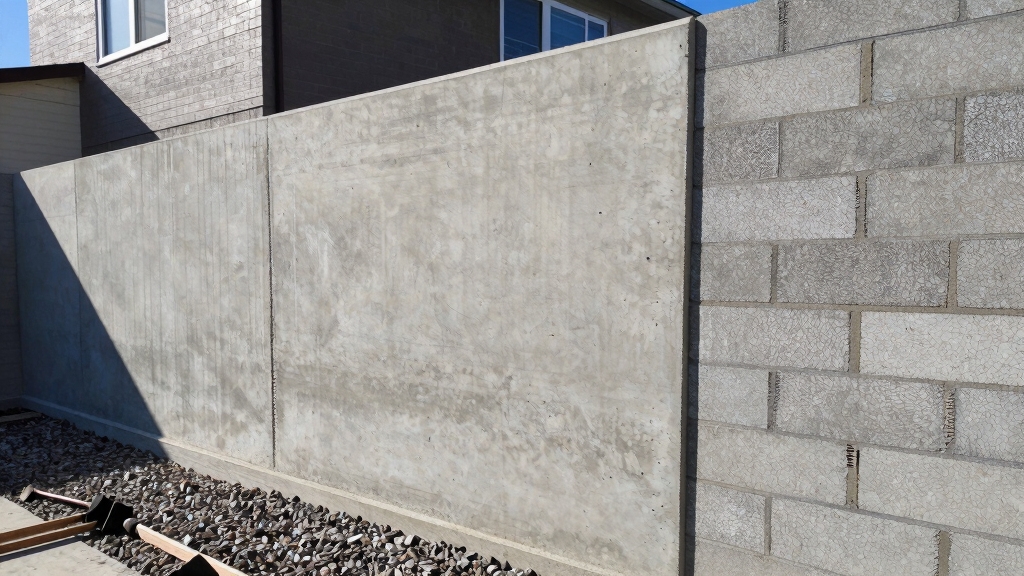
Although poured concrete retaining walls generally cost more upfront, their pricing becomes competitive for larger or more complex projects.
Poured concrete walls may cost more initially but offer better value for bigger or complex projects.
You’ll typically see poured concrete priced between $35 and $60 per square foot installed, reflecting the specialized labor and equipment required.
In contrast, concrete block walls usually range from $25 to $45 per square foot, benefiting from simpler installation techniques.
For small walls, block walls offer cost efficiency due to less specialized labor.
However, as you scale up in height, length, or site complexity, poured concrete’s monolithic nature and faster installation can reduce overall costs.
For example, a 4-foot block wall might run $600 to $1,500 per linear foot, but poured concrete can outperform this economically in demanding conditions.
This makes it the rational choice for substantial retaining structures.
Installation timing and preparation can significantly influence overall project costs and duration, with factors like subfloor preparation and curing time playing important roles.
Strength Comparison: Poured Concrete vs Block Walls
When evaluating retaining wall options, you’ll find that poured concrete delivers superior lateral strength and continuous compressive capacity compared to block walls.
This advantage arises because poured concrete forms a seamless, monolithic structure that effectively resists soil pressure without joints or weak points.
In contrast, block walls consist of modular units that can shift independently under lateral loads, reducing uniformity and overall rigidity.
While blocks provide some flexibility to accommodate minor ground movement, this can compromise long-term stability in high-stress environments.
Additionally, poured concrete’s continuous mass performs better in challenging soil conditions such as high water tables or unstable clay.
If your project demands maximum structural integrity and resistance to lateral forces, poured concrete is the technically superior choice over block systems.
Proper preparation and protecting the work area are essential steps to ensure the durability and safety of any construction project.
Installing Poured Concrete vs Block Walls: What to Expect
Installing poured concrete walls demands careful preparation and precise execution, involving temporary formwork, steel reinforcement placement, and accurate concrete mixing to guarantee structural integrity. You’ll need to set and brace forms securely to maintain shape during curing.
Make certain reinforcement bars are correctly positioned for lateral strength. Concrete mixing must meet specified ratios for durability.
In contrast, block walls require stacking precast units methodically, aligning them accurately, and filling joints with mortar to achieve stability.
While block installation is more modular and allows easier adjustments, poured concrete walls cure continuously, speeding up overall completion for large projects. However, any errors like bulges or uneven surfaces in poured walls are difficult to correct, so meticulous workmanship is vital.
Ultimately, your choice affects installation time, labor requirements, and potential for post-construction modifications.
Additionally, ensuring proper protection measures during installation can prevent damage similar to how careful preparation is essential in fixing pipes under concrete.
Maintenance and Lifespan of Concrete Retaining Walls
Poured concrete walls usually last around 50 to 75 years, and the great part is they need minimal maintenance.
You mainly just have to keep an eye out for occasional cracks and seal those up when needed.
On the other hand, concrete block walls have a slightly shorter lifespan, generally ranging from 40 to 60 years.
You might find that they require some periodic re-leveling if they start settling over time.
So, when you’re deciding which type of wall to go with, it’s really important to consider these differences in durability and maintenance.
It’ll help you choose the right option for your needs, ensuring long-term performance and cost efficiency!
Durability Over Time
Although concrete retaining walls are engineered for longevity, understanding their maintenance requirements is essential to maximizing lifespan.
Poured concrete walls typically endure 50 to 75+ years due to their monolithic structure, which offers superior resistance to lateral soil pressure and environmental stressors.
In contrast, concrete block walls generally last 40 to 60+ years, benefiting from modular flexibility but are vulnerable to differential settling and joint degradation.
Both systems exhibit durability contingent on proper installation and site conditions.
Poured concrete’s seamless mass resists water infiltration effectively, while block walls’ mortar joints may require attention to prevent moisture intrusion.
You’ll find poured concrete more resilient in demanding environments, especially with high water tables or frost exposure.
Ultimately, durability hinges on material performance and structural integrity over time.
Regular inspection and repair, including addressing any cracks or moisture issues, are crucial to preserving the wall’s structural integrity and extending its service life.
Maintenance Requirements
Because maintenance directly impacts the lifespan and performance of concrete retaining walls, understanding the specific requirements for poured concrete and block systems is essential.
Poured concrete walls offer a lifespan of 50 to 75+ years with minimal upkeep. This primarily involves periodic inspection and sealing of any developing cracks to prevent moisture intrusion and structural degradation.
In contrast, concrete block walls typically last 40 to 60+ years but require more frequent attention. You’ll need to monitor for settling, which can necessitate re-leveling, and inspect mortar joints for deterioration.
Block walls’ modular nature facilitates easier repairs, but they remain more susceptible to movement and water penetration.
Ultimately, your maintenance strategy should reflect the wall type’s structural behavior and exposure conditions to optimize longevity and performance. Additionally, implementing routine maintenance to detect vulnerabilities early can significantly reduce the risk of water damage and structural issues over time.
Design Options and Appearance for Concrete Retaining Walls
When choosing a concrete retaining wall, understanding the design options and appearance can markedly influence your project’s outcome. Poured concrete and concrete block walls offer distinct aesthetic and structural possibilities that affect both functionality and visual impact.
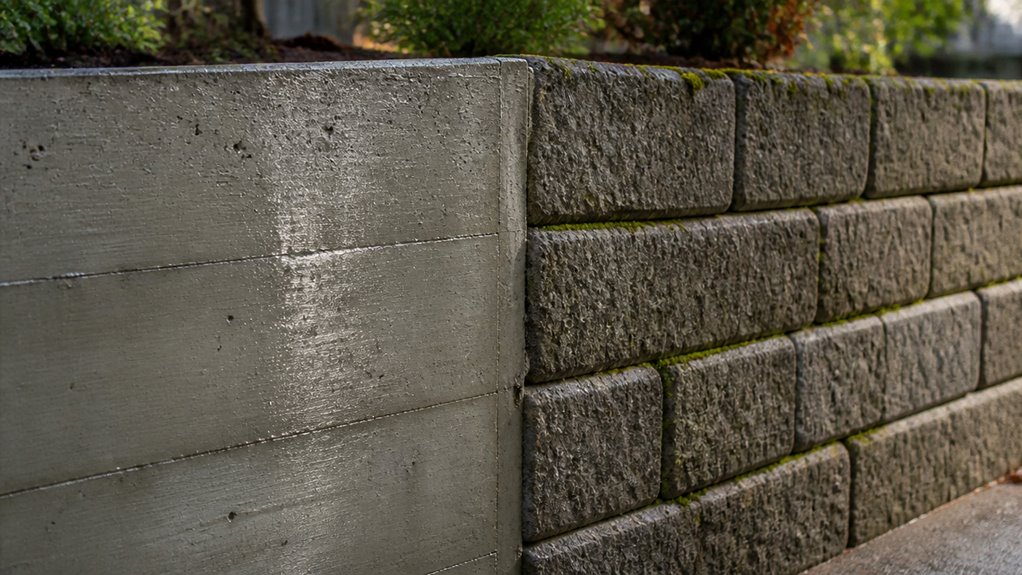
- Customization: Poured concrete enables you to create seamless, monolithic structures with customizable shapes and finishes. Options like smooth or board-formed textures are ideal for modern or tall walls.
- Modularity: Block walls provide versatility with varied colors and finishes. They can also form curves or terraces, making them suitable for garden borders or moderate-height walls.
- Drainage Integration: Design considerations include weep holes for poured walls and joint gaps for block walls. These features are vital for managing hydrostatic pressure beyond mere appearance.
Proper preparation and selecting materials with UV protection can significantly enhance the durability and longevity of outdoor concrete features.
Best Uses and Environmental Factors for Each Wall Type
Understanding the design and drainage features of concrete retaining walls helps clarify which wall type suits specific applications and environments.
Poured concrete walls excel in tall structures over 10 feet, sites with high water tables, and cold climates requiring frost resistance. Their monolithic design delivers superior lateral strength and minimizes water infiltration.
Poured concrete walls offer unmatched strength and frost resistance for tall, water-prone, and cold climate structures.
On the other hand, block walls fit moderate heights (up to 6 feet), curved layouts, and terraced landscapes. Their modular nature allows easier installation and repair, making them ideal for smaller-scale projects with budget constraints.
Drainage considerations are critical: poured walls rely on weep holes, while block walls use gaps between units. Selecting the appropriate wall depends on environmental stability, wall height, and site complexity, ensuring long-term performance and structural integrity. Proper foundation protection and soil grading are essential to reduce hydrostatic pressure and prevent water damage behind retaining walls.
How to Choose Between Poured Concrete and Block Retaining Walls?
Choosing between poured concrete and block retaining walls boils down to evaluating project-specific factors such as wall height, site conditions, budget constraints, and desired durability.
To make an informed decision, consider these key aspects:
- Structural Requirements: For walls over 10 feet or unstable soils, poured concrete offers superior strength and continuous compressive capacity. Block walls suffice for moderate heights (up to 6 feet) and flexible layouts.
- Cost and Installation: Block walls generally cost less and require simpler labor, ideal for smaller projects. Poured concrete becomes cost-effective for large, complex walls but demands skilled labor and precise mixing.
- Maintenance and Longevity: Poured concrete lasts 50–75+ years with minimal upkeep. Block walls last 40–60+ years but may need re-leveling over time.
Additionally, addressing any issues promptly can prevent more extensive damage, as early intervention helps avoid costly repairs and structural problems.
Analyze these factors relative to your project to choose the most suitable retaining wall type.
Frequently Asked Questions
Can I Install a Poured Concrete Wall Myself Without Professional Help?
You technically can install a poured concrete wall yourself, but it’s challenging.
You’ll need to build precise forms, place steel reinforcement accurately, and mix and pour concrete with exact ratios.
Mistakes like uneven surfaces or improper curing are tough to fix later.
Without professional skills and equipment, you risk structural issues and increased costs.
For best results, especially on large or tall walls, hiring experienced contractors is strongly recommended.
How Do Weather Conditions Affect the Curing Time of Poured Concrete?
If you’re pouring concrete and a sudden rainstorm hits, it’ll slow curing considerably.
Cooler temperatures delay hydration, extending curing time, while heat speeds it up but risks cracking if too fast.
Ideal curing happens between 50°F and 75°F with controlled moisture.
You’ll need to monitor weather closely; unexpected cold or heat can compromise strength and durability.
Adjust curing methods, like using blankets or misting, to maintain ideal conditions for proper set times.
Are There Eco-Friendly Alternatives to Traditional Poured Concrete and Blocks?
Yes, you can use eco-friendly alternatives like geopolymer concrete, which reduces carbon emissions by replacing cement with industrial byproducts.
Recycled aggregate concrete lowers landfill waste by incorporating crushed concrete or glass.
Additionally, rammed earth walls use compacted natural soil, offering thermal mass and sustainability.
You’ll also find hempcrete, a bio-composite material, providing insulation with low embodied energy.
These options help you minimize environmental impact while maintaining structural integrity.
What Safety Precautions Are Needed During the Installation of Retaining Walls?
Safety starts with site setup: secure the surroundings and stabilize the soil to stop slips.
Wear warnings-worthy wear, hard hats, gloves, goggles to guard against grit and grit.
Handle heavy hardware with hoisting help, harnessing proper posture to prevent physical pain.
Monitor moisture and mixing meticulously, avoiding chemical contact.
Maintain machinery meticulously and mark margins clearly to minimize mishaps.
Always adhere to all applicable codes and conduct continuous communication with your crew.
Can I Add Lighting or Electrical Fixtures to Poured Concrete or Block Walls?
Yes, you can add lighting or electrical fixtures to both poured concrete and block walls.
For poured concrete, embed conduit sleeves during pouring to allow wiring without drilling later, preserving structural integrity.
With block walls, you can route wiring through hollow cores before filling them with grout.
Always make certain electrical components are rated for outdoor use and comply with local codes.
Plan placement carefully to avoid compromising wall strength or waterproofing.
Choose the Wall That Fits Your Site Conditions
When deciding between poured concrete and block retaining walls, consider your site’s load requirements and budget.
For example, a homeowner in Colorado chose poured concrete for its superior strength and longevity on a steep slope, despite higher upfront costs.
You’ll get durability and low maintenance with poured concrete. Block walls offer easier installation and design flexibility.
Analyze your project’s specifics to select the best option that balances cost, strength, and aesthetics.