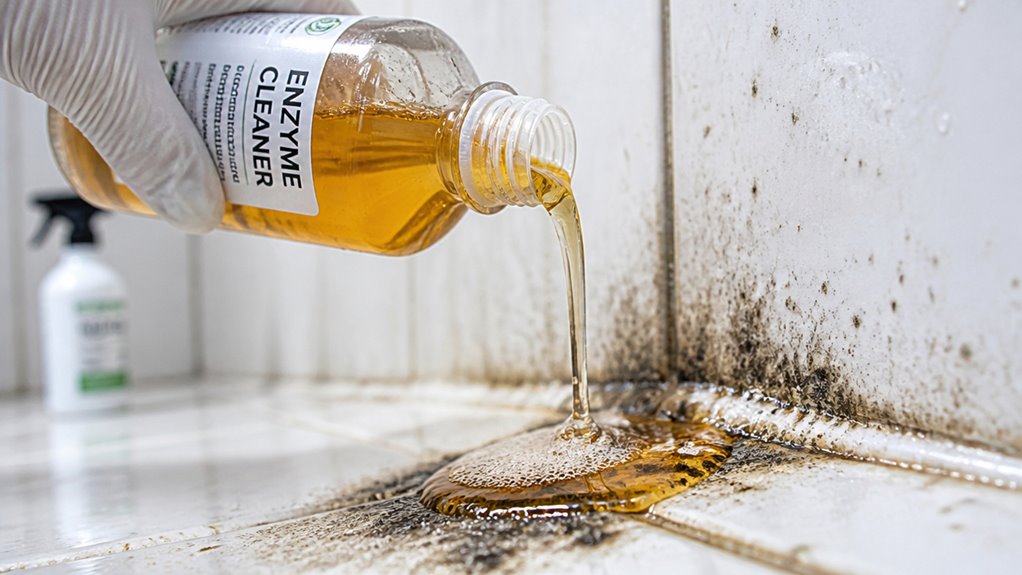
Does Enzyme Cleaner Kill Mold? The Truth Explained
Enzyme cleaners break down mold-associated organic residues by targeting proteins, starches, and fats. However, they don’t kill mold spores or fungal cells.
You can rely on them to remove visible mold grime and reduce odors, yet they lack fungicidal activity and won’t prevent mold regrowth. Their function supports cleaning rather than sterilization.
For thorough mold control, combining enzymes with disinfectants and moisture management is essential. Explore how to best use enzyme cleaners and when stronger treatments are necessary.
Key Takeaways
- Enzyme cleaners break down organic residues but do not kill mold spores or fungal cells.
- They lack fungicidal activity and cannot inactivate or destroy mold organisms.
- Enzyme cleaners are primarily cleaning agents, not mold sterilizers or fungicides.
- For killing mold and spores, disinfectants or fungicides with validated efficacy are necessary.
- Using enzyme cleaners alone cannot prevent mold regrowth or replace comprehensive remediation steps.
How Enzyme Cleaners Break Down Mold Residue?

Enzyme cleaners work by deploying specific enzymes, such as protease, amylase, and lipase, that target and break down the proteins, starches, and fats composing the organic residue left by mold growth.
Enzyme cleaners use protease, amylase, and lipase to break down mold’s organic residues effectively.
When you apply these cleaners, protease hydrolyzes protein chains, amylase catalyzes starch breakdown into simpler sugars, and lipase cleaves lipid molecules.
This enzymatic action disrupts the structural integrity of mold-associated grime, dissolving it into smaller, water-soluble components.
As a result, you can more effectively remove visible mold residue and associated organic debris from surfaces.
These enzymatic reactions don’t attack the mold organism itself but focus on the organic matrix it produces.
This facilitates surface cleaning and reduces materials that support mold regrowth.
This precise biochemical mechanism underpins enzyme cleaners’ effectiveness in mold residue removal.
For best results in preventing mold recurrence, it is important to maintain proper humidity control after cleaning to inhibit mold growth.
Why Enzyme Cleaners Don’t Reliably Kill Mold Spores?
So, here’s the thing with enzyme cleaners. They’re great at targeting organic matter like proteins, starches, and fats. This means they can break down and remove that visible mold residue you see.
But here’s where it gets tricky: killing mold spores is a whole different ball game.
To actually destroy those pesky fungal cells, you need disinfectants. Enzymes just can’t get the job done on their own. So, if you’re hoping to eliminate mold spores completely, you’ll need to pair those enzyme cleaners with some additional antimicrobial agents. That way, you can tackle both the visible mold and the spores lurking around.
It’s also important to maintain indoor humidity levels below 60% to prevent mold growth from recurring after cleaning.
Enzymes Target Organic Matter
Frequently, cleaning products that rely on enzymes focus on breaking down organic materials like proteins, starches, and fats rather than directly targeting mold spores or fungal structures.
Enzymes such as protease, amylase, and lipase catalyze the hydrolysis of these compounds, effectively degrading the organic residue mold feeds on but not the mold cells themselves.
When you apply enzyme cleaners, you’re fundamentally removing the substrate that supports mold growth, which can reduce visible staining and odors.
However, since enzymes don’t disrupt the fungal cell walls or spores, they don’t reliably kill mold or prevent regrowth on their own.
This enzymatic action is primarily a cleaning mechanism, not a fungicidal one, so relying solely on enzyme cleaners won’t eliminate mold infestations or sterilize contaminated surfaces.
For effective mold odor control and prevention, it is important to also address mineral buildup and microbial colonies that create environments conducive to mold growth.
Mold Killing Requires Disinfectants
Although enzyme cleaners effectively break down organic residues, they don’t possess the chemical properties required to kill mold spores or fungal cells. Mold elimination requires disinfectants that disrupt fungal cell walls or inactivate spores through oxidative or biocidal mechanisms.
Enzymes like protease or amylase degrade organic matter but lack fungicidal activity, so they don’t reliably sterilize surfaces contaminated with mold. Disinfectants such as hydrogen peroxide or bleach chemically destroy mold cells on contact, ensuring microbial death rather than mere residue removal.
Therefore, relying solely on enzyme cleaners for mold remediation risks incomplete treatment and regrowth, especially on porous materials where spores embed beneath surfaces. For effective mold control, you need products explicitly labeled and tested as disinfectants or fungicides that can reliably kill mold, not just clean its organic byproducts. Additionally, proper moisture control and drying are essential to prevent mold regrowth after cleaning, as elevated humidity encourages spore reactivation and proliferation, making moisture control and drying critical components of effective remediation.
When Enzyme Cleaners Are Useful in Mold Cleanup?
Enzyme cleaners come into play primarily during the initial stages of mold cleanup. They break down and remove organic residues that support mold growth.
You’ll find them useful for dissolving proteins, fats, and starches left behind by mold. This helps eliminate grime and odors.
While they don’t kill mold spores, they prepare surfaces for further treatment by making residue easier to wipe away. Enzyme cleaners work best on light contamination and organic buildup but don’t replace thorough remediation.
Proper cleanup techniques, including safe disposal of contaminated materials, are essential to prevent spreading mold spores and further contamination.
| Use Case | Purpose |
|---|---|
| Initial residue removal | Break down organic matter supporting mold |
| Odor reduction | Eliminate organic sources of musty smells |
| Surface preparation | Facilitate easier wiping and cleaning |
| Light contamination | Manage minor mold presence |
| Post-remediation cleanup | Remove residual organic debris |
Which Surfaces Benefit Most From Enzyme Cleaners?
After removing organic residue and preparing surfaces during initial mold cleanup, your choice of cleaner should match the material you’re treating.
Enzyme cleaners excel on surfaces where organic buildup supports mold growth, effectively breaking down proteins, starches, and fats. You’ll find the best results on:
- Non-porous surfaces like tile, metal, and sealed concrete, where enzymes remove grime and residues efficiently.
- Semi-porous materials such as sealed wood and laminate, which benefit from enzyme action without deep penetration risks.
- Fabric and carpet fibers, where enzymes break down organic stains but may not fully eliminate embedded mold spores.
- Painted drywall or ceilings, provided the surface is dry and structurally sound, to reduce visible mold-associated debris.
Selecting enzyme cleaners for these surfaces aids residue removal but doesn’t guarantee mold eradication. For optimal results, it is crucial to ensure moisture control is maintained to prevent mold regrowth.
How Enzyme Cleaners Differ From Disinfectants?
When you choose a cleaning product for mold-affected areas, understanding the fundamental differences between enzyme cleaners and disinfectants is essential.
Enzyme cleaners contain biological catalysts like protease and amylase that break down organic materials, such as proteins, fats, and starches associated with mold residue. This aids in physical removal and odor reduction.
However, they don’t reliably kill mold spores or fungal hyphae. Disinfectants, in contrast, chemically inactivate or destroy microbial cells, including mold, often through oxidizing agents or biocides.
While enzyme cleaners focus on digesting organic debris to facilitate cleaning, disinfectants provide proven fungicidal action. Relying solely on enzyme cleaners risks incomplete mold eradication.
Consequently, if your goal is to kill mold, you should select a disinfectant with validated antifungal efficacy rather than an enzyme-based cleaner designed primarily for residue breakdown.
For effective mold removal, it is also important to identify and fix moisture sources to prevent mold recurrence.
Why Controlling Moisture Beats Just Cleaning Mold?
Controlling moisture remains the most critical factor in preventing mold growth, as mold requires damp environments to thrive and reproduce.
Simply cleaning visible mold isn’t enough if the moisture source persists.
You must address humidity and water intrusion to stop mold from returning.
Here’s why moisture control beats just cleaning mold:
- Mold spores are ubiquitous; without moisture, they can’t germinate or colonize surfaces.
- Porous materials trap moisture, allowing mold to regrow beneath cleaned surfaces.
- Dry environments inhibit fungal metabolism and spore viability, limiting mold proliferation.
- Continuous moisture control reduces the need for repeated cleaning or chemical treatments.
Maintaining ideal relative humidity between 40–50% with dehumidifiers and ventilation is essential to prevent mold recurrence.
When to Choose a Fungicidal Product Instead of Enzyme Cleaners?
When you’re dealing with extensive mold growth or if the mold has gone deep into porous materials, enzyme cleaners may not cut it. They just don’t reliably kill off those pesky fungal spores or hyphae.
In these cases, it’s best to go for a fungicidal product that’s specifically labeled for mold elimination. This way, you can ensure effective microbial control.
Now, figuring out how severe the mold problem is can really help guide your decision. If the situation calls for more than just a cleaning agent, a disinfectant might be what you need.
Knowing the extent of the mold can make all the difference in getting the right solution! For persistent or stubborn mold, treatments often require repeated application and thorough scrubbing techniques to fully remove the growth.
Identifying Mold Severity
Frequently, evaluating the severity of mold contamination guides your choice between enzyme cleaners and fungicidal products. You should consider these factors:
- Extent of Growth: Small, localized patches may respond to enzyme cleaning. Extensive growth requires fungicides.
- Surface Type: Porous materials like drywall or wood harbor mold beneath the surface, limiting enzyme effectiveness.
- Health Risks: Severe contamination with allergenic or toxic molds demands stronger, fungicidal treatments.
- Visible Damage: Structural damage or staining indicates mold penetration, necessitating remediation beyond surface cleaning.
If contamination is light and confined, enzyme cleaners can assist in residue removal. However, when mold is widespread, embedded in porous materials, or poses health risks, rely on fungicidal products to effectively kill and control mold growth. This ensures more thorough remediation. For persistent or severe cases, professional remediation with specialized enzymatic cleaners may be necessary to fully eliminate mold.
Choosing Effective Fungicides
Evaluating mold severity helps determine whether enzyme cleaners will suffice or if you need to employ fungicidal products for effective remediation.
You should choose a fungicidal product when mold contamination is extensive, deeply embedded in porous materials, or associated with active fungal growth.
Fungicides contain active ingredients proven to kill mold spores and hyphae, ensuring microbial elimination rather than just organic matter removal.
When selecting a fungicide, verify that the product has EPA registration or validated fungicidal claims, as enzyme cleaners typically lack these certifications.
Use fungicides especially where moisture control alone won’t prevent regrowth or where health risks from mold exposure are significant.
In contrast, enzyme cleaners serve best as adjuncts for cleaning residues post-remediation rather than primary mold eradication agents.
When Enzymes Fall Short
Although enzyme cleaners effectively break down organic residues, they don’t reliably eliminate mold spores or active fungal growth. You should opt for a fungicidal product when:
- Mold infestation is extensive or penetrates porous materials, where enzymes can’t reach embedded spores.
- You need to kill fungal spores to prevent regrowth, which enzyme cleaners aren’t proven to do.
- Moisture issues persist, requiring remediation alongside chemical treatments to stop mold recurrence.
- Product labels lack validated fungicidal claims, indicating the cleaner is primarily for organic residue removal, not disinfection.
Relying solely on enzymes risks incomplete mold control. Fungicidal products with proven efficacy ensure you eliminate mold at the source, providing a necessary step beyond surface cleaning for effective remediation.
How to Use Enzyme Cleaners Safely During Mold Cleanup?
Applying enzyme cleaners during mold cleanup requires careful attention to product instructions and safety precautions to guarantee effective use without health risks.
You should wear gloves and ensure adequate ventilation, as enzyme formulations may cause skin irritation or respiratory sensitivity.
Avoid mixing enzyme cleaners with other chemicals, which can reduce effectiveness or create hazardous reactions.
Apply the cleaner directly to mold-affected surfaces, allowing sufficient dwell time for enzymes to break down organic residues.
Use appropriate tools, such as soft brushes or cloths, to gently agitate and remove loosened material without dispersing spores.
After cleaning, thoroughly rinse and dry the area to prevent moisture retention that supports regrowth.
Always store enzyme cleaners securely, out of reach of children and pets, and dispose of any waste according to local regulations to maintain environmental safety.
How to Read Enzyme Cleaner Labels for Mold Claims?
When you examine enzyme cleaner labels for mold-related claims, focus closely on the specific language used to describe their effects.
Manufacturers often emphasize cleaning and residue removal rather than fungicidal action. To evaluate claims, consider these points:
Manufacturers highlight cleaning and residue removal more than actual mold-killing properties.
- Check if the label states the product “kills” mold or simply “cleans” or “breaks down organic matter.”
- Look for any mention of disinfecting or antimicrobial properties supported by scientific testing.
- Note if the product targets organic debris like proteins and fats associated with mold growth.
- Beware of vague claims such as “eliminates mold at the source” without independent efficacy data.
Understanding these distinctions helps you identify enzyme cleaners’ true function and avoid assuming they eradicate mold spores.
Key Steps for Effective Mold Remediation Beyond Enzyme Cleaning
To achieve effective mold remediation, you must go beyond simply cleaning surfaces with enzyme cleaners and address the underlying causes and extent of contamination.
Start by identifying moisture sources and correcting them to prevent regrowth. Inspect porous materials for mold penetration; these often require removal or specialized treatment because surface cleaning alone won’t reach embedded spores or hyphae.
Use products with validated fungicidal claims if your goal is to kill mold spores effectively. Guarantee thorough drying of affected areas to inhibit mold development.
For heavy infestations, remove damaged materials and apply appropriate biocides or antifungal agents. Enzyme cleaners can support by removing organic residues and odors but should never replace all-inclusive remediation steps.
These steps involve moisture control, physical removal, and disinfection to ensure lasting mold control.
Frequently Asked Questions
Can Enzyme Cleaners Remove Mold Odors Completely?
You can rely on enzyme cleaners to markedly reduce mold odors because they break down the organic matter that causes the smell.
However, they mightn’t completely eliminate odors if mold has deeply penetrated porous materials or if moisture issues persist.
To fully remove mold odors, you’ll need thorough cleaning combined with drying and moisture control.
Enzyme cleaners are effective deodorizing tools but aren’t a standalone solution for persistent mold smells.
Are Enzyme Cleaners Safe for Pets and Children?
Yes, enzyme cleaners are generally safe for pets and children when used as directed.
They break down organic matter using natural enzymes, avoiding harsh chemicals.
However, you should always check the product label for specific safety information and avoid ingestion or direct skin contact.
Some formulations may include additives or fragrances that could irritate sensitive individuals.
Proper ventilation and careful application minimize risks during use around your family.
How Long Does It Take for Enzyme Cleaners to Work on Mold Stains?
You might wish enzyme cleaners worked like a magic eraser that vanishes mold stains instantly, but they don’t.
Typically, enzyme cleaners need anywhere from 15 minutes to several hours to break down organic residues effectively.
The exact time depends on the stain’s severity, surface type, and product formulation.
For best results, you should let the cleaner sit undisturbed, allowing enzymes to digest proteins and grime before wiping or rinsing the area.
Can Enzyme Cleaners Be Mixed With Other Cleaning Products?
You shouldn’t mix enzyme cleaners with other cleaning products unless the label explicitly permits it.
Combining enzymes with harsh chemicals like bleach or ammonia can inactivate their biological action or produce hazardous reactions.
Enzymes work best in controlled formulations designed to preserve their activity.
Always follow manufacturer guidelines to avoid reducing effectiveness or creating toxic fumes.
When in doubt, use enzyme cleaners separately for ideal, safe cleaning results.
Do Enzyme Cleaners Have Any Environmental Benefits Compared to Traditional Cleaners?
Yes, enzyme cleaners offer environmental benefits compared to traditional cleaners.
They use biodegradable enzymes that specifically target organic matter, reducing reliance on harsh chemicals and toxins.
This minimizes water pollution and lowers chemical residues in your home.
Enzyme cleaners also often come from renewable resources and break down naturally, making them safer for aquatic life and ecosystems.
Does Enzyme Cleaner Kill Mold? Final Takeaways
While enzyme cleaners effectively break down mold residues, they don’t reliably kill mold spores themselves. You might think enzyme cleaners alone are enough, but scientific evidence shows they lack fungicidal properties required for complete mold eradication.
Instead, use enzyme cleaners as a complementary step alongside proven fungicides or disinfectants. Always read product labels carefully and follow safety guidelines to ensure thorough mold remediation.
Understanding these distinctions helps you tackle mold both efficiently and safely.