Pedestal vs Submersible Sump Pump: Which Is Better?
When choosing between pedestal and submersible sump pumps, consider your basement’s water volume, noise tolerance, and maintenance capacity.
Pedestal pumps have motors mounted above the pit, making them quieter and easier to service. However, they are less efficient and prone to clogging under heavy use.
Submersible pumps operate fully underwater, offering higher power, better clog resistance, and quieter operation. They are ideal for frequent flooding and finished basements.
A detailed comparison will help you match the right pump to your specific needs.
Key Takeaways
- Pedestal pumps have motors mounted above water, making maintenance easier but limiting continuous underwater operation.
- Submersible pumps feature sealed, fully submerged motors designed for heavy water volumes and debris-laden floodwaters.
- Submersible pumps operate more quietly and efficiently, ideal for finished basements and high-volume pumping needs.
- Pedestal pumps are prone to clogging and louder noise but generally last longer due to dry motor placement.
- Submersible pumps require more complex servicing and have shorter lifespans but handle continuous, heavy-duty pumping better.
Pedestal vs Submersible Sump Pump: Key Differences in Performance, Noise, and Durability
| Comparison Factors | Pedestal Sump Pump | Submersible Sump Pump |
|---|---|---|
| Pump Design | Vertical shaft design with an elevated motor | Sealed, compact design installed within the sump basin |
| Motor Location | Above the waterline | Submerged in the sump pit |
| Primary Function | Removes groundwater from light to moderate water accumulation | Removes groundwater from moderate to heavy water accumulation |
| Pumping Performance | Suitable for lower water volumes, depending on capacity | Often available with higher pumping capacities |
| Noise Levels | Generally louder due to the exposed motor | Generally quieter because the motor operates underwater |
| Installation Space | Motor extends above the sump pit | Compact and concealed inside the basin |
| Maintenance Access | Easier motor inspection and servicing | Often requires removing the unit from the basin |
| Debris Handling | May be more vulnerable to debris-related clogging | Many models offer improved debris handling |
| Energy Efficiency | Depends on motor design and operating conditions | Depends on motor efficiency and pumping requirements |
| Expected Lifespan | Article estimates 10–25 years | Article estimates 5–15 years |
| Motor Protection | Dry motor placement reduces direct water exposure | Watertight motor housing protects submerged components |
| Heavy Flooding | Generally less suitable for frequent high-volume pumping | Often preferred for frequent or substantial water intrusion |
| Suitable Basement Type | Unfinished basements with accessible sump pits | Finished basements requiring discreet, quiet operation |
| Installation Considerations | Requires vertical clearance above the basin | Requires adequate basin dimensions and submersion clearance |
| Overall Recommendation | Best for accessible maintenance and lighter pumping needs | Best for quiet operation and demanding water-removal needs |
How a Pedestal Sump Pump Works?

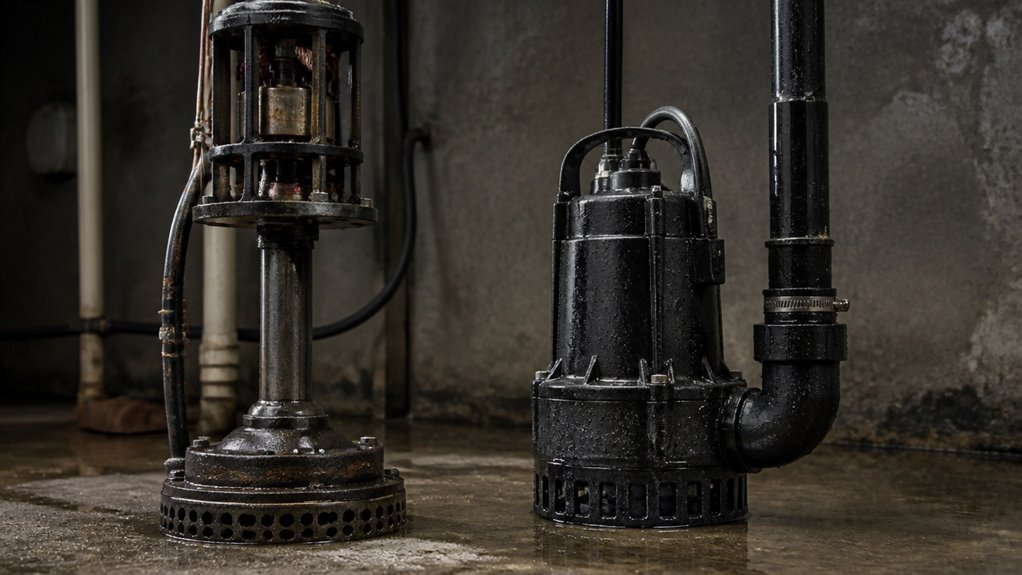
Although pedestal sump pumps use an older design, they operate by positioning the motor above the sump pit while only the pump’s base and impeller are near or in the water.
You’ll find the motor mounted on a vertical shaft extending above the basin, keeping it dry and accessible. The impeller, submerged in the water, spins to create centrifugal force, pushing water out through the discharge pipe.
This separation reduces motor exposure to moisture and corrosion, enhancing durability. However, because the motor is external, you’ll notice increased noise and visibility.
The pump relies on a check valve to prevent backflow, preserving system efficiency. Understanding this setup helps you evaluate its suitability for your space, especially if ease of maintenance and long motor life are priorities.
To further protect the system, it is important to inspect the valve box regularly to prevent water pooling and damage.
How Submersible Sump Pumps Differ From Pedestal Pumps?
Because submersible sump pumps operate fully underwater, their design contrasts sharply with pedestal pumps that keep the motor above the waterline.
You’ll notice submersible pumps feature a sealed motor assembly submerged within the sump basin. Pedestal pumps have an exposed motor mounted on a vertical shaft.
This fundamental distinction affects efficiency, maintenance, and lifespan. Submersible pumps handle heavy water flow better but require more complex repairs.
Pedestal pumps offer easier servicing due to motor accessibility but tend to be less efficient and more prone to clogging.
Proper maintenance, such as regularly clearing debris from the sump pit and checking the float switch mechanism, is essential to prevent pump failure.
| Feature | Submersible Pump | Pedestal Pump |
|---|---|---|
| Motor Location | Fully submerged | Above waterline |
| Efficiency | Higher, suitable for heavy use | Lower, better for light use |
| Maintenance | Harder, requires removal | Easier, motor accessible |
| Lifespan | 5–15 years | 10–25 years |
| Application | Finished basements, frequent flooding | Unfinished basements, low use |
Noise and Appearance: Pedestal vs Submersible Pumps
You might’ve noticed that pedestal pumps tend to be a bit louder. That’s because their motors sit above the sump pit, which allows the sound to travel directly into your space.
On the other hand, submersible pumps are a lot quieter since they operate underwater. This really helps in reducing the noise levels.
And when it comes to looks, there’s a difference too. Pedestal units are more noticeable, sitting above the ground, while submersible pumps are tucked away discreetly in the basin.
Additionally, choosing the right pump size is important since the 1/3 HP pump emits softer noise but may wear out faster under heavy use compared to larger models.
Noise Levels Compared
How much noise can you expect from your sump pump?
Pedestal pumps generate more noise because their motors sit above the sump pit, exposing moving parts and vibrations directly to your basement environment.
This design lacks substantial sound insulation, so motor noise and mechanical hums are more perceptible.
Conversely, submersible pumps operate fully underwater within the sump basin, where the surrounding water dampens motor noise and vibration transmission.
This enclosure makes submersible units markedly quieter in operation.
If noise is a critical factor, a pedestal pump with a fitted lid may reduce sound somewhat but won’t match the inherent quietness of submersible models.
Thus, for noise-sensitive areas or finished basements, submersible pumps provide a clear advantage due to their submerged, insulated design that minimizes operational sound.
It is also important to monitor for slow drainage or gurgling sounds in your basement, as these can indicate potential plumbing blockages that may impact pump efficiency.
Visual Impact Differences
Although both pedestal and submersible sump pumps perform the same fundamental function, their visual presence in your basement or crawlspace differs markedly.
Pedestal pumps feature a motor mounted above the sump pit, making them prominently visible and more intrusive in your space. This exposed design can disrupt aesthetics, especially in finished basements, and may require additional noise-reducing lids.
Conversely, submersible pumps sit fully submerged within the sump basin, rendering them largely concealed and minimally obtrusive. Their compact, enclosed design integrates seamlessly with the surrounding environment and suits finished or visually sensitive areas.
When choosing between them, consider that pedestal pumps prioritize accessibility over discreetness. Submersible models balance quieter operation with a low-profile appearance, enhancing the overall visual experience in your home’s wet area. It is important to regularly inspect the float switch and sump pit to prevent debris-induced false alarms that can affect either type of pump.
Which Pump Handles Heavy Water and Flooding Better?
When it comes to heavy water and flooding, you really want a pump that can handle continuous, high-volume operation. That’s where submersible sump pumps shine. Their design allows them to be fully submerged, which means they can tackle heavier water loads and debris more efficiently than pedestal pumps.
On the other hand, pedestal models have their motors positioned above the pit. This design can be a bit of a drawback, especially in severe flooding conditions. They tend to struggle more and can clog easily. So, if you’re facing heavy water issues, submersible pumps are definitely the way to go! Proper management of moisture is essential to prevent issues like floor buckling caused by water infiltration.
Flooding Performance Comparison
Evaluating flooding performance reveals that submersible sump pumps handle heavy water and flooding more effectively than pedestal pumps.
Because the entire pump assembly operates underwater, submersible models can continuously manage larger volumes of water without overheating or losing efficiency.
Their sealed motors resist water damage, enabling sustained operation during severe flooding.
In contrast, pedestal pumps have exposed motors positioned above the pit, limiting their capacity for prolonged heavy use.
They also risk motor damage if water levels rise too high.
Additionally, submersible pumps tend to maintain performance with debris-laden water better due to their enclosed design, reducing clogging risks compared to pedestal units.
Consequently, if you expect frequent or intense flooding, a submersible pump provides superior reliability and continuous operation under demanding conditions.
Prompt and effective water extraction using appropriate equipment is crucial in flood situations to prevent further structural damage and microbial growth, making the choice of pump an important factor in water mitigation.
Heavy Water Handling
Understanding which sump pump handles heavy water and flooding better requires examining their design and operational capabilities under demanding conditions.
Submersible pumps, fully submerged and sealed, excel at managing heavy water volumes and debris-laden floodwaters due to their robust impellers and enclosed motors. They operate efficiently during extended pumping and resist clogging better than pedestal pumps.
Pedestal pumps, with motors positioned above the sump pit, are less suited for heavy water handling. Their exposed motors limit continuous underwater operation and increase clogging risk when debris is present.
While pedestal units offer easier maintenance, their design inherently restricts performance under severe flooding. Consequently, if heavy water handling and frequent flooding are concerns, you’ll find submersible pumps provide superior reliability and efficiency despite higher upfront costs and maintenance complexity.
When pumping heavy water, it is also important to pump water out gradually to avoid structural stress and prevent soil erosion near the foundation.
Pedestal vs Submersible Pump Efficiency and Power
Compare the efficiency and power of pedestal and submersible sump pumps by examining their design and operational capabilities.
Submersible pumps, fully submerged in water, operate more efficiently due to direct cooling and reduced motor strain. This allows them to handle higher horsepower motors and sustain prolonged heavy-duty pumping.
Submersible pumps excel in efficiency with direct cooling, supporting higher horsepower for extended heavy-duty use.
Their enclosed design minimizes clogging, enhancing power delivery under challenging conditions.
Pedestal pumps, with motors above the pit, typically have lower efficiency. Motor cooling relies on ambient air, which limits continuous operation and power output.
They’re more prone to clogging, reducing effective pumping capacity. While pedestal pumps suit lighter water loads, submersible models provide superior power and efficiency for frequent or severe water intrusion.
This makes them technically preferable when sustained, high-volume pumping is critical.
Comparing Costs of Pedestal and Submersible Sump Pumps
While choosing between pedestal and submersible sump pumps, you’ll find that upfront costs vary markedly due to differences in design and capabilities.
Pedestal pumps typically range from $60 to $200, making them the more budget-friendly option initially.
Submersible pumps, however, cost between $100 and $700, reflecting their advanced waterproof design and higher power capacity.
Installation expenses follow a similar pattern: pedestal pumps often require $400 to $900, while submersible units usually demand a higher investment.
Though submersible pumps cost more upfront and can be pricier to repair, their efficiency and suitability for heavy-duty pumping may justify the expense.
Understanding these cost differentials helps you balance initial budget constraints against long-term performance needs in your sump pump selection.
For optimal maintenance, it is important to follow manufacturer’s guidelines to ensure longevity and effectiveness of your sump pump system.
Maintenance and Repair: What to Expect for Each Pump
You’ll frequently find that pedestal sump pumps are easier to maintain and repair due to their motor being positioned above the sump pit. This keeps it dry and accessible. This design reduces corrosion risks and simplifies routine inspections.
Conversely, submersible pumps require removal from the basin for servicing. This complicates repair tasks and increases downtime.
Here’s what you should expect for each pump type:
- Pedestal Pumps: Easier motor access allows quick motor checks and impeller cleaning without full disassembly.
- Submersible Pumps: Enclosed design demands full extraction from the pit for most repairs, raising labor intensity and costs.
- Durability Considerations: Pedestal motors are less exposed to moisture, reducing wear and extending intervals between maintenance.
Regular maintenance intervals are crucial, as moisture exposure can significantly impact the durability and lifespan of sump pump components.
Understanding these factors helps you plan maintenance schedules and budget for potential repairs effectively.
Lifespan of Pedestal and Submersible Sump Pumps
Although both pedestal and submersible sump pumps serve the same fundamental purpose, their expected lifespans differ markedly due to design and operational factors.
Pedestal and submersible sump pumps share a purpose but differ significantly in lifespan due to design and use.
Pedestal pumps typically last between 10 to 25 years, sometimes reaching 30 years, owing to their motor’s dry placement above the sump pit. This placement minimizes corrosion and wear.
In contrast, submersible pumps, fully submerged and exposed to continuous moisture, generally last 5 to 15 years, with many averaging 7 to 10 years. The submersion accelerates wear on seals and electrical components despite the waterproof housing.
Your pump’s longevity will also depend on usage frequency and water conditions. If you prioritize durability and easier maintenance access, pedestal pumps outperform submersibles in lifespan under comparable conditions.
Best Pump Types for Different Basements and Water Conditions
When it comes to picking the right pump for your basement, it’s all about matching the pump type to your space and the water conditions. So, if you have an unfinished basement with a shallow pit and only a little water flow, a pedestal pump might be your best bet. They’re pretty straightforward and do well in those kinds of settings.
On the flip side, if your basement is finished or you expect higher water volumes, a submersible pump is the way to go. These pumps are designed to handle more significant amounts of water, and they do it efficiently. Just take a moment to evaluate your basement’s layout and the typical water intrusion you experience. This will really help you make the right choice!
Basement Types Compatibility
Selecting the right sump pump depends heavily on your basement’s construction and typical water intrusion levels.
Pedestal pumps suit unfinished or shallow basements with low to moderate water presence, where noise and appearance are less critical.
Submersible pumps excel in finished basements requiring discreet, quiet operation and are better for frequent or heavy water intrusion.
- Unfinished Basements: Pedestal pumps offer easier maintenance and longer lifespan, ideal for light to moderate moisture issues.
- Finished Basements: Submersible pumps provide quiet, concealed performance, minimizing disruption and protecting finished spaces.
- Wet or Debris-Prone Environments: Submersible pumps handle debris and heavier water better, reducing clog risks and improving efficiency.
Match your pump choice to your basement type and water conditions for peak performance and longevity.
Water Volume Handling
Frequently, the volume of water your sump pump must handle dictates the most effective pump type for your basement’s conditions.
If you face heavy or frequent water intrusion, a submersible pump is typically your best bet. Its design allows full submersion and efficient handling of large water volumes, making it ideal for finished basements or severe flooding.
Conversely, pedestal pumps suit lighter water flow in shallower pits, such as in unfinished basements with minimal water problems.
Pedestal units may clog more easily and struggle with debris-laden water, limiting their effectiveness in high-volume scenarios.
How to Choose the Right Sump Pump for Your Home?
Evaluate your home’s specific conditions and requirements before choosing a sump pump to guarantee peak performance and longevity. You need to analyze factors such as water volume, noise tolerance, and maintenance capacity.
Consider these three critical points:
- Water handling capacity: For heavy water intrusion, opt for a submersible pump, which excels at continuous, high-volume pumping. Pedestal pumps suit lighter water problems.
- Noise and location: If your sump pump is in a finished basement or living area, choose a submersible model for quieter operation. Pedestal pumps emit more noise but are easier to service.
- Maintenance and lifespan: Pedestal pumps last longer and are simpler to maintain since the motor stays dry. Submersible pumps have shorter lifespans and may incur higher repair costs.
Match the pump type to your home’s conditions to guarantee efficiency and durability.
Frequently Asked Questions
Can I Use a Battery Backup With Pedestal or Submersible Pumps?
Yes, you can use a battery backup with both pedestal and submersible sump pumps.
Battery backup systems are designed to power the pump during power outages, ensuring continuous operation.
However, confirm compatibility between the pump’s power requirements and the backup system’s output.
Submersible pumps may require more robust backups due to higher power needs.
Always verify voltage, amperage, and connector types to guarantee reliable performance and avoid damage to your pump or backup unit.
What Are Common Signs My Sump Pump Is Failing?
About 30% of sump pumps fail due to mechanical issues.
You’ll notice signs like unusual noises, frequent cycling, or water pooling despite the pump running.
Also, check for a malfunctioning float switch or failure to activate during tests.
Reduced pumping capacity can indicate clogging or motor wear.
Monitoring these symptoms helps you act before a costly basement flood, ensuring your pump operates reliably under pressure.
How Often Should I Test My Sump Pump for Functionality?
You should test your sump pump at least twice a year, ideally before the wet seasons.
Activate the pump manually by pouring water into the sump pit to confirm it starts automatically and pumps water efficiently.
Check the float switch and discharge pipe for proper operation and clear any debris.
Regular testing helps you catch malfunctions early, reducing the risk of basement flooding and costly repairs.
Don’t wait until an emergency to verify functionality.
Are There Any Warranty Differences Between Pedestal and Submersible Pumps?
Warranty periods typically range from 1 to 5 years for both pedestal and submersible pumps.
However, submersible pumps often come with shorter warranties due to their underwater operation and higher wear risk.
You’ll find pedestal pumps sometimes offer longer coverage, up to 5 years, reflecting their simpler, less corrosive design.
When choosing, carefully compare warranty terms, as repair costs differ markedly. A longer warranty can offset higher initial expenses.
Can Sump Pumps Be Connected to Home Automation or Monitoring Systems?
Yes, you can connect sump pumps to home automation or monitoring systems. Many modern pumps offer smart sensors or compatible modules that track water levels, pump activity, and power status.
You can receive alerts on your phone for malfunctions or flooding risks, enabling proactive maintenance. Integration often requires compatible hardware and apps, so make certain your pump supports these features or add aftermarket sensors designed for sump pump monitoring.
Which Sump Pump Is Best for Your Basement?
Choosing between a pedestal and submersible sump pump is like selecting the right tool for a specific task. Each excels under different conditions.
Pedestal pumps offer easier maintenance and longer lifespans but can be noisier and less powerful.
Submersible pumps handle heavy flooding quietly and efficiently but may require more upkeep.
Analyze your basement’s water challenges and noise tolerance carefully to select the pump that best balances performance, durability, and maintenance for your home.