Does Paint Thinner Evaporate? Key Facts
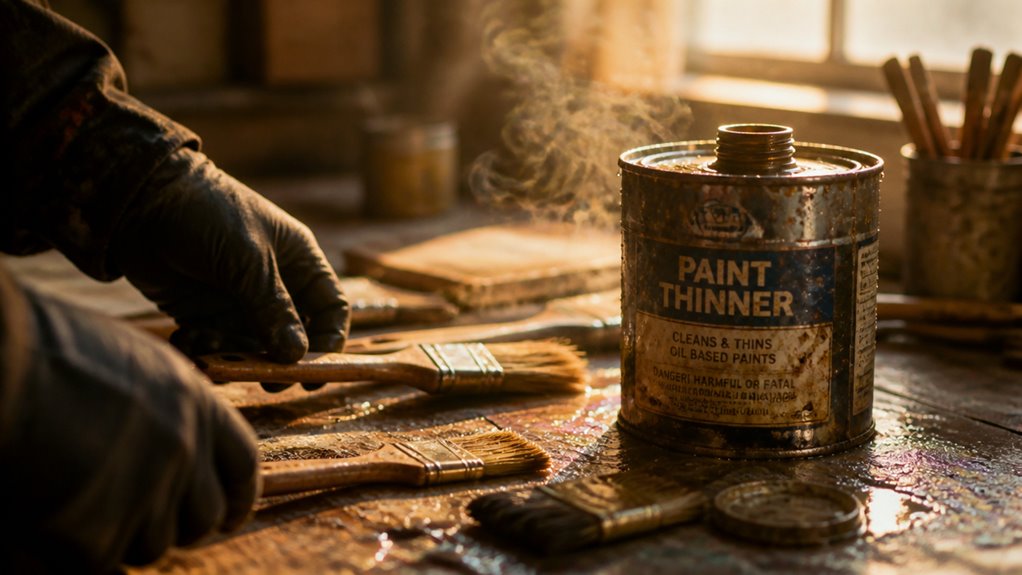
Yes, paint thinner does evaporate quickly because it contains volatile organic solvents.
Factors like temperature, surface area, and airflow speed up this process, while high humidity and sealed containers slow it down.
Ingredients such as acetone and naphtha increase evaporation rates, affecting performance and safety risks like flammability and respiratory irritation.
Proper storage in cool, sealed environments is vital to maintain effectiveness and limit vapor release.
Understanding these aspects helps you manage paint thinner use more effectively.
Key Takeaways
- Paint thinner contains volatile solvents that cause it to evaporate when exposed to air.
- Evaporation speed depends on solvent type, temperature, airflow, humidity, and surface area.
- Thinners with acetone or lacquer thinner evaporate quickly, often within minutes.
- Mineral spirits-based paint thinners evaporate more slowly, taking hours or days in cooler conditions.
- Properly sealed containers and cool storage reduce evaporation and preserve paint thinner effectiveness.
How Quickly Does Paint Thinner Evaporate?

While paint thinner generally evaporates quickly due to its volatile solvents, the exact speed depends on its specific formulation and environmental conditions.
You’ll notice that open containers lose solvent faster than sealed ones because of greater surface exposure.
Temperature, airflow, humidity, and surface area heavily influence how rapidly the liquid shifts to vapor.
Some thinner blends, like those with acetone or lacquer thinner, evaporate in minutes, especially in well-ventilated spaces.
Conversely, mineral spirits-based thinners can take hours or even days to fully evaporate under cooler or stagnant conditions.
Spilled paint thinner evaporates faster due to increased surface area.
Understanding these variables helps you anticipate drying times and manage fumes effectively, optimizing your workspace safety and efficiency.
Proper storage in a cool, dry place can slow evaporation and maintain the thinner’s effectiveness.
What Causes Paint Thinner to Evaporate?
Because paint thinner contains volatile solvents, it evaporates when these compounds convert from liquid to vapor upon exposure to air.
Paint thinner evaporates as its volatile solvents shift from liquid to vapor when exposed to air.
You’ll notice this phase change occurs as solvent molecules gain enough kinetic energy to overcome intermolecular forces and escape the liquid surface.
Factors like airflow and temperature increase this molecular energy, accelerating evaporation. The exposed surface area directly affects the rate, as more molecules can shift simultaneously.
Conversely, high humidity can slow the process by saturating the air with solvent vapor. This reduces the concentration gradient that drives evaporation.
The process is continuous until a dynamic equilibrium forms between liquid and vapor phases or the solvent fully dissipates.
Understanding these physical mechanisms helps you control evaporation during paint thinning or cleanup tasks. Proper ventilation is essential to ensure safe and efficient evaporation when using flammable solvents.
Which Ingredients Affect Paint Thinner’s Evaporation?
The evaporation rate of paint thinner really hinges on the types of volatile solvents it includes. You’ll notice that different formulations mix things up with solvents like mineral spirits, naphtha, or acetone. Each of these has its own unique volatility profile, which plays a big role in how quickly the thinner evaporates. For example, mineral spirits are incompatible with water-based products and have a slower evaporation compared to water-based thinners like distilled water.
Volatile Solvent Types
Understanding which ingredients make up paint thinner can shed light on its evaporation behavior. Paint thinner’s volatility hinges on the specific solvents it contains, each contributing differently to how quickly it vaporizes when exposed to air.
You’ll find that:
- Mineral spirits, derived from petroleum, evaporate relatively slowly due to their higher boiling points. This makes them suitable for longer working times.
- Naphtha evaporates faster than mineral spirits, increasing the evaporation rate and fume release.
- Lacquer thinner blends, often containing acetone or toluene, evaporate rapidly because of their low molecular weight and high volatility.
The evaporation rate also influences the workable set time when using coatings or fillers like epoxy on wood surfaces.
Formulation Impact On Evaporation
Solvent selection directly dictates how quickly paint thinner evaporates, as each ingredient exhibits distinct volatility characteristics.
For example, acetone and lacquer thinner contain low molecular weight solvents that vaporize rapidly, accelerating evaporation.
In contrast, mineral spirits, composed of heavier hydrocarbons, evaporate more slowly due to lower vapor pressures.
Naphtha-based thinners fall intermediate, balancing evaporation rate and solvency.
The presence and proportion of volatile organic compounds (VOCs) markedly influence evaporation kinetics; higher VOC content leads to faster vapor release.
You should also consider additives or blends that modify evaporation by altering solvent interactions or surface tension.
Ultimately, understanding the formulation’s solvent profile enables you to predict evaporation behavior accurately.
This knowledge informs application methods, drying times, and safety precautions during use and storage.
Proper ventilation and safety precautions are essential when using solvents with high volatile organic compounds to prevent health risks and ensure safe handling.
How Paint Thinner Evaporation Affects Performance?
You know, the evaporation rate of paint thinner really plays a big role in how well it performs. It changes its viscosity and solvent strength as time goes on.
If it evaporates quickly, you might find that the paint dries faster, but watch out—it could mean less open time for you to work smoothly.
Proper storage in tightly sealed containers helps slow evaporation and maintain solvent integrity.
Impact On Workability
When paint thinner begins to evaporate during use, it directly alters the mixture’s viscosity and drying time. This impacts how smoothly you can apply the paint or clean tools. As the solvent content decreases, the paint thickens, making it harder to spread evenly.
This can lead to uneven finishes or brush marks. You’ll also notice reduced flow and leveling properties, complicating surface coverage.
Consider these impacts on workability:
Increased viscosity demands more effort to achieve a uniform coat.
Shortened open time limits your ability to manipulate paint before it sets.
Tool cleaning becomes less effective as solvent concentration diminishes, leaving residues.
Understanding evaporation’s influence helps you adjust technique or thinner choice for peak application performance. Proper cleaning solutions and maintenance are essential to preserving the finish and avoiding damage related to improper solvent use, as seen in polyurethane floor care.
Evaporation And Drying
Although paint thinner evaporation is essential for drying, it directly influences the overall performance of your coating or cleaning process. As the volatile solvents vaporize, they reduce the liquid’s volume, enabling the paint or residue to harden or be removed effectively.
The evaporation rate, dictated by solvent composition, temperature, airflow, and surface exposure, determines drying speed and finish quality. If evaporation occurs too rapidly, it can cause surface defects like blistering or incomplete leveling. Conversely, slow evaporation prolongs drying times, affecting productivity and adhesion.
Selecting a thinner with an appropriate volatility profile guarantees optimal drying without compromising film integrity. Additionally, controlling environmental factors and container sealing minimizes inconsistent evaporation, thus maintaining consistent thinning properties and performance throughout your application or cleanup. Proper drying times and conditions are critical to avoid a soft or easily damaged finish, as emphasized in drying and sanding guidelines.
What Are the Safety Risks of Paint Thinner Vapors?
Because paint thinner contains volatile organic compounds, its vapors pose significant safety risks that require careful management.
Inhaling these vapors can cause respiratory irritation, dizziness, or more severe toxic effects depending on exposure duration and concentration.
Additionally, the vapors are highly flammable, creating a critical fire hazard when exposed to sparks, heat, or open flames.
Poor ventilation increases vapor accumulation, intensifying these risks in enclosed spaces.
Be aware of these key safety concerns:
- Toxicity from inhalation leading to acute or chronic health effects.
- Flammability of vapors increasing potential for fires or explosions.
- Vapor dispersion and accumulation in confined or poorly ventilated areas.
Understanding these risks helps you handle paint thinner safely and minimize hazards.
Contact with uncured polyurethane residues from paint products may also cause skin irritation and sensitization due to isocyanate exposure.
How to Store Paint Thinner to Prevent Evaporation?
To effectively prevent evaporation, you need to store paint thinner in tightly sealed containers that minimize air exposure.
Select chemically resistant metal or high-density polyethylene containers, as these reduce permeability and solvent loss.
Store the container in a cool, dry, and well-ventilated area away from heat sources and direct sunlight. Elevated temperatures accelerate evaporation rates.
Avoid frequent opening, which increases solvent vapor release and depletes the product’s effectiveness.
Make certain the lid is screwed on securely to maintain an airtight environment, limiting vapor diffusion.
Additionally, position the container upright to prevent leaks and surface area expansion.
By controlling storage conditions—temperature, container integrity, and ventilation, you markedly reduce solvent evaporation, preserve thinner quality, and minimize volatile organic compound emissions.
This enhances safety and product longevity.
Proper storage between 5°C and 25°C is essential to avoid accelerated evaporation and maintain product integrity.
Frequently Asked Questions
Can Paint Thinner Evaporation Affect Indoor Air Quality Long-Term?
Yes, paint thinner evaporation can affect your indoor air quality long-term. The volatile organic compounds released accumulate in enclosed spaces, increasing toxic vapor concentrations over time.
Without proper ventilation, these fumes persist, posing health risks such as respiratory irritation or neurological effects. You should always seal containers tightly and store thinners in well-ventilated areas.
Limit exposure to prevent prolonged indoor air contamination and associated hazards.
How Does Humidity Specifically Influence Paint Thinner Evaporation?
Humidity slows paint thinner evaporation because higher moisture levels reduce the solvent’s vapor pressure gradient. This limits solvent molecules’ escape into the air.
When you work in a humid environment, the air’s saturation with water vapor decreases evaporation rate, extending drying times.
Conversely, low humidity increases evaporation speed by allowing solvent molecules to disperse more readily.
Therefore, controlling humidity is essential for managing paint thinner’s drying performance and indoor air quality.
Is Evaporated Paint Thinner Residue Harmful to Surfaces?
Think of evaporated paint thinner residue as a subtle, lingering guest that can quietly impact your surfaces.
Yes, this residue can be harmful.
It may cause discoloration, dull finishes, or degrade certain materials over time due to its solvent remnants.
You should carefully test surfaces before use and clean residues promptly with appropriate cleaners.
Proper ventilation and sealing containers help minimize residue buildup, preserving the integrity and appearance of your treated surfaces.
Can Evaporation Rates Differ in Outdoor Versus Indoor Use?
Yes, evaporation rates differ between outdoor and indoor use.
Outdoors, higher airflow and often warmer temperatures speed up evaporation markedly.
Indoors, limited ventilation, lower airflow, and sometimes higher humidity slow the process.
You’ll notice paint thinner evaporates faster outside because air movement disperses vapors quickly.
Indoors, vapors accumulate, reducing the evaporation rate.
Does Evaporation Change the Chemical Properties of Leftover Paint Thinner?
Yes, evaporation alters the chemical properties of leftover paint thinner.
As volatile solvents evaporate, the remaining mixture becomes less potent and more viscous, changing its effectiveness.
You’ll notice slower evaporation rates and reduced solvency due to the loss of lighter compounds.
This shift can impact performance and safety, so you should store thinner properly to minimize evaporation and maintain its original chemical balance for future use.
Final Answer: Does Paint Thinner Evaporate?
You might notice paint thinner vanishing quickly, especially in warm, ventilated spaces. This coincidence of heat and airflow accelerates evaporation.
Understanding the solvent blend and environmental factors lets you predict its behavior precisely.
Remember, evaporation impacts both your project’s outcome and safety, as vapors pose risks you can’t ignore.
So, store paint thinner tightly sealed in a cool, dark place to preserve its integrity and minimize hazardous exposure.