Crown Molding vs Baseboard: Which to Choose?
You’ll choose crown molding to elegantly frame where your ceiling meets the wall, adding graceful curves that visually lift and refine your space.
Baseboards, installed at the floor junction, provide essential protection by covering gaps and preventing damage from scuffs or vacuums. They ground the room with clean, understated lines.
Crown molding tends to be more intricate and costly, while baseboards offer functional simplicity. Discover how their proportions, installation, and styles can perfectly complement your interior design.
Key Takeaways
- Crown molding is decorative trim installed where walls meet ceilings, enhancing elegance and perceived height, while baseboards are functional trims at wall-floor junctions.
- Baseboards protect walls from damage, conceal gaps, and ground the room visually, whereas crown molding primarily adds architectural detail and draws the eye upward.
- Crown molding features intricate, layered profiles ranging 2.5–6 inches tall, while baseboards are simpler, flatter trims typically 3–8 inches tall for understated practicality.
- Crown molding installation requires angled cuts, coping, and precise leveling, whereas baseboards use straightforward 90-degree cuts and flush nailing for easier installation.
- Crown molding tends to cost more due to complexity and skilled installation, while baseboards are less expensive and cover more linear footage per room.
Crown Molding vs Baseboard Comparison: Style, Placement, Cost, and Installation
| Comparison Point | Crown Molding | Baseboard | Best Choice |
|---|---|---|---|
| Installation Location | Installed where the wall meets the ceiling | Installed where the wall meets the floor | Depends on the area you want to finish |
| Main Purpose | Adds decorative architectural detail | Protects walls and covers floor gaps | Crown for style, baseboard for function |
| Visual Effect | Draws the eye upward and can make ceilings feel taller | Grounds the room with a clean lower edge | Crown for height and elegance |
| Wall Protection | Offers little practical wall protection | Shields walls from scuffs, shoes, furniture, and vacuums | Baseboard for daily protection |
| Profile Style | Often has curved, layered, or ornate profiles | Usually flatter, simpler, and more understated | Crown for decorative detail |
| Typical Size | Often around 2.5–6 inches tall | Often around 3–8 inches tall | Match size to room scale |
| Installation Difficulty | Requires angled cuts, coping, and careful ceiling alignment | Easier with straight cuts and flush wall placement | Baseboard for DIY-friendly installation |
| Cost Level | Usually costs more due to detail and labor | Usually more affordable and predictable | Baseboard for lower cost |
| Best Room Style | Traditional, elegant, formal, or upscale interiors | Works in nearly every room style | Crown for elegance, baseboard for versatility |
| Best Overall Use | Perfect for adding a polished ceiling transition | Essential for protecting and finishing the floor line | Use both for a complete trim design |
What Are Crown Molding and Baseboard?

Crown molding and baseboard are essential trim elements that define the edges of your walls in a room, each serving distinct roles both functionally and visually.
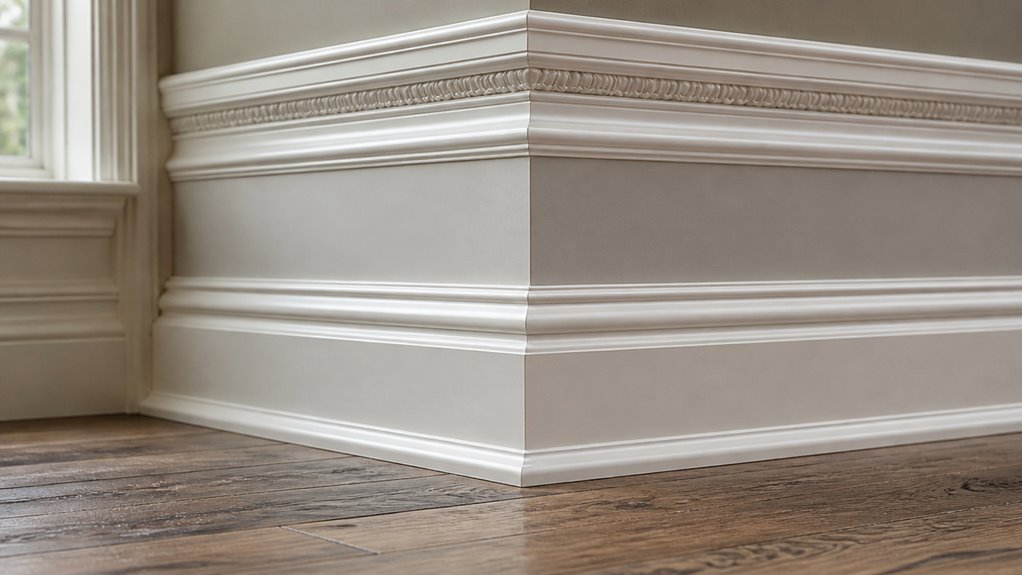
Crown molding sits where the wall meets the ceiling, creating an elegant passage that softens this junction with curved or stepped profiles. It draws the eye upward, adding perceived height and architectural detail.
In contrast, baseboard runs along the wall’s base, bridging the gap between floor and wall. It’s often simpler in design but vital for protecting walls from scuffs and damage caused by shoes, furniture, and vacuums.
While crown molding emphasizes decorative refinement, baseboard provides a clean, grounded finish. Both use precise measurements, but crown molding’s angled installation demands more technical skill than the straightforward, linear baseboard fit.
Proper installation of crown molding typically requires 2-inch finishing nails to ensure secure attachment to studs through drywall.
Where Are Crown Molding and Baseboard Installed?
Crown molding is typically installed right where the wall meets the ceiling. It adds a touch of elegance by framing that junction with either graceful curves or stepped profiles. Pretty neat, right?
On the other hand, baseboard is all about anchoring the room. It sits at the connection between the floor and the wall, giving a clean look while also protecting that area. Understanding these placement differences really helps in achieving a balanced architectural feel in your space.
Additionally, proper installation must consider expansion gaps at the baseboard level to accommodate wood movement and maintain durability.
Wall And Ceiling Junction
At the intersection where walls meet ceilings, molding plays a pivotal role in defining the room’s architectural character.
Crown molding, installed precisely at this junction, softens the edge where vertical and horizontal planes converge.
You’ll notice it often features intricate profiles that add elegance and height perception, visually crowning the space.
Unlike baseboards, crown molding requires angled cuts and careful alignment to fit snugly.
Crown molding bridges wall and ceiling, creating a graceful shift.
Its installation demands precision to maintain seamless corner joints.
The molding’s profile and projection enhance a room’s sophistication and depth.
For a smooth and polished finish, ensuring proper leveling surfaces before installation is essential.
Floor And Wall Connection
While crown molding elegantly frames the ceiling, the junction where walls meet floors demands its own finishing touch. This is where baseboards come in, installed precisely at the floor-to-wall intersection.
Baseboards cover gaps, protect walls from damage, and create a polished visual base, grounding the room’s design. Unlike crown molding’s angled installation, baseboards align flush with the floor, offering a simpler, yet essential, finishing detail. Selecting the proper nail size for baseboards is essential to ensure a secure and professional installation.
| Feature | Installation Location |
|---|---|
| Crown Molding | Wall-ceiling junction |
| Baseboard | Wall-floor junction |
| Crown Molding Effect | Frames and caps the ceiling |
| Baseboard Effect | Grounds and protects the wall |
Vertical Placement Differences
When distinguishing crown molding from baseboard, their vertical placement within a room plays a pivotal role in both function and visual impact.
Crown molding is installed where the wall meets the ceiling, elegantly framing the upper boundary and softening the junction with refined detailing.
Baseboard, conversely, anchors the room at the floor-wall intersection, providing a finished shift that protects lower walls from wear.
Consider these key placement distinctions:
- Crown Molding: Positioned high, it visually elevates the ceiling and enhances architectural sophistication.
- Baseboard: Located low, it conceals gaps between flooring and walls while offering practical protection.
- Installation Angle: Crown molding fits at an angled junction; baseboard aligns flat against the floor and wall.
This vertical contrast defines their distinct roles in room aesthetics and durability. Additionally, similar to baseboards protecting walls at floor level, T moulding is used to cover and protect expansion gaps between flooring surfaces, ensuring a polished and safe transition.
Crown Molding vs Baseboard: Key Differences Explained
The defining difference between crown molding and baseboard lies in their placement and purpose within a room’s architecture. Crown molding sits where the wall meets the ceiling, adding a graceful, often ornate segue that visually elevates the space.
It draws attention upward, enhancing perceived height and softening the wall-to-ceiling junction with curved, stepped profiles. In contrast, baseboard anchors the room at floor level, offering a clean, practical finish that conceals gaps between wall and floor.
It protects walls from daily wear with simpler, flatter profiles and is easier to install. While crown molding focuses on decorative sophistication, baseboard balances aesthetics with functionality.
Understanding these distinctions helps you select the right trim for both style and practicality. Additionally, considering the ease of installation and load demands can guide your choice much like selecting between mortise and non-mortise hinges in door hardware.
How Crown Molding Enhances Your Room’s Style?
Few architectural details can transform your room’s ambiance quite like crown molding.
By visually capping the wall-to-ceiling junction, it creates a polished shift that elevates your space’s overall aesthetic.
Crown molding draws the eye upward, adding perceived height and a sense of grandeur that simple walls lack.
Its curved or stepped profiles introduce elegant depth and shadow lines, enriching the room’s texture without overwhelming it.
When you choose crown molding, you’re not just adding trim; you’re framing your ceiling and defining your room’s character with architectural precision.
- Enhances vertical dimension by directing focus upward
- Adds intricate texture through curved, layered profiles
- Frames the ceiling edge with refined, decorative geometry
Additionally, pairing crown molding with wide plank hardwoods can create a seamless, warm flow that enhances the room’s overall style.
How Baseboard Protects Walls and Floors?
Baseboards step up to shield your walls and floors from everyday wear and tear while providing a seamless visual shift at the room’s base.
They cover the inevitable gaps where flooring meets the wall, preventing dust and debris accumulation while maintaining a clean edge.
By absorbing impacts from shoes, furniture, and vacuum cleaners, baseboards defend your drywall from scuffs and dents that would otherwise mar the surface.
Their subtle profile creates a finished boundary, grounding your room visually and structurally.
The baseboard’s height and material thickness play a vital role in durability, ensuring it withstands repeated contact.
When installed flush against both floor and wall, it forms a tight seal, enhancing both protection and aesthetic continuity without drawing undue attention.
This makes it an essential element in practical, polished interior design.
In some cases, removing baseboards may be necessary to achieve a flawless refinishing result or to address uneven floor surfaces.
Comparing Sizes and Profiles of Crown Molding and Baseboard
When you’re deciding between crown molding and baseboard, it’s really important to keep their height ranges in mind. Crown molding usually spans from about 2.5 to 6 inches, and it often has a more dramatic projection. On the other hand, baseboards typically range from 3 to 8 inches, but they tend to have a simpler profile.
If you take a closer look, you’ll see that crown molding often features intricate curves and stepped designs that draw the eye upward, creating a sense of height in the room. In contrast, baseboards have flatter, more understated lines that help ground the space.
These differences in size and profile shape not only affect how you install them but also play a big role in defining the room’s overall visual rhythm and architectural character. So, whether you want to elevate your ceiling or keep things grounded, it really comes down to the look you’re aiming for! Additionally, when working with hardwood floors in rooms featuring moldings and baseboards, it’s important to avoid using harsh chemical cleaners that can damage both the floor and adjacent woodwork.
Typical Height Ranges
The height of molding plays a pivotal role in defining a room’s character and visual balance. When selecting crown molding, you’ll typically find heights ranging from 2.5 to 6 inches, though larger, more dramatic profiles are available. This size helps create an elegant junction where the wall meets the ceiling, enhancing perceived ceiling height.
Baseboards generally range from 3 to 8 inches tall, grounding the room and protecting walls from daily wear. Their height depends on ceiling height and room style, often chosen to maintain proportional harmony.
Crown molding’s moderate height emphasizes refinement without overwhelming the space. Taller baseboards provide practical protection and a solid visual foundation. Both heights should coordinate with room scale for seamless integration. Additionally, incorporating acoustic treatments near molding can subtly improve room sound quality by reducing echo and reverberation.
Profile Complexity Differences
Although crown molding and baseboards may share the role of framing a room’s edges, their profiles differ markedly in complexity and design intent.
Crown molding typically features intricate curves, steps, and layered geometries, projecting outward to create a graceful junction between wall and ceiling. Its detailed profiles demand precise craftsmanship to achieve a seamless fit, reflecting an architectural elegance that catches the eye.
In contrast, baseboards usually present simpler, flatter profiles, ranging from subtle beveled edges to gentle curves that prioritize function and protection over ornamentation.
Standing between 3 to 8 inches tall, baseboards provide a clean, grounded finish at the floor line without overwhelming the space.
When selecting molding, you’ll notice crown molding’s complexity offers visual sophistication, while baseboards maintain understated practicality.
Visual Impact Variations
Because crown molding and baseboard vary markedly in size and profile, they create distinctly different visual effects within a room.
Crown molding typically stands between 2.5 to 6 inches tall with intricate curves and stepped details. It projects outward to draw your eye upward and enhance ceiling height.
In contrast, baseboards range from 3 to 8 inches, often featuring simpler, flatter profiles. They ground the space and provide a clean shift between floor and wall.
Consider these distinctions:
Crown molding’s ornate, curved profiles add elegance and architectural interest.
Baseboards’ modest profiles emphasize subtlety and functional finishing.
Size difference influences spatial perception; crown molding elongates, while baseboards stabilize.
Understanding these variations helps you choose the right trim to balance visual weight and style in your interiors.
Installing Crown Molding vs Baseboard: What You Need to Know
Mastering the installation of crown molding or baseboard demands attention to detail and careful measurement.
When installing crown molding, you’ll work at an angle where the wall meets the ceiling.
This requires precise miter and coping cuts to guarantee seamless joints.
Since crown molding often projects and features complex profiles, you’ll need specialized tools like a coping saw and miter box.
In contrast, baseboards sit flush along the floor-wall junction, making them easier to measure and cut with straightforward 90-degree angles.
Baseboards typically use simpler, flat profiles, so installation is more forgiving and DIY-friendly.
Regardless of your choice, accurate measurement, secure nailing, and careful caulking will guarantee a clean, refined finish.
This finish complements your room’s architecture and enhances visual appeal.
Cost Comparison: Crown Molding vs Baseboard
When planning your trim work, understanding the cost differences between crown molding and baseboard can help you make informed design choices.
Crown molding tends to be pricier due to its larger, more intricate profiles and the skill required for precise angled installation.
Baseboards, while essential, usually cost less because of their simpler shapes and straightforward floor-level placement.
Consider these factors:
- Material and Profile Complexity: Crown molding often uses elaborate designs and premium materials, increasing costs.
- Installation Difficulty: Crown molding installation demands precise cutting and fitting, adding labor expenses.
- Coverage Area: Baseboards cover more linear footage per room, but their uniformity keeps costs predictable.
Knowing these distinctions allows you to balance budget with aesthetic impact effectively.
How to Choose Crown Molding or Baseboard for Your Home’s Style?
Choosing between crown molding and baseboard involves more than just function. It’s about enhancing your home’s architectural character and complementing its overall style.
Consider your room’s height, design complexity, and how much visual impact you want. Crown molding suits traditional or upscale interiors with ornate profiles. Baseboards fit nearly all styles, adding a clean, grounded finish.
Use the table below to match your style needs:
| Style Aspect | Crown Molding | Baseboard |
|---|---|---|
| Visual Impact | Adds height, ornate profiles | Grounds space, simpler profiles |
| Installation | Complex, precise angled cuts | Easier, follows floor line |
| Function | Decorative, architectural | Protective, finishing |
| Ideal Style | Traditional, elegant spaces | Contemporary, versatile rooms |
Choose based on your space’s architectural features and desired aesthetic.
Tips for Combining Crown Molding and Baseboard Seamlessly
To create a cohesive look, you’ll want to carefully coordinate the profiles and proportions of your crown molding and baseboard. Matching the scale ensures neither element overwhelms the other, maintaining balance between the ceiling and floor connections.
Pay close attention to the design language. If your crown molding is ornate, opt for a baseboard with complementary but simpler detailing to avoid visual clutter.
Align the color palette to unify the two elements, using consistent paint finishes.
Maintain proportional relationships; typically, your baseboard should be slightly taller than the crown molding’s projection.
Use quality miters and precise cuts at corners to guarantee smooth, seamless joints that enhance craftsmanship.
Frequently Asked Questions
Can Crown Molding or Baseboard Be Painted or Stained to Match Decor?
You can definitely paint or stain both crown molding and baseboard to match your decor.
Painting offers a crisp, clean look that emphasizes architectural details, while staining highlights natural wood grain, adding warmth and texture.
Choose paint or stain based on your room’s style and lighting.
Just prep surfaces well for smooth adhesion and use high-quality finishes to guarantee durability, especially since baseboards endure more wear.
How Do Climate and Humidity Affect Crown Molding and Baseboard Materials?
You’ll find that climate and humidity greatly impact molding materials.
Wood expands and contracts with moisture changes, causing warping or gaps.
In humid areas, you’ll want moisture-resistant materials like PVC or MDF with proper sealing.
Dry climates can lead to cracking if wood isn’t acclimated correctly.
Keeping consistent indoor humidity levels helps maintain your molding’s structural integrity and appearance.
This ensures those elegant profiles stay flawless and well-fitted over time.
Are There Eco-Friendly or Sustainable Options for Crown Molding and Baseboard?
Yes, you can choose eco-friendly crown molding and baseboard options crafted from reclaimed wood, bamboo, or rapidly renewable MDF with low-VOC finishes.
These materials reduce environmental impact while maintaining elegance and durability.
Look for FSC-certified wood or recycled composites to balance sustainability with style.
By selecting these, you enhance your space’s aesthetic appeal responsibly, blending technical quality with green living.
You’ll appreciate both the beauty and the conscience behind your choice.
What Tools Are Essential for DIY Crown Molding or Baseboard Installation?
You’ll need a miter saw, capable of cutting precise 45-degree angles, to achieve those seamless corner joints.
Think of it as your magic wand for perfect edges.
A coping saw helps refine inside corners with intricate cuts.
Don’t forget a nail gun or hammer with finishing nails for secure attachment.
A tape measure, level, and pencil guarantee accuracy, while caulk and putty fill gaps, giving your trim that flawless, polished look every time.
How Do Crown Molding and Baseboard Impact Home Resale Value?
You’ll boost your home’s resale value by adding crown molding. It creates a sophisticated, upscale feel that appeals to buyers seeking elegance.
Baseboards also help by providing a polished, clean finish that protects walls and signals quality craftsmanship.
Together, they enhance a room’s architectural details and perceived quality. This makes your property more attractive and potentially increases its market price without heavy renovation costs.
Final Verdict on Crown Molding vs Baseboard
Choosing between crown molding and baseboard is like deciding whether to frame a masterpiece or lay a solid foundation.
Crown molding gracefully crowns your room with elegance, while baseboards protect and anchor your walls.
Together, they sculpt your space, blending style with function.
By understanding their roles and details, you’ll craft a harmonious design that’s both visually stunning and structurally sound.
This is a true architectural duet that transforms your home’s personality.