
Fir vs Cedar: Which Wood Is Better?
When choosing between fir and cedar, consider fir if you need superior strength, stiffness, and cost efficiency for structural projects. Plan on regular sealing to prevent rot outdoors.
Cedar offers natural decay resistance, weather durability, and low maintenance. This makes it ideal for exterior applications like decking and fencing despite a higher price.
Your decision hinges on balancing load-bearing needs, outdoor exposure, budget, and upkeep. Exploring each wood’s properties will clarify which suits your project best.
Key Takeaways
- Fir offers greater strength, hardness, and stiffness, making it ideal for structural uses like framing and load-bearing applications.
- Cedar naturally resists decay, rot, and insects, making it more durable outdoors without frequent treatments.
- Fir is generally 10–25% cheaper than cedar but requires pressure treatment and regular sealing for outdoor use.
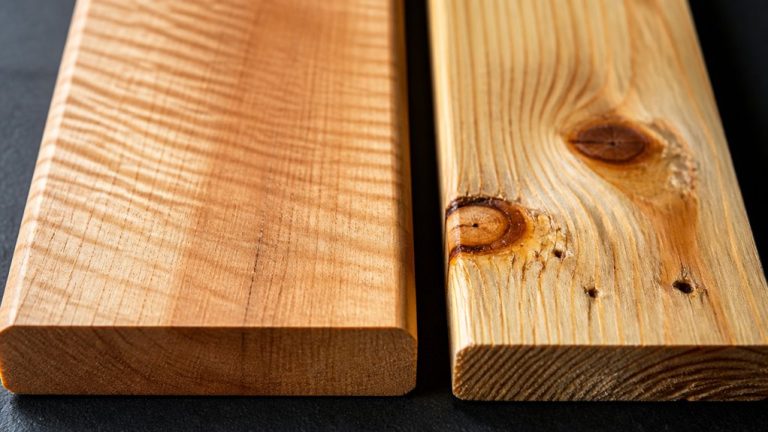
- Cedar has a richer, reddish hue and distinctive grain, while fir shows a cleaner, straighter, and lighter appearance.
- Cedar needs less maintenance outdoors, while fir requires annual inspections and sealant applications to prevent moisture damage.
Fir vs Cedar Comparison: Strength, Outdoor Durability, Cost, and Best Uses
| Comparison Point | Fir | Cedar | Best Choice |
|---|---|---|---|
| Strength | Offers higher strength, stiffness, and load-bearing capacity | Softer and less suited for heavy structural loads | Fir for structural strength |
| Hardness | Douglas fir has stronger hardness and bending resistance | Western red cedar is softer and easier to work with | Fir for toughness |
| Outdoor Durability | Needs pressure treatment or sealing to resist rot outdoors | Has natural decay, rot, and insect resistance | Cedar for weather exposure |
| Maintenance | Requires regular sealing and annual inspections | Needs less frequent upkeep due to natural oils | Cedar for low maintenance |
| Cost | Usually 10–25% cheaper than cedar | Higher upfront cost but lower long-term treatment needs | Fir for lower upfront cost |
| Appearance | Has a cleaner, straighter grain with lighter color | Has richer reddish tones and more character | Cedar for visual warmth |
| Weathering | Holds appearance better only with protective treatment | Naturally weathers to a gray patina outdoors | Depends on desired finish |
| Best Structural Use | Framing, beams, roofing, and load-bearing components | Light-duty exterior details or non-heavy-load uses | Fir for construction framing |
| Best Outdoor Use | Works outdoors only with proper treatment and care | Ideal for decking, fencing, siding, and cladding | Cedar for exterior projects |
| Overall Value | Best when strength and budget matter most | Best when durability and lower upkeep matter most | Choose by project priority |
Fir vs Cedar: Strength and Durability Compared

When comparing fir and cedar, you’ll find that Douglas fir offers markedly greater strength and hardness. This makes it the preferred choice for structural applications where load-bearing capacity matters.
With a Janka hardness rating of 660 lbf (2,900 N), Douglas fir substantially outperforms western red cedar’s 350 lbf (1,600 N). This strength translates into superior stiffness, toughness, and bending resistance, which are vital for framing, roofing, and load-bearing components.
Douglas fir’s higher Janka hardness ensures greater stiffness and durability for critical structural uses.
Cedar, being softer, can’t reliably support heavy structural loads. While both are softwoods, fir’s denser grain and firmer texture provide enhanced durability under mechanical stress.
Consequently, if your project prioritizes structural integrity and resistance to deformation, Douglas fir is technically the more suitable material compared to cedar. Cedar excels primarily in other performance aspects not related to strength.
Additionally, unlike cedar, fir lacks the natural decay resistance that helps wood withstand biological threats and weathering over time.
Which Wood Stands Up to Outdoor Exposure?
While Douglas fir excels in strength and structural capacity, its performance outdoors requires additional consideration. Fir rates as Class 3 (moderately durable) on the BS EN 350 scale, indicating moderate resistance to decay and insects.
Untreated, it’s vulnerable to rot, so you’ll need pressure treatment or protective finishes to enhance longevity in outdoor settings. In contrast, western red cedar rates as Class 2 (durable), offering superior natural resistance to moisture, decay, and insect damage.
Cedar’s inherent oils and cellular structure reduce maintenance demands and extend service life without chemical treatment. If your project prioritizes weather durability and minimal upkeep, cedar stands out as the better choice.
However, if you’re prepared to apply preservatives, fir can perform adequately outdoors but requires more vigilant maintenance to prevent degradation.
Proper installation and regular maintenance can significantly extend cedar’s lifespan, often beyond 20 years, making it a reliable option for outdoor use with moisture prevention.
Fir vs Cedar: Cost Differences
Several factors influence the cost difference between Douglas fir and western red cedar, with fir generally being 10–25% cheaper.
Douglas fir’s lower price stems from faster growth rates and greater availability, making it a budget-efficient choice for large-scale projects.
Douglas fir’s rapid growth and abundance make it an economical option for extensive construction projects.
In contrast, western red cedar commands a price premium due to its superior natural decay resistance and weather durability. This reduces long-term maintenance costs.
When you choose fir, you’ll often need to invest in pressure treatment or sealants for outdoor use, adding to the total expenditure.
Cedar’s upfront cost is higher, but it compensates by requiring less frequent protective treatments. Regional market variations, product grades, and supply chain factors also affect price differences. You should assess these variables alongside your project’s budget and performance priorities.
Additionally, cedar’s natural oils provide pest resistance that can lower chemical treatment costs over time.
Appearance and Grain: What Sets Fir and Cedar Apart
Although both Douglas fir and western red cedar serve many structural and aesthetic purposes, they differ distinctly in appearance and grain characteristics.
This can influence your choice depending on the desired visual impact.
Fir typically presents a cleaner, straighter grain with a fine-to-medium texture.
It offers a consistent, uniform look.
Cedar displays a richer color range and a more pronounced, distinctive grain pattern, often accompanied by a natural aroma.
Over time, untreated cedar weathers to a gray patina, whereas fir maintains its appearance longer with proper treatment.
Key differences include:
- Fir’s straight grain vs. cedar’s more varied, textured grain
- Fir’s consistent light color vs. cedar’s richer, reddish hues
- Cedar’s natural aromatic oils enhancing visual character
- Weathering effects: cedar grays naturally; fir requires sealing to retain look
Additionally, cedar’s natural oils and hydrophobic compounds provide rot and insect resistance, making it well-suited for outdoor applications.
Best Uses for Fir and Cedar in Construction and Design
When you’re deciding between fir and cedar, it’s important to think about what your project really needs.
Fir is fantastic for framing and load-bearing applications because it’s super strong and hard. If you’re looking for something that can handle a lot of weight, fir might just be your best bet.
On the other hand, if your project is going to be exposed to the elements, cedar really shines.
It’s naturally resistant to decay and insects, making it a great choice for outdoor use. So, understanding these differences can really help you pick the right wood for both performance and longevity.
Additionally, ensuring proper moisture control around wood structures is key to reducing risks such as termite damage, which cedar’s natural oils can help mitigate due to their insect-repelling properties.
Structural Applications Overview
Choose Douglas fir for structural applications that demand high strength, stiffness, and load-bearing capacity, such as framing, roofing, and beams. Its superior hardness (Janka 660 lbf) and bending resistance make it ideal where toughness is critical.
Cedar’s lower strength limits its use in heavy-load scenarios but offers natural decay resistance. When selecting between fir and cedar for structural tasks, consider these points:
- Fir supports heavy loads better due to greater stiffness and hardness.
- Cedar excels in environments needing natural rot resistance but not heavy load-bearing.
- Fir typically requires protective treatment for outdoor structural use.
- Cost-efficiency often favors fir for large-scale framing and structural projects.
Use fir when strength is your priority. Reserve cedar for less demanding structural roles or where decay resistance is essential. Oak wood, by comparison, offers high bending strength and stiffness that exceed those of both fir and cedar, making it a superior choice for demanding structural and load-bearing applications.
Outdoor Durability Comparison
Structural strength sets Douglas fir apart for framing and load-bearing roles. However, evaluating outdoor durability highlights distinct advantages for cedar in exposed environments.
Cedar rates Class 2 on the BS EN 350 scale for durability. It demonstrates superior natural resistance to decay, rot, and insects compared to Douglas fir’s moderate Class 3 rating. This inherent resistance makes cedar ideal for fencing, decking, and cladding without requiring frequent treatments.
In contrast, fir demands pressure treatment or sealing to withstand outdoor conditions effectively. If you prioritize long-term weather resistance with minimal maintenance, cedar is your best choice.
However, fir offers cost efficiency and exceptional strength where structural integrity is critical. It requires proactive protection against moisture and biological degradation when used outdoors. Your project’s exposure and maintenance capacity will guide the prime wood selection.
Proper sealing with an oil-based sealer can significantly extend the outdoor life of pressure-treated fir by preventing moisture infiltration and UV damage.
Maintenance Tips for Fir and Cedar Outdoors
Maintaining fir and cedar outdoors requires distinct approaches due to their differing properties. Fir, being moderately durable, demands regular sealing or preservative treatments to prevent moisture penetration and decay.
Cedar’s natural resistance reduces maintenance frequency, but periodic care preserves its color and prevents graying.
- For fir, apply a high-quality sealant every 1-2 years, focusing on end grains and exposed surfaces.
- Inspect fir annually for signs of rot or insect damage; re-treat promptly.
- Clean cedar surfaces with mild detergent and water to remove dirt and mildew.
- Use UV-protective finishes on cedar to maintain its rich color, reapplying every 3-5 years depending on exposure.
Choosing the right oil-based sealant can enhance cedar’s natural grain and provide lasting protection against moisture and UV damage.
Choosing Fir or Cedar for Your Project
When you’re trying to decide between fir and cedar for your project, it really helps to think about what you need most. Are you looking for something with higher structural strength, or is weather durability more important? Fir is a solid choice if you need something that can handle a lot of weight and is easier on the wallet. Just keep in mind that it does require regular maintenance to keep it in good shape.
On the other hand, cedar has its own perks. It naturally resists decay, which means it can stand up to the elements pretty well. However, that comes with a higher price tag. The good news is that once it’s installed, you won’t have to worry about as much upkeep. So, weighing these factors will really help you pick the best wood for your specific needs. Additionally, cedar can often exceed 20 years outdoors due to its natural oils and rot resistance, making it a lasting choice for exterior projects.
Strength Versus Durability
Balancing strength and durability is key when deciding between fir and cedar for your project.
Fir, specifically Douglas fir, excels in strength with a Janka hardness of 660 lbf. This makes it ideal for structural uses where load-bearing capacity and stiffness matter.
Cedar, however, offers superior natural durability, rated Class 2 on the BS EN 350 scale. It resists decay, rot, and insects better than fir.
Consider these factors:
- Fir provides higher hardness and bending resistance, suited for framing and roofing.
- Cedar naturally withstands outdoor exposure without pressure treatment.
- Fir needs protective finishes for durability outdoors.
- Cedar’s rot resistance reduces long-term degradation risks in moist environments.
Choose fir if strength dominates your needs. Select cedar if durability against weather is essential.
Additionally, when using wood like fir or cedar for pallets or structural projects, understanding the regional availability of these species can influence your material choice and cost.
Cost And Maintenance
After evaluating strength and durability, you’ll want to factor in cost and maintenance to determine which wood suits your project budget and ongoing care expectations.
Douglas fir typically costs 10–25% less than western red cedar, making it a budget-friendly option for larger structural projects.
However, fir requires regular sealing or pressure treatment to maintain outdoor performance, adding to long-term maintenance costs.
Cedar carries a higher upfront price but offers superior natural decay and insect resistance, reducing the frequency and expense of upkeep.
If you prefer lower maintenance and better weather resistance, cedar is worth the premium.
Conversely, if budget constraints dominate and you can commit to periodic treatments, fir provides excellent value.
Evaluate your project’s financial limits and maintenance capacity carefully to choose the most suitable wood.
Frequently Asked Questions
How Do Fir and Cedar Compare in Terms of Environmental Sustainability?
You’ll find both fir and cedar environmentally sustainable when sourced responsibly, as they’re renewable softwoods.
Fir’s faster growth rate can make it more eco-friendly by reducing harvest pressure and carbon footprint.
Cedar’s natural rot resistance means less chemical treatment, lowering environmental impact during use.
However, both require certification, like FSC, to guarantee sustainable practices.
Your choice depends on balancing growth rate, treatment needs, and sourcing transparency for your project.
Are Fir and Cedar Safe for Indoor Air Quality and Allergies?
You might be surprised. Both fir and cedar generally pose low risks to indoor air quality. They don’t emit high levels of VOCs, so you won’t usually face irritants indoors.
However, cedar’s natural oils can sometimes trigger allergic reactions or sensitivities in certain individuals, especially those prone to respiratory issues. Fir lacks this strong aroma, making it less likely to cause allergies.
Still, proper ventilation and sealing help keep your indoor air safe.
Can Fir or Cedar Be Easily Stained or Painted?
You can stain or paint both fir and cedar, but their absorption differs. Fir’s tighter grain accepts paint and stain more evenly, giving you a smooth, consistent finish.
Cedar’s open grain soaks up stain faster, often highlighting its rich color and texture, but it may blotch without proper pre-treatment.
Both woods benefit from sanding and priming before painting.
Cedar typically requires less primer for stain adherence due to its natural oils.
What Are the Typical Sources or Regions for Fir and Cedar Lumber?
When you hold fir lumber, you’re touching the strength of the Pacific Northwest. It’s mainly harvested from dense Douglas fir forests in the western United States and Canada.
Cedar lumber, rich and fragrant, typically comes from western red cedar trees thriving in coastal regions of British Columbia and the U.S. Northwest.
These geographic origins shape their durability and appearance. Knowing their sources helps you choose wood that fits your project’s environmental demands precisely.
How Do Fir and Cedar Perform in High-Humidity or Coastal Climates?
In high-humidity or coastal climates, cedar outperforms fir due to its superior natural resistance to moisture, decay, and insects.
You’ll find cedar requires less maintenance and retains integrity longer when exposed to constant dampness and salt air.
Fir, while stronger structurally, needs pressure treatment or regular sealing to prevent rot and warping.
If durability in moist, salty environments matters most, cedar is your better choice for outdoor applications.
Choose the Wood That Matches Your Project Needs
Choosing between fir and cedar is like picking the right tool for a job.
Just as a craftsman wouldn’t use a screwdriver to hammer a nail, you’ll want cedar for outdoor durability and natural resistance to decay.
Fir suits structural strength and budget-conscious projects.
Remember, cedar’s maintenance ease and weather resilience make it the “armor” for your outdoor wood.
Fir’s solid strength supports your construction’s backbone. Choose wisely for lasting results.