Hickory vs Oak Flooring: Which Is Better for Your Home?
If you want durable flooring, hickory offers superior hardness (Janka 1820) and high dent resistance, ideal for busy areas. However, it needs rot treatments in humid spots.
Oak, with lower hardness (Janka 1220–1360), is easier to refinish and suits moderate traffic rooms.
Hickory’s bold color and grain create a rustic look, while oak’s uniform grain fits classic designs.
Installation and cost differ, as hickory requires specialized tools and is pricier.
Learn how these factors impact your flooring choice.
Key Takeaways
- Hickory is harder and more durable (Janka 1820) than oak (Janka 1220-1360), ideal for high-traffic areas but may need rot treatments.
- Oak offers a classic, uniform grain and is easier to stain and refinish, fitting formal and modern interior styles.
- Hickory’s bold, varied grain and color create a rustic, dynamic look with distinctive character and contrast.
- Installation of hickory is more complex, requiring carbon-tipped blades and stronger fasteners, while oak is easier and more affordable to install.
- Hickory flooring costs more ($6–$14/sq ft) due to rarity and milling difficulty; oak is generally more affordable and widely available.
Hickory vs. Oak Flooring: Which Should You Choose?

Choosing between hickory and oak flooring requires evaluating your priorities in hardness, appearance, maintenance, and budget.
Hickory stands out with its high density, intricate grain, and broad color variation, offering a bold, rustic aesthetic.
Oak presents a more uniform, linear grain with consistent tones, suiting traditional or modern interiors.
You’ll find hickory generally costs more due to its rarity and milling difficulty, whereas oak tends to be more affordable and widely available.
Maintenance-wise, both woods demand care, but hickory needs specific treatments for rot resistance and specialized cutting tools.
Oak is easier to refinish and less prone to decay but may suffer more insect damage.
Your choice hinges on balancing these technical aspects against your design goals and practical needs.
Additionally, oak’s dimensional stability helps maintain its shape and fit under humidity fluctuations, making it a reliable flooring option.
How Hard Are Hickory and Oak? Which Lasts Longer?
Understanding the hardness and longevity of hickory and oak helps you determine which wood best suits your flooring needs. Hickory stands out as the hardest domestic hardwood with a Janka rating of 1820, offering superior resistance to dents and scratches.
Oak, including white and red variants, has lower ratings between 1220 and 1360, making it moderately durable. Both woods can last decades with proper care, but each has unique vulnerabilities and maintenance needs.
Hickory resists heavy foot traffic damage better than oak. Oak is easier to refinish despite being softer. Hickory requires specialized cutting tools due to its density. Oak is more prone to insect damage and decay.
Both species can achieve longevity exceeding several decades with maintenance. Maintaining proper moisture content is essential to preserve the hardness and appearance of hardwood floors.
What Do Hickory and Oak Flooring Look Like? Color and Grain Differences
Hickory flooring is quite the visual treat! You’ll see a beautiful range of colors, from creamy beige to rich golden brown. Plus, the grain patterns are really something special—bold and varied, with lots of knots and intricate details that give each plank its own character.
On the other hand, oak flooring takes a different approach. It tends to offer more consistent, muted tones, which can create a lovely, cohesive look in your space. The grain patterns are smoother and more linear, repeating across the planks, which adds a more classic feel. Hickory’s higher Janka hardness rating means it provides exceptional durability while maintaining its distinctive grain texture.
Color Variation Comparison
Although both hickory and oak flooring originate from hardwood species, their color and grain characteristics differ markedly. This impacts aesthetic outcomes. When selecting flooring, understanding these color variations helps you achieve the desired look.
Hickory features broad color ranges, from creamy beige to rich golden brown. This creates bold contrasts.
Oak exhibits consistent, subtle tones with uniformity across planks. This lends predictability to your design.
You’ll notice hickory planks vary considerably in color, enhancing a rustic, dynamic appearance.
Oak’s colors remain steady, offering a classic, refined aesthetic suitable for diverse interiors.
Hickory’s diverse palette adds complexity, whereas oak’s restrained hues emphasize uniform elegance.
These differences guide your choice depending on whether you want a statement floor or a harmonious backdrop.
Additionally, oak’s pronounced, open grain supports a broad spectrum of finishes, allowing greater customization in overall ambiance and style.
Grain Pattern Differences
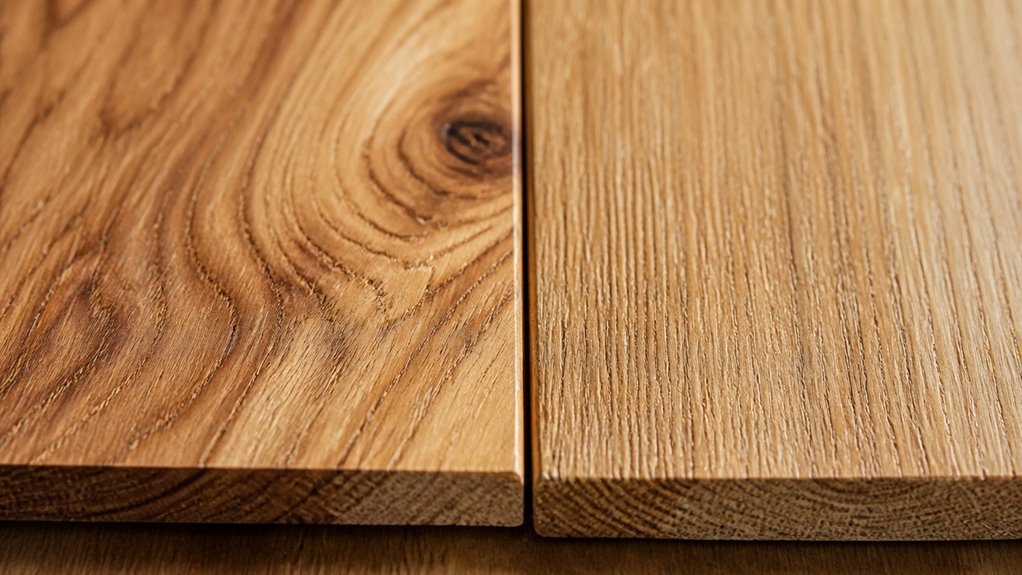
When comparing grain patterns, hickory presents a varied and knotty texture with pronounced character marks that highlight its natural complexity.
You’ll notice bold contrasts and irregularities across planks, making each piece distinct.
In contrast, oak exhibits a linear, smooth, and more uniform grain pattern.
Oak planks tend to share similar visual traits, offering a consistent and predictable appearance.
Hickory’s grain complexity creates a rustic, dynamic look, while oak’s linearity supports traditional and contemporary aesthetics.
These differences affect how each wood stains; oak absorbs finishes evenly due to its uniform grain, whereas hickory may produce a mottled effect.
Understanding these grain distinctions helps you choose flooring that aligns with your design goals and maintenance preferences.
Oak’s grain characteristics also influence its finish absorption and final surface appearance.
How Much Does Hickory or Oak Flooring Cost?
When it comes to hickory flooring, you’re looking at a price range of about $6 to $14 per square foot. This variance is largely due to how rare hickory is and the complexity involved in milling it. So, if you’re drawn to that unique look and durability, keep in mind that it might stretch your budget a bit.
On the other hand, oak flooring, which includes both white and red varieties, tends to be more budget-friendly. It typically ranges from $5 to $12 per square foot, thanks to its wider availability in the market. This makes oak a popular choice for many homeowners.
Ultimately, these price differences can significantly impact your budget and project planning. So, when you’re choosing between hickory and oak, it’s definitely worth considering how each option fits into your overall financial plan! Additionally, engineered hardwood like Acacia offers durability and eco-friendly benefits that may provide a cost-effective and sustainable alternative.
Material Cost Comparison
Understanding the material costs of hickory and oak flooring is essential for budgeting your project accurately. Hickory generally costs more due to its density and milling challenges. Oak, being more readily available, offers a lower price point.
Here’s a detailed cost comparison:
Hickory ranges between $6 and $14 per square foot.
White Oak typically costs $5 to $12 per square foot.
Red Oak shares a similar price range of $5 to $12 per square foot.
Hickory’s higher price reflects its rarity and manufacturing complexity.
Oak’s widespread availability often results in lower entry-level costs.
Choosing the right material also involves considering the hardwood species durability, as this impacts the floor’s lifespan and maintenance needs.
Market Availability Factors
Although both hickory and oak flooring serve as durable hardwood options, their market availability considerably influences their cost and accessibility.
Hickory flooring typically costs between $6 and $14 per square foot, reflecting its relative rarity and the complexity involved in milling its dense wood.
Oak, including both white and red varieties, generally ranges from $5 to $12 per square foot due to its widespread availability and more straightforward processing.
You’ll find oak easier to source, making it a cost-effective choice for many homeowners.
In contrast, hickory’s limited supply and specialized cutting requirements, such as the need for carbon-tipped saw blades, drive up its price.
Consequently, your decision should consider not only the aesthetic and durability differences but also the practical implications of availability and cost.
Additionally, understanding the Janka hardness ratings of these woods can help in selecting flooring that best fits your durability needs.
Installing Hickory vs. Oak Flooring: What You Need to Know?
When installing hardwood flooring, the distinct density and grain structure of hickory and oak demand specific tools and techniques to guarantee best results.
Hickory’s high density requires carbon-tipped saw blades to cut through its hardness without damaging equipment. Oak, with its uniform grain, cuts more easily but still benefits from sharp blades for clean edges.
Both species demand acclimation to room humidity before installation to prevent warping. Nail or staple sizes may differ; hickory’s density calls for stronger fasteners.
Key points to take into account:
- Use carbon-tipped blades for hickory cutting
- Acclimate wood to ambient moisture for both
- Select appropriate fasteners based on wood hardness
- Prepare subfloor meticulously for unevenness
- Monitor spacing for wood expansion and contraction
These measures make certain a durable, professional installation. Proper acclimation, including maintaining consistent temperature and humidity levels during the process, is essential to avoid issues like warping and buckling. This step ensures the flooring adjusts to the room conditions before installation, contributing to its longevity and stability through moisture control.
Which Flooring Is Easier to Maintain: Hickory vs. Oak?
After ensuring proper installation with the right tools and acclimation, you’ll want to take into account how each wood species performs over time.
Hickory’s high Janka hardness rating (1820) makes it extremely resistant to dents and scratches, reducing the frequency of surface repairs. However, its natural susceptibility to rot means you’ll need to apply rot treatments periodically, especially in humid environments.
Oak, while softer (Janka 1220-1360), is less prone to rot but more vulnerable to insect damage and heartwood decay, requiring vigilant pest control. You’ll find oak easier to refinish thanks to its consistent grain and softer density, which allows for multiple sanding cycles.
In contrast, hickory’s density demands specialized carbon-tipped blades, complicating refinishing.
Both hardwoods have vessels and dense cellular structures that contribute to their durability and resistance, which is essential for flooring longevity.
How to Stain Hickory vs. Oak Flooring?
When you’re looking to stain hickory flooring, it’s important to keep in mind its unique grain and knots. These features can lead to uneven absorption, which might give you that mottled look.
On the flip side, oak has a more uniform grain, so it usually takes stain more evenly. This means you’re likely to get a consistent color throughout.
Understanding these differences is key. It helps you pick the right stain and application technique to achieve the finish you want.
Staining Challenges And Tips
Because of its highly varied grain and color contrasts, staining hickory flooring often yields a mottled or uneven appearance that can challenge even experienced installers.
Oak, with its uniform grain, generally accepts stain more evenly, simplifying the process. When staining hickory, you must carefully prepare and test to avoid blotching or excessive contrast.
Consider these tips for effective staining:
Use a wood conditioner to minimize uneven absorption on hickory.
Test stain samples on scrap pieces before full application.
Apply stain in thin, even coats, allowing drying between layers.
Sand lightly between coats to guarantee smoothness.
Choose stain types compatible with the wood’s density and grain complexity.
These steps help manage hickory’s natural variability while leveraging oak’s consistent response to staining.
Color Outcomes And Effects
Understanding how staining impacts the final color of hickory and oak flooring helps you make informed choices tailored to your design goals.
Hickory’s pronounced grain and natural color variation create a mottled effect when stained, emphasizing its rustic and dynamic character.
You should expect uneven absorption due to knots and contrasting hues, which enhances its unique aesthetic.
Conversely, oak’s uniform grain allows for a more consistent, even stain application.
Red oak tends to develop warm, reddish-brown tones, while white oak shifts toward cooler tans and grays, aligning with modern or traditional styles.
When staining, you’ll find oak offers predictability, whereas hickory delivers pronounced visual complexity.
Selecting the right stain and technique depends on whether you prioritize uniformity or a bold, varied appearance in your flooring’s final look.
Best Rooms for Hickory Flooring
Hickory flooring frequently excels in high-traffic areas due to its exceptional hardness and durability. Its Janka hardness rating of 1820 makes it highly resistant to dents and scratches, ideal for rooms where wear is expected.
Hickory flooring stands out in busy spaces thanks to its superior hardness and resistance to wear.
When selecting rooms for hickory flooring, consider spaces demanding robust performance and unique visual character.
Best rooms for hickory flooring include:
- Entryways and hallways, where foot traffic is concentrated.
- Family rooms and living rooms, combining durability with rustic aesthetics.
- Kitchens, benefiting from hickory’s hardness against dropped objects.
- Mudrooms, where resistance to dirt and impact is essential.
- Home gyms or playrooms, accommodating heavy use without damage.
You’ll appreciate hickory’s bold grain and color variation adding distinctive character to these functional spaces.
Best Rooms for Oak Flooring
Oak flooring offers a versatile solution for a variety of indoor spaces due to its moderate hardness, uniform grain, and classic appearance.
You’ll find oak well-suited for living rooms, dining areas, and bedrooms where moderate foot traffic occurs. Its Janka hardness rating (1220-1360) balances durability with ease of refinishing, making it ideal for spaces that require both endurance and aesthetic upkeep.
The consistent grain allows for even staining, which complements formal settings and modern designs. Additionally, oak’s moderate resistance to dents and scratches means it performs adequately in hallways and home offices but may require more care in high-impact zones.
Avoid placing oak in areas prone to moisture or heavy wear, as it’s less resistant to rot and damage compared to harder woods like hickory.
Picking Hickory or Oak Flooring for Your Style and Needs
Choosing between hickory and oak flooring involves evaluating your specific lifestyle demands, aesthetic preferences, and budget constraints.
Selecting hickory or oak flooring depends on your lifestyle, design taste, and budget considerations.
Hickory’s superior hardness suits high-traffic areas, while oak’s uniform grain supports versatile design styles.
Consider these factors when deciding:
- Durability: Hickory rates 1820 on the Janka scale. Oak averages 1250–1360.
- Appearance: Hickory offers bold, varied grain. Oak provides consistent, linear patterns.
- Cost: Hickory costs $6–$14/sq ft. Oak is generally less expensive at $5–$12/sq ft.
- Maintenance: Oak resists rot better, but hickory withstands dents and scratches more effectively.
- Installation: Oak is easier to cut and install. Hickory requires specialized saw blades.
Assess how these technical differences align with your home’s functional needs and visual goals before selecting.
Frequently Asked Questions
Can Hickory or Oak Flooring Be Installed Over Radiant Heating Systems?
Yes, you can install both hickory and oak flooring over radiant heating systems, but you’ll need to take precautions.
Hickory’s density requires careful acclimation to prevent warping, while oak’s stability makes it more forgiving. Use engineered wood versions of either species for better dimensional stability.
Always maintain consistent temperature and humidity levels. Follow manufacturer guidelines to ensure your hardwood flooring performs well without damage from radiant heat.
Are There Eco-Friendly Options Available for Hickory and Oak Flooring?
Imagine you’re sourcing sustainably harvested wood certified by the Forest Stewardship Council (FSC).
Both hickory and oak offer eco-friendly options when you choose FSC-certified materials, ensuring responsible forest management.
Additionally, reclaimed hickory or oak flooring reduces environmental impact by repurposing existing wood.
You’ll also want to verify low-VOC finishes to minimize indoor air pollution, further enhancing your flooring’s eco-friendliness while maintaining durability and aesthetic appeal.
How Do Hickory and Oak Flooring Affect Indoor Air Quality?
You’ll find both hickory and oak flooring have minimal impact on indoor air quality when properly finished and maintained.
They emit low volatile organic compounds (VOCs), especially if you choose water-based finishes.
However, hickory’s denser nature might trap more dust and allergens if not cleaned regularly.
Oak’s more uniform grain allows for smoother finishes, potentially reducing airborne particles.
Opt for certified low-VOC products to guarantee healthier indoor air quality with either wood.
What Types of Finishes Are Recommended for Outdoor Use of Oak or Hickory?
For outdoor use, you should apply a high-quality penetrating oil finish or a spar urethane to both oak and hickory.
These finishes provide UV protection, moisture resistance, and flexibility to handle wood expansion.
You’ll want to make certain the finish is specifically formulated for exterior use to prevent cracking or peeling.
Regular maintenance and reapplication every 1-2 years will help preserve durability and appearance in outdoor conditions.
Can Hickory or Oak Flooring Be Used in Basement or High-Moisture Areas?
You generally shouldn’t install hickory or oak flooring in basements or high-moisture areas without proper precautions.
Both woods are susceptible to moisture-related issues. Hickory is prone to rot and requires treatment, while oak can suffer from insect damage and decay.
If you choose to use them, provide excellent subfloor moisture barriers and controlled humidity.
Engineered wood or moisture-resistant materials are often better suited for these environments.
Hickory or Oak? Find the Perfect Floor for Your Space
Choosing between hickory and oak flooring often comes down to your specific needs and style preferences.
Both offer exceptional durability, but hickory’s hardness suits high-traffic areas, while oak’s consistent grain provides a classic look.
You’ll find their cost and installation requirements comparable, yet staining techniques differ slightly.
By understanding these technical nuances, you can confidently select the flooring that perfectly balances longevity, aesthetics, and functionality for your space.