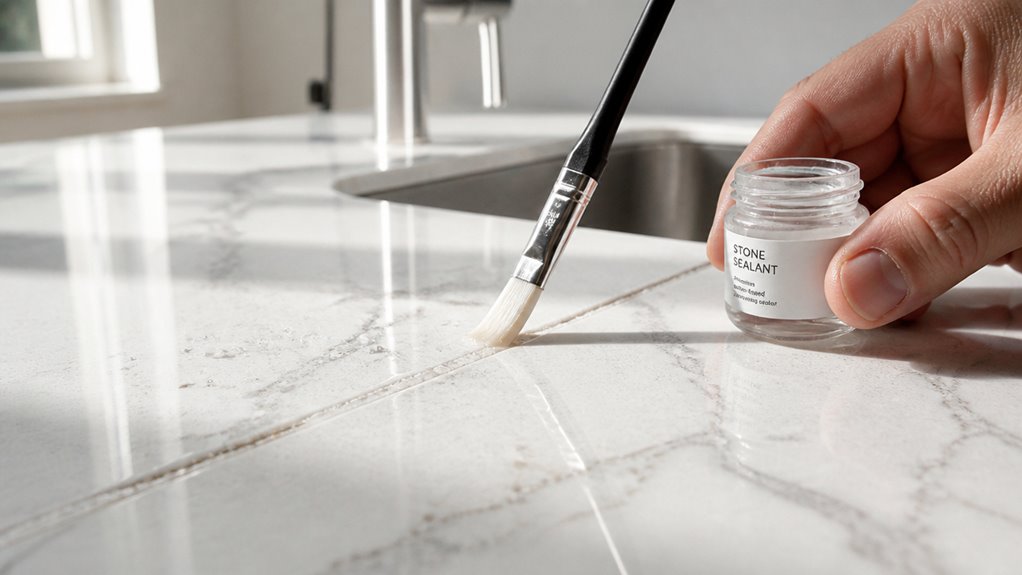
Do I Need to Seal Quartz Countertops at Home?
You don’t need to seal quartz countertops because their engineered, non-porous surface naturally resists stains and moisture.
Quartz combines crushed quartz with resins that form a protective barrier, making sealing unnecessary and often harmful.
Applying sealers can cause cloudiness, residue, or damage. Instead, focus on regular cleaning and promptly wiping spills to maintain durability.
If you want to understand how quartz withstands stains or when sealing might be considered, there’s more to explore.
Key Takeaways
- Quartz countertops are non-porous and have a built-in protective barrier, so they do not require sealing.
- Sealing quartz can cause cloudiness, residue buildup, or damage to the engineered surface.
- Most manufacturers explicitly advise against sealing quartz and recommend routine cleaning instead.
- Sealing is generally unnecessary and may void product coverage or reduce countertop lifespan.
- For lighter-colored quartz prone to stains, only follow manufacturer guidance before considering sealing.
Do Quartz Countertops Need Sealing? The Quick Answer

If you’re wondering whether you need to seal your quartz countertops, the straightforward answer is no.
Quartz countertops are engineered with resins and polymers that create a built-in protective barrier, making them non-porous by design.
Quartz countertops feature resins and polymers that form a non-porous, built-in protective barrier.
Unlike natural stone, quartz doesn’t absorb moisture or stains, so sealing isn’t necessary to maintain its durability or appearance.
Applying a sealer can even cause problems, like residue buildup or cloudiness, because the surface doesn’t allow penetration.
Instead, focus on routine cleaning with mild soap and water, wiping spills promptly, and avoiding harsh abrasives.
Always follow your countertop manufacturer’s care instructions.
Trust that quartz’s engineered composition provides effective stain resistance without additional sealing, saving you time and effort on unnecessary maintenance.
For durable surfaces in your home, consider materials like EVP flooring that also combine engineered design with water resistance and easy maintenance.
Differences Between Quartz and Quartzite Countertops
While quartz countertops typically don’t require sealing thanks to their engineered, non-porous makeup, quartzite countertops present a different care profile.
Quartzite is a natural stone, formed through heat and pressure, making it porous to varying degrees. Unlike quartz, quartzite can absorb moisture and stains, so sealing is often necessary to protect its surface.
You’ll want to check your specific quartzite slab’s porosity and follow manufacturer guidelines on sealing frequency. Quartz, composed of crushed quartz mixed with resin, already has a built-in barrier.
This means sealing usually won’t penetrate or add protection. Recognizing this fundamental difference helps you maintain your countertops properly and avoid unnecessary treatments that could harm quartz’s engineered finish or leave quartzite vulnerable without proper sealing.
Proper maintenance and environmental resistance are key factors that affect the longevity of both natural and engineered stone surfaces, similar to considerations seen with material durability in flooring options.
How Quartz Countertops Resist Stains and Moisture?
Quartz countertops resist stains and moisture primarily because of their engineered composition, which combines natural minerals with durable resin binders.
This blend creates a dense, non-porous surface that prevents liquids and oils from seeping in, unlike porous natural stones. You don’t have to worry about common kitchen spills penetrating the surface, as quartz’s resins act as a built-in barrier against absorption and staining.
This inherent protection means quartz doesn’t rely on topical sealers to maintain its resistance. Instead, the countertop’s stain resistance comes from its very structure, making it easier for you to clean and maintain.
Quartz requires minimal maintenance and does not need sealing due to its non-porous surface.
When to Consider Sealing Quartz Countertops?
It’s a good idea to check your manufacturer’s care instructions before thinking about sealing your quartz countertop.
The thing is, most engineered quartz doesn’t really need it. Just keep in mind that quartzite, which is a natural stone, often does require sealing, so don’t mix those two up!
If you do start to notice any staining or surface damage despite cleaning it properly, it might be worth chatting with a professional about sealing. They can help you figure out the best course of action! Proper maintenance and prompt spill cleanup are essential to preserve the surface’s appearance and durability, much like with engineered hardwood care.
Manufacturer Care Instructions
Manufacturer care instructions serve as your most reliable guide when deciding whether to seal quartz countertops.
Since engineered quartz is non-porous and factory-finished with a built-in protective layer, most manufacturers explicitly state sealing isn’t necessary.
You should always check the care guidelines specific to your quartz brand before applying any sealer.
Some manufacturers may recommend occasional sealing for particular product lines, especially lighter colors prone to staining.
However, applying the wrong sealer can cause cloudiness or residue, damaging your countertop’s appearance.
Follow the recommended cleaning methods, usually mild soap and water, and avoid harsh chemicals or abrasives.
Ultimately, adhering to your manufacturer’s instructions guarantees you maintain your quartz countertop’s durability and look without risking unnecessary or harmful sealing attempts.
Regular testing and awareness of indoor air quality can also help maintain a safe and healthy kitchen environment.
Quartzite Versus Quartz
Natural stone surfaces like quartzite often require sealing because their porous structure can absorb moisture and stains, unlike engineered quartz countertops.
When deciding whether to seal your countertop, consider these key differences:
- Quartzite is a natural stone with variable porosity, so sealing helps protect it from damage.
- Engineered quartz is non-porous, made with resins that block absorption, making sealing unnecessary.
- Sealing quartzite prevents stains and moisture penetration, which quartz’s built-in resin barrier already handles.
- Applying sealers to quartz can cause surface issues like cloudiness or residue, so avoid it unless manufacturer guidance says otherwise.
Additionally, engineered quartz’s non-porous surface makes it easier to maintain and clean compared to natural stone options.
Understanding these distinctions helps you maintain your countertop properly. Seal quartzite as needed but skip sealing engineered quartz to preserve its finish and durability.
Signs Sealing Might Help
Although sealing quartz countertops is usually unnecessary, certain situations may call for it to protect or restore the surface.
If your quartz slab shows signs of surface damage, such as dullness or minor staining that regular cleaning can’t fix, sealing might help restore its appearance.
If your countertop is a lighter color prone to visible stains or discoloration, a specialized sealer designed for quartz could provide extra protection. However, always check your manufacturer’s care instructions before applying any product.
Avoid generic sealers since improper use can cause cloudiness or residue.
Ultimately, sealing is only advisable if the countertop’s brand specifically recommends it or if you notice persistent staining despite proper cleaning.
Otherwise, routine maintenance remains the best approach for quartz countertops.
For ongoing care, using specialized cleaners formulated for quartz can maintain your countertop’s finish without the risks associated with improper sealing.
Why You Should Think Twice Before Sealing Quartz Countertops?
You might think that sealing your quartz countertop is a good idea, right? It seems like it would add that extra layer of protection.
But here’s the thing—quartz actually comes with a built-in barrier that makes sealing pretty much unnecessary.
Now, if you do decide to seal it anyway, be careful! Applying the wrong sealer can leave behind residue or even cause cloudiness, and nobody wants that.
Plus, some sealers can actually damage your countertop if they’re not designed for the specific brand you have.
For those considering protection options, understanding the compatibility with surface materials is crucial to avoid damage or discoloration.
Quartz’s Built-In Protection
Quartz countertops almost always come with built-in protection thanks to their engineered composition.
Unlike natural stone, quartz blends natural minerals with resins and polymers, creating a non-porous surface that resists moisture and stains without extra sealing.
Here’s why you should rely on quartz’s built-in barrier:
- The resin binders fill pores, preventing liquid absorption.
- Factory finishing acts as a built-in seal, eliminating the need for additional coatings.
- Manufacturers design quartz to maintain durability and stain resistance without resealing.
- Quartz’s protection comes from its composition, not a topical layer that wears off.
Because of these factors, sealing quartz is often unnecessary.
Instead, focus on routine cleaning to keep your countertops looking pristine, as proper maintenance can extend the life of quartz’s built-in durability.
Risks of Unnecessary Sealing
When you apply sealer to quartz countertops without verifying its necessity, you risk leaving a cloudy residue or smudgy film that’s difficult to remove.
Because quartz is engineered to be non-porous, sealers can’t penetrate properly and often just sit on the surface, wasting product and potentially dulling the finish.
Some sealers may react negatively with the resin binders in quartz, causing discoloration or uneven texture.
Overapplication can make routine cleaning harder, trapping dirt and grime instead of protecting the surface.
Instead of sealing, focus on proper cleaning and maintenance to preserve your quartz’s natural resistance.
Remember, unnecessary sealing doesn’t enhance quartz’s durability; it can actually compromise the countertop’s appearance and performance.
Always confirm whether sealing is needed before applying any product.
Proper cleaning often involves using pH-neutral disinfectants to avoid damage when maintaining engineered surfaces like quartz.
Manufacturer Care Recommendations
Check your countertop’s care instructions before reaching for any sealers. Most manufacturers explicitly advise against sealing engineered quartz.
Since quartz already contains resins that create a built-in protective barrier, adding a sealer can do more harm than good. Here’s what you should keep in mind:
- Manufacturers design quartz to be non-porous and stain-resistant, so sealing isn’t necessary.
- Applying sealers can cause cloudy residue or surface damage.
- Using the wrong product may void coverage terms or reduce your countertop’s lifespan.
- Routine cleaning with mild soap and prompt spill cleanup are the recommended maintenance steps.
Always follow the specific brand’s guidance to avoid unnecessary sealing. When in doubt, skip the sealer and focus on proper cleaning.
Cleaning and Maintaining Quartz Countertops
Regularly cleaning and properly maintaining your quartz countertops guarantees they stay beautiful and durable over time.
Use a pH-neutral cleaner or mild soap and water for daily cleaning. Wipe spills immediately to prevent stains.
Avoid abrasive pads and harsh chemicals that can damage the surface. Protect your investment by using cutting boards and trivets.
| Action | Benefit | Feeling |
|---|---|---|
| Wipe spills fast | Prevents stains | Confident |
| Use gentle soap | Preserves finish | Reassured |
| Avoid abrasives | Maintains shine | Proud |
| Use cutting boards | Prevents scratches | Careful |
| Use trivets | Avoids heat damage | Secure |
Things to Know Before You Seal Your Quartz Countertops
Although quartz countertops are designed to resist stains and moisture without sealing, you should understand why applying a sealer is usually unnecessary and can sometimes cause more harm than good.
Quartz is engineered with resins that provide a built-in barrier, leaving little to no pore space for sealers to penetrate.
Before you consider sealing, keep these points in mind:
- Most manufacturers advise against sealing quartz as it may void coverage.
- Applying sealer can cause cloudy residue or surface damage.
- Sealers often sit on the surface, wasting product without adding protection.
- Misapplication can make cleaning more difficult and degrade the finish.
Stick to proper cleaning and manufacturer guidelines to maintain your quartz countertops without risking damage from unnecessary sealing.
Frequently Asked Questions
Can Sealing Quartz Countertops Affect Their Warranty?
Yes, sealing your quartz countertops can affect their warranty.
Most manufacturers design quartz as non-porous and don’t require sealing, so applying a sealer might void your warranty.
If you use the wrong product, it can damage the surface or create residue, leading to denied claims.
Always check your manufacturer’s care instructions before sealing to keep your warranty valid and protect your investment properly.
How Often Should Quartz Countertops Be Professionally Polished?
Think of your quartz countertop as a well-tailored suit. It rarely needs a professional shine to keep looking sharp.
You typically don’t need to have quartz countertops professionally polished unless deep scratches or dullness appear.
When necessary, a polish every few years is plenty.
Instead, focus on daily care: clean gently and avoid abrasive tools.
This simple routine keeps your quartz gleaming without extra fuss or expense.
Are There Specific Cleaners to Avoid on Quartz Surfaces?
You should avoid cleaners with bleach, ammonia, or harsh chemicals on quartz surfaces, as they can damage the finish.
Stay away from abrasive pads or scrubbers that might scratch the countertop. Instead, use a pH-neutral cleaner or mild soap with water for routine cleaning.
Always wipe spills promptly and follow your manufacturer’s care instructions to keep your quartz looking its best without risking dullness or surface damage.
Can Quartz Countertops Withstand Heat Without Damage?
You wouldn’t set a hot iron straight on a delicate parchment, and quartz countertops deserve similar care.
While quartz resists heat better than some surfaces, it’s not invincible. You should avoid placing hot pots or pans directly on it.
Sudden temperature changes can cause cracking or discoloration. Always use trivets or hot pads to protect your quartz and keep it looking pristine for years to come.
What Should I Do if My Quartz Countertop Gets Scratched?
If your quartz countertop gets scratched, don’t panic.
Light scratches can often be buffed out gently using a non-abrasive cleaner and a soft cloth.
For deeper scratches, contact a professional for repair, as DIY fixes risk further damage.
Always avoid abrasive pads or harsh chemicals to prevent scratches.
To protect your surface moving forward, use cutting boards and avoid dragging heavy or sharp objects across the quartz.
Final Answer: Do I Need to Seal Quartz Countertops?
You don’t need to seal your quartz countertops because their non-porous surface already fights stains and moisture effectively.
Think of sealing like adding armor to a suit that’s already built to protect. It is often unnecessary and sometimes risky.
Instead, focus on proper cleaning and maintenance to keep your countertops looking pristine.
Before you decide to seal, weigh the benefits against potential drawbacks to make certain you’re not doing more harm than good.