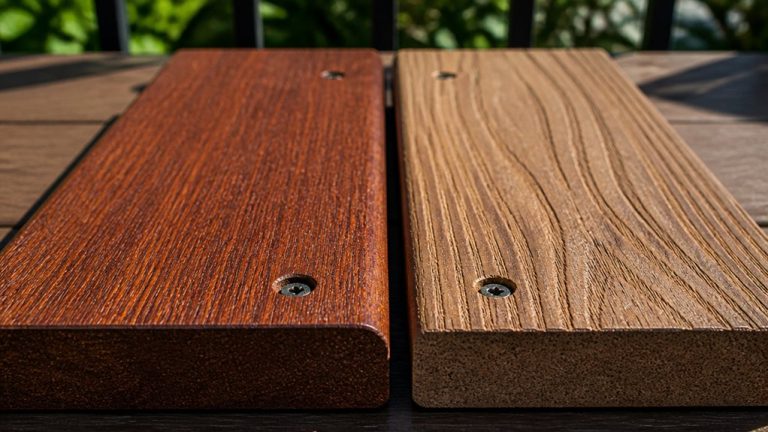

Teak Oil vs Tung Oil: Which Finish Is Better?
When choosing between teak oil and tung oil, consider your project’s pace and finish needs.
Teak oil dries faster, forming a semi-hard surface layer with quick scratch resistance but requires frequent maintenance.
Tung oil penetrates deeply, curing slowly inside wood fibers for superior moisture protection and longer-lasting durability.
However, it demands patience and multiple coats over weeks.
Each imparts distinct looks and safety profiles.
If you want a thorough understanding of their differences and applications, keep exploring the details ahead.
Key Takeaways
- Teak oil is a blended product with faster drying, while tung oil is 100% pure and cures slowly inside wood fibers.
- Tung oil provides superior moisture resistance and longer-lasting protection through deep polymerization.
- Teak oil forms a semi-hard surface layer that enhances scratch resistance but requires more frequent maintenance.
- Tung oil preserves wood’s natural color, whereas teak oil imparts a warm amber tone and darkens the grain.
- Teak oil contains synthetic solvents needing ventilation; pure tung oil is nontoxic and safe for food-contact surfaces.
Teak Oil vs Tung Oil: Key Differences at a Glance
| Feature | Teak Oil | Tung Oil |
|---|---|---|
| Composition | Usually a blend of oils, solvents, and resins | Commonly available as 100% pure plant-based oil |
| Drying Time | 5–24 hours per coat, depending on formulation | Around 24–48 hours between coats |
| Full Curing | Generally provides a faster turnaround | Can require several days to weeks for complete curing |
| Wood Penetration | Penetrates wood but also forms a semi-hard surface layer | Penetrates deeply into the wood fibers |
| Moisture Resistance | Provides good everyday protection | Offers stronger long-term moisture resistance |
| Scratch Protection | Surface-forming additives provide good scratch resistance | Protects through deep curing and polymerization |
| Appearance | Adds a warm amber tone and enriches grain | Maintains a more natural-looking wood color |
| Maintenance | Usually requires more frequent reapplication | Typically offers longer maintenance intervals |
| Application Speed | Better suited to projects needing quick completion | Better when slow curing is acceptable |
| Safety Considerations | Solvent-containing formulas require good ventilation | Pure tung oil is plant-based and nontoxic once fully cured |
| Best Suited For | Fast refinishing and rich-looking wood surfaces | Long-term protection and moisture-prone wood projects |
Teak Oil or Tung Oil: What’s the Difference?

How do teak oil and tung oil differ fundamentally in composition and performance?
When you examine teak oil, you find it’s not a single substance but a blend. It often combines linseed oil, tung oil, mineral spirits, and sometimes varnish resins. This mixture varies by brand, making teak oil a commercial term rather than a pure product.
Tung oil, in contrast, is extracted solely from tung tree seeds and is typically labeled 100% pure, plant-based oil. This difference affects drying times: teak oil dries faster, usually within 5 to 24 hours per coat, while tung oil requires 24 to 48 hours or even longer to cure fully.
You’ll notice that teak oil’s blended nature offers quicker application, whereas tung oil’s purity leads to slower, deeper curing.
For optimal results with tung oil, proper surface preparation is essential to ensure deep penetration and a smooth finish.
How Teak and Tung Oil Protect and Enhance Wood?
Understanding the composition and drying characteristics of teak and tung oil sets the stage for examining their protective qualities and aesthetic effects on wood. When you apply these oils, they interact with the wood differently:
- Teak oil forms a semi-hard surface layer thanks to varnish additives. This enhances scratch resistance and imparts a warm amber tone that enriches the grain.
- Tung oil penetrates deeply and cures within the wood fibers. It provides superior moisture resistance while preserving the wood’s natural color and texture.
- Both oils enhance durability, but tung oil’s polymerization creates a longer-lasting, waterproof barrier. Teak oil offers quicker protection that requires more frequent maintenance.
- Applying multiple thin coats and removing excess oil immediately helps control darkening and finish quality when using tung oil.
Drying Times Compared: What It Means for Your Project
Although both teak and tung oil serve as effective wood finishes, their drying times differ markedly, influencing project scheduling and application technique.
Teak and tung oils both finish wood well, but their drying times greatly impact project timing and methods.
Teak oil typically dries within 5 to 12 hours per coat, occasionally up to 24 hours depending on the formulation. This quick drying allows you to apply multiple coats in a single day and finish projects promptly.
In contrast, tung oil requires 24 to 48 hours between coats, with pure tung oil needing up to 7 to 14 days to dry and up to 30 days for full curing. This extended drying time demands patience and careful timing but results in deeper penetration and enhanced protection.
Choose teak oil for faster turnaround; opt for tung oil when your project can accommodate longer curing for superior durability.
Both oils provide lasting care by restoring moisture and protecting wood surfaces, but their differing penetration depth affects how they enhance and preserve hardwood furniture over time.
Maintenance and Longevity of Teak vs Tung Oil Finishes
Since teak oil contains synthetic additives and forms a surface layer that wears down with exposure, you’ll need to reapply it more frequently, typically every 3 to 6 months outdoors, to maintain protection and appearance.
In contrast, tung oil penetrates deeply and cures within the wood fibers, extending maintenance intervals to 1–2 years after full curing.
For upkeep, consider this:
- Teak oil: Reapply every 3–6 months; surface layer can crack or peel.
- Tung oil: Requires fewer reapplications; cures inside wood, enhancing moisture resistance.
- Environmental factors: Sunlight and moisture accelerate wear on both finishes, but tung oil’s natural flexibility reduces damage.
Choosing oils with natural ingredients and protective properties can further extend the lifespan of your hardwood finishes.
Appearance and Safety: What to Expect From Each Oil
When you apply teak oil, expect it to impart a warm amber tone that enriches and slightly darkens the wood grain.
This creates a hand-rubbed appearance that many find visually appealing.
In contrast, tung oil preserves the wood’s original color, curing to a nearly colorless, natural finish.
Regarding safety, teak oil often contains synthetic solvents and additives.
Use it in well-ventilated areas and wear protective gloves to avoid skin irritation or inhalation risks.
Tung oil, especially 100% pure, is plant-based and nontoxic once fully cured.
This makes it safer for food-contact surfaces like cutting boards.
However, both oils require caution during application due to flammability risks of rags or brushes soaked in oil.
Proper disposal and storage are essential to prevent spontaneous combustion.
For long-term maintenance of wooden kitchen surfaces, regular application of food-safe mineral oil combined with natural waxes can help preserve and protect the wood.
Frequently Asked Questions
Can Teak Oil or Tung Oil Be Mixed With Other Finishes?
Yes, you can mix teak oil with other finishes because it’s often a blend containing solvents and varnish resins. This makes it compatible with oils like linseed or tung oil and some urethane additives.
Tung oil, being a pure plant-based oil, can also be blended with drying oils but requires careful ratios to maintain curing properties. Always test small batches for compatibility, as improper mixing may affect drying time, durability, or appearance.
Which Oil Is Better for Restoring Old Wood Furniture?
When reviving old wood furniture, choose tung oil. It’s like a patient healer, penetrating deeply to restore strength and natural beauty over time.
Its slow curing process guarantees thorough protection, sealing moisture out and preserving wood integrity. While teak oil offers quick fixes, tung oil’s durable, food-safe finish bonds with the fibers, reducing frequent maintenance.
You’ll appreciate its nearly colorless sheen that honors the wood’s original character as it breathes new life.
Are There Environmental Concerns With Disposing of Teak or Tung Oil?
Yes, you should handle disposal carefully. Teak oil often contains synthetic solvents and additives, which can be toxic to the environment if poured down drains or soil.
You need to treat leftover teak oil and rags as hazardous waste, following local disposal regulations.
Tung oil, being natural and biodegradable, poses fewer environmental risks but still requires you to avoid large spills and improper disposal.
Oily rags can spontaneously combust if not stored correctly.
Can Either Oil Be Used on Non-Wood Surfaces?
You can apply both oils to non-wood surfaces, but their effectiveness varies.
Teak oil’s solvent and resin blend may adhere to some porous materials like certain composites or bare metal.
However, it lacks strong bonding on plastics or sealed surfaces.
Tung oil, being a penetrating natural oil, generally won’t cure properly on non-porous materials like plastic or metal.
For non-wood, you’ll often need specialized coatings designed for those substrates to guarantee durability and proper finish.
What Tools Are Best for Applying Teak or Tung Oil?
You’ll want to use lint-free cloths or foam brushes for applying both oils, as they allow smooth, even coverage without leaving fibers behind.
For detailed work, a natural-bristle brush helps push the oil into wood pores.
Avoid synthetic brushes that can shed. Rubber gloves protect your skin, and a well-ventilated workspace is essential.
Always apply thin coats, wiping off excess with a clean cloth to prevent sticky residue.
Final Thoughts: Choosing the Right Wood Finish
Choosing between teak oil and tung oil is like picking the right tool for a delicate craft. Each has its precise role.
Teak oil penetrates quickly, offering faster drying times and rich enhancement. Tung oil provides a durable, water-resistant finish that ages beautifully.
Understanding their drying, maintenance, and appearance helps you select the perfect finish for your wood project. This ensures long-lasting protection and stunning results tailored to your specific needs.