How Is a Yard of Mulch Measured for Landscaping?
You measure a yard of mulch by calculating the volume. One cubic yard equals 27 cubic feet based on your garden’s area and desired mulch depth.
First, measure your bed’s square footage. Then decide on mulch depth in inches, typically 2–4 inches.
Use the formula (square footage × depth in inches) ÷ 324 to convert to cubic yards. Knowing how to adjust for irregular shapes and bag sizes guarantees you order just right.
There’s more to mastering precise mulch measurement and ordering.
Key Takeaways
- A yard of mulch is measured as one cubic yard, equal to 27 cubic feet of material regardless of mulch type or density.
- Calculate the area to be mulched by measuring length and width for rectangles, or use π × radius² for circular beds.
- Convert area and desired mulch depth (in inches) to cubic yards using the formula: (Square footage × Depth in inches) ÷ 324.
- For irregular beds, divide the area into simple shapes, calculate each area separately, then sum totals before converting to cubic yards.
- Use a depth gauge to ensure uniform mulch depth and round up cubic yard calculations to avoid shortages during application.
How to Understand What a Yard of Mulch Is?

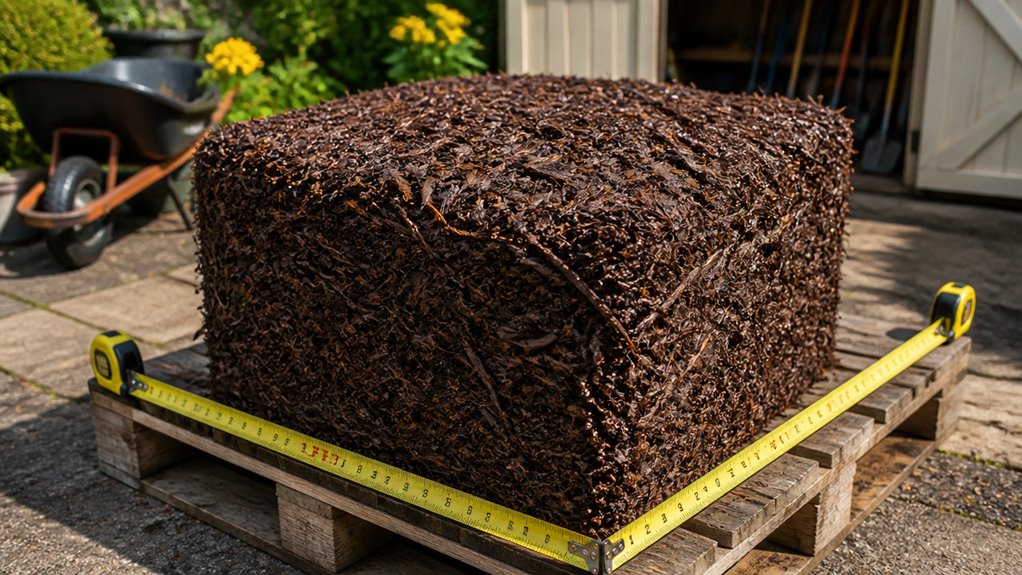
A yard of mulch refers to a cubic yard, which means a volume of material measuring 3 feet long by 3 feet wide by 3 feet tall.
This standard measurement equals 27 cubic feet of mulch, regardless of its type or density.
Unlike linear or square yards, a cubic yard focuses on volume, making it the consistent unit for ordering bulk mulch in landscaping and construction.
When you understand this, you’ll realize that whether you’re dealing with wood chips, bark, or compost, one cubic yard always represents the same amount of space.
This consistency helps you accurately estimate how much mulch you’ll need for your project, ensuring you order neither too little nor too much.
Keep this volume in mind as you plan your landscaping materials.
Note that typically, 1 cubic yard covers approximately 108 sq ft at 3 inches depth, which is useful for estimating coverage in your yard.
How to Measure Your Garden Bed’s Square Footage?
Measuring your garden bed’s square footage is pretty straightforward!
If you’ve got a rectangular or square area, just multiply the length by the width. Easy, right?
Now, if your garden bed is circular, you’ll want to use a different formula.
Just take π (that’s about 3.14) and multiply it by the radius squared.
Getting these measurements right is super important.
It helps you order the right amount of mulch, so you won’t end up with too much or too little. Happy gardening!
Choosing the right mulch material, such as engineered wood fiber, can make a big difference in safety and maintenance for your garden beds.
Measuring Rectangular Beds
Measure the length and width of your rectangular garden bed using a tape measure or yardstick to determine its square footage accurately.
Multiply these two measurements (in feet) to get the total square footage. This value helps you calculate how much mulch you’ll need.
Keep in mind, if you have multiple rectangular beds, measure each and sum the areas.
| Length (ft) | Width (ft) | Square Footage (ft²) |
|---|---|---|
| 5 | 3 | 15 |
| 10 | 4 | 40 |
| 8 | 6 | 48 |
| 12 | 5 | 60 |
| 7 | 7 | 49 |
Accurate square footage ensures you order the right mulch volume without waste or shortage. Applying mulch at the recommended 2–4 inch layer depth maximizes weed suppression and moisture retention.
Calculating Circular Areas
When working with circular garden beds, calculating square footage involves a slightly different approach than rectangular beds.
Instead of multiplying length by width, you’ll use the formula Area = πr², where “r” is the radius, the distance from the center to the edge of your bed.
Measure this radius in feet, square it, then multiply by pi (approximately 3.14).
For example, if the radius is 4 feet, your area is 3.14 × 4² = 50.24 square feet.
This precise measurement helps you determine how much mulch you’ll need.
If you have multiple circular beds, calculate each area separately and add them together for the total square footage before converting to cubic yards for mulch ordering.
Adding layering solutions like soft furnishings and acoustic panels can help reduce sound reflection in your garden shed or outdoor workspace with hardwood or smooth surfaces.
How to Measure Irregularly Shaped Garden Areas?
Breaking irregularly shaped garden areas into smaller, manageable sections helps you calculate their total square footage accurately.
Start by sketching the area and dividing it into familiar shapes like rectangles, triangles, or circles. Measure each section’s dimensions, calculate their individual areas, then sum them for the total square footage.
Use this table to organize your measurements:
| Section | Shape | Area Formula |
|---|---|---|
| 1 | Rectangle | Length × Width |
| 2 | Triangle | ½ × Base × Height |
| 3 | Circle | π × Radius² |
| 4 | Irregular | Sum of all sections |
This method guarantees precise total square footage for mulch estimation without guesswork or waste. For best results, consider layout direction to ensure accurate measurement alignment and visual flow.
How Mulch Depth Affects Coverage and Plant Health?
Although mulch depth may seem like a minor detail, it plays a crucial role in both coverage efficiency and the health of your plants.
Applying mulch at the right depth guarantees you maximize coverage while protecting roots and retaining soil moisture.
Typically, a 2 to 3-inch layer provides sufficient weed suppression and moisture retention.
If you go deeper than 4 inches, you risk smothering plant roots, which can stunt growth or cause decay.
Conversely, mulch layers under 2 inches won’t effectively control weeds or conserve moisture, reducing benefits.
By carefully choosing your mulch depth based on plant needs and garden conditions, you optimize both coverage and plant health.
This makes your landscaping efforts more successful and sustainable.
Additionally, maintaining a gap around plant stems when applying mulch helps prevent stem decay and promotes healthy root growth.
How to Convert Square Feet and Depth Into Cubic Yards?
Calculating cubic yards from your garden bed’s square footage and desired mulch depth guarantees you order the right amount of mulch without waste or shortage.
To convert these measurements accurately, follow these steps:
- Multiply your garden bed’s length by its width to find the square footage.
- Decide on the mulch depth in inches based on your plant needs.
- Use the formula: (Square footage × Depth in inches) ÷ 324 = Cubic yards needed.
- Round up the result to the nearest half or whole yard to ensure full coverage.
This method lets you convert two-dimensional measurements into the three-dimensional volume mulch suppliers use.
It helps you purchase exactly what your garden requires.
When choosing materials for outdoor projects like mulch beds, consider durability and environmental conditions to ensure long-lasting results.
Calculating Mulch Needs for Multiple Garden Beds
Once you’ve calculated the cubic yards needed for one garden bed, applying the same method to multiple beds guarantees you order the right total amount of mulch.
Measure each bed’s length and width, calculate its square footage, then factor in the desired mulch depth in inches.
Use the formula (Square footage × Depth ÷ 324) for each bed to find individual cubic yard needs. Add these values together to get the total cubic yards required.
Remember to round up to avoid running short. This approach works for beds of any shape; just break irregular beds into smaller sections before summing.
Proper planning and measurement help prevent localized stress on garden beds, ensuring long-lasting mulch coverage and soil protection.
How Mulch Bag Sizes Affect Quantity Needed?
When you break down your mulch needs into bags, the size of each bag directly impacts how many you’ll have to buy. Bag sizes vary, so knowing the volume each holds helps you order efficiently without excess or shortage. Here’s what to take into account:
Understanding bag sizes ensures you buy the right amount of mulch without waste or shortage.
- A standard 2 cubic foot bag means you’ll need about 13.5 bags to equal one cubic yard of mulch.
- If using 1.5 cubic foot bags, expect to buy around 18 bags per cubic yard.
- For larger 3 cubic foot bags, only 9 bags cover one cubic yard.
- Always verify the bag size with your supplier before ordering to avoid miscalculations.
Additionally, understanding the importance of moisture barriers can help protect your mulch and underlying soil from excess dampness, extending the longevity of your landscaping project.
The Benefits of Rounding Up Your Mulch Volume Estimate
Although you might’ve a precise mulch volume calculation, rounding up guarantees you won’t run short during application.
Mulch settles and compacts once spread, so ordering exactly what you calculated can leave you with less coverage than intended.
By rounding up to the nearest whole or half cubic yard, you ensure consistent depth and full coverage across your garden beds.
This approach also accounts for slight measurement errors, irregular bed shapes, and variations in mulch density.
Plus, having extra mulch on hand lets you make last-minute adjustments without delay.
Ultimately, rounding up prevents multiple trips to the supplier and avoids disrupting your landscaping schedule.
It’s a practical, cost-effective strategy that safeguards your project’s success with minimal waste.
For projects requiring precision and consistency, using tools with digital readout technology can help ensure accurate measurements and adjustments.
Tips for Ordering the Correct Mulch Quantity From Suppliers
Because accurate measurements are essential, you should verify your total cubic yard requirement before placing an order with your mulch supplier.
Accurate measurements are crucial; always double-check your total cubic yard needs before ordering mulch.
To order correctly, follow these tips:
- Confirm your calculated cubic yards, rounding up to avoid shortages.
- Check with the supplier about mulch type and bulk packaging options.
- Ask about delivery methods and minimum order quantities to prevent surprises.
- Factor in any extra mulch needed for settling or future touch-ups.
Essential Tools for Accurate Mulch Measurement
To get the most accurate measurements for your garden beds, you’ll want to grab a reliable measuring tape. It’s super handy for figuring out the precise length and width.
Now, while you’re at it, don’t forget to use a depth gauge! This little tool is key for keeping your mulch thickness just right, and that’s crucial for calculating volume accurately.
When you combine these tools, you can be confident that you’re measuring both area and depth correctly. This way, you’ll order just the right amount of mulch without any guesswork!
Measuring Tape Accuracy
When measuring your garden beds for mulch, using an accurate measuring tape is essential to avoid ordering too much or too little material. A precise tape guarantees your length and width measurements reflect the actual area, preventing costly errors.
Here’s how to maintain measuring tape accuracy:
- Choose a tape with clear, easy-to-read markings in feet and inches.
- Regularly check for wear or stretching, which can distort measurements.
- Use a rigid or locking tape to keep it straight and minimize sagging.
- Measure from the end hook properly, guaranteeing it’s flush against surfaces to avoid gaps.
Calculating Area Precisely
Accurate measurements from your tape set the stage for precise area calculations, which directly impact how much mulch you’ll need.
Start by measuring the length and width of rectangular or square beds, then multiply them to find the square footage.
For circular beds, measure the radius and apply the formula πr².
If your garden bed has irregular shapes, break it down into smaller, manageable sections. Calculate each area separately and sum them up.
For multiple beds, add every individual area to get your total square footage.
This precision guarantees you calculate the mulch volume correctly, avoiding waste or shortage.
Having the exact area measurement makes converting to cubic yards straightforward. This helps you order just the right amount of mulch for your project.
Depth Gauge Usage
Use a depth gauge to guarantee your mulch layer meets your planned thickness exactly. This essential tool assures uniform coverage, helping you avoid over- or under-application that can affect plant health and material costs.
Here’s how to use it effectively:
- Insert the depth gauge vertically into the mulch at various points.
- Read the measurement where the mulch surface meets the gauge.
- Adjust mulch depth by adding or removing material to reach your target thickness.
- Repeat measurements across the bed to confirm consistent depth.
Frequently Asked Questions
What Types of Mulch Are Best for Different Garden Plants?
You’ll want hardwood mulch for trees and shrubs because it breaks down slowly, enriching soil.
Pine bark works great for acid-loving plants like azaleas or blueberries.
Straw or hay suits vegetable gardens, adding nutrients without compacting soil.
Cocoa hull mulch smells nice and looks attractive, perfect for flower beds.
Just avoid dyed mulches on edible plants since chemicals can leach.
Choose mulch based on plant needs and soil improvement goals.
How Long Does Mulch Typically Last Before Needing Replacement?
Mulch acts like a cozy blanket for your garden, usually lasting about one to three years before needing replacement.
Its lifespan depends on the type. Organic mulches like bark or wood chips break down faster, enriching soil but requiring more frequent refreshes.
Inorganic mulches last longer but don’t improve soil. You’ll want to check yearly; if it’s thinning or decomposing, it’s time to top it up to keep your plants protected and thriving.
Can Mulch Improve Soil Quality or Just Cover the Surface?
Mulch does more than just cover your soil’s surface. It actively improves soil quality.
As it breaks down, mulch adds organic matter, boosting nutrient content and encouraging beneficial microbial activity.
It also helps retain moisture and regulate soil temperature, creating a healthier environment for plant roots.
Are There Environmental Impacts of Using Certain Mulch Materials?
Think of mulch as nature’s blanket. While it protects, some fabrics harm the earth beneath.
Using certain mulches, like rubber or dyed wood, can release toxins, disrupt soil health, and harm nearby wildlife.
You should choose organic options like bark or composted leaves, which enrich soil and support ecosystems.
Always consider the source and biodegradability of mulch to minimize negative environmental impacts and promote a healthier garden.
How Should Mulch Be Stored if Not Used Immediately?
If you’re not using mulch immediately, store it in a dry, shaded area to prevent moisture buildup and mold growth.
Keep it covered with a tarp or breathable fabric to protect it from rain while allowing airflow.
Avoid placing mulch directly on concrete or asphalt to reduce moisture retention.
Proper storage keeps mulch fresh, maintains its texture, and prevents nutrient loss, so it’s ready when you need it for your garden or landscaping projects.
Plan Your Garden Mulch With Better Accuracy
Understanding how a yard of mulch is measured helps you avoid costly mistakes and ensures your garden thrives.
While some think estimating mulch volume is guesswork, it’s actually straightforward when you measure your space and depth accurately.
By converting square footage and depth into cubic yards, you get a precise amount.
Remember, rounding up is smart to cover settling.
Use the right tools, and you’ll order just what your garden needs—no waste, no shortage.