Douglas Fir vs Pine: Which Wood Is Better?
If you need strong, stiff wood for structural projects, Douglas fir outperforms pine with higher density, superior hardness, and better dimensional stability.
It holds fasteners well and resists warping, making it ideal for beams and framing.
Pine, being softer and lighter, is easier to work by hand and fits budget-friendly, decorative, or non-structural uses.
Understanding these differences guarantees you select the right material for strength, appearance, and cost.
Plus, there’s more on how their properties impact application choices.
Key Takeaways
- Douglas fir is stronger, denser, and stiffer than pine, making it better for structural and load-bearing applications.
- Pine is softer, lighter, and easier to work with hand tools, suitable for decorative and non-structural projects.
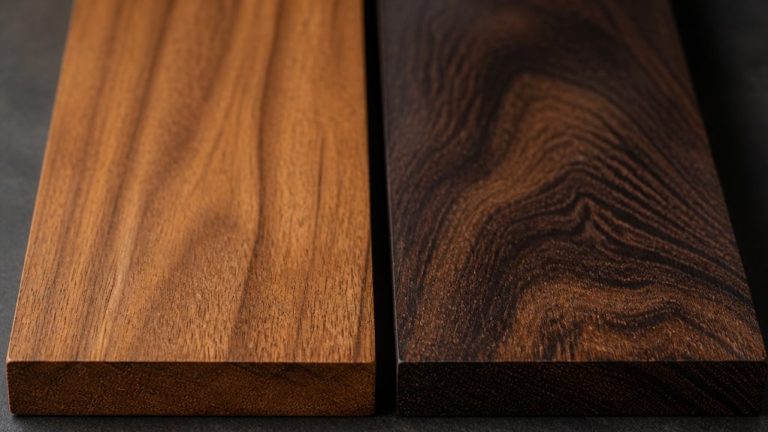
- Douglas fir has a reddish-tan to orange-red heartwood with straight grain, while pine is lighter with more knots and character.
- Douglas fir offers greater durability, better fastener holding, and less warping compared to pine.
- Pine’s knotty appearance enhances rustic aesthetics but requires careful finishing to handle uneven stain absorption.
Douglas Fir vs Pine: Key Differences in Strength, Durability, and Workability
| Comparison Factors | Douglas Fir | Pine |
|---|---|---|
| Wood Classification | Softwood from the Pseudotsuga genus | Softwood from the Pinus genus |
| Typical Density | 32–35 lb/ft³ | Approximately 25 lb/ft³ for Eastern white pine |
| Janka Hardness | Approximately 620–660 lbf | Approximately 380–420 lbf for Eastern white pine |
| Structural Strength | High strength and stiffness | Varies by species, generally lower for softer pines |
| Grain Pattern | Straight, pronounced grain | Variable grain with visible knots |
| Natural Color | Reddish-tan to orange-red | Light cream, pale yellow, or light brown |
| Workability | Machines well, but harder to cut with hand tools | Easier to cut, shape, and carve |
| Fastener Holding | Strong screw and nail retention | Moderate holding strength, depending on species |
| Dent Resistance | Greater surface hardness | More susceptible to dents in softer species |
| Dimensional Stability | Good stability when properly dried | May experience warping or twisting if improperly dried |
| Moisture and Decay Resistance | Moderate natural durability, depending on heartwood and exposure | Variable durability; many types benefit from protective treatment |
| Staining and Finishing | Pronounced grain; may require careful staining | Rustic appearance; knots and uneven absorption may need preparation |
| Common Applications | Structural beams, joists, framing, and exposed timber | Interior trim, cabinetry, shelving, and decorative woodworking |
| Availability | Region-dependent lumber availability | Widely available in many markets |
| Overall Recommendation | Best for demanding structural applications | Best for decorative projects and easier hand-tool work |
What Is Douglas Fir Wood and How Does It Differ From Pine?

Douglas fir wood comes from the Pseudotsuga genus, which sets it apart from pine species that belong to the Pinus genus.
While both are softwoods, Douglas fir isn’t a true fir, pine, or spruce but occupies its own distinct botanical category.
You should avoid confusing Douglas fir with pine, even though some historical names like Oregon pine suggest otherwise.
Pine species belong to a separate group with different anatomical and growth characteristics.
When you work with Douglas fir, you’re handling lumber commonly marketed as softwood, but it has unique traits distinct from pine’s softer texture and structure.
Understanding this botanical separation helps you make informed decisions about material properties and applications.
These woods come from fundamentally different tree groups despite superficial similarities.
For finishing pine, it is important to select the appropriate finish type to ensure durability and enhance its natural grain.
Why Is Douglas Fir Wood Stronger and Stiffer Than Pine?
Douglas-fir is known for being stronger and stiffer than pine, and that really comes down to its unique botanical classification. You see, it doesn’t belong to the true pine genus, which already sets it apart.
One of the key reasons for its superior performance is its higher density and hardness. This means that when it comes to structural integrity and load-bearing capacity, Douglas-fir really shines. Its higher modulus of elasticity contributes significantly to its stiffness and resistance to deformation compared to pine.
Botanical Differences Impact Strength
Because it belongs to a distinct genus, Pseudotsuga, Douglas-fir’s wood structure differs fundamentally from that of pine species in the Pinus genus. This results in superior strength and stiffness.
You’ll find Douglas-fir’s cellular arrangement features thicker cell walls and a more uniform grain pattern, enhancing its load-bearing capacity. Its tracheids are longer and have a higher microfibril angle, contributing to greater rigidity.
In contrast, pine species tend to have more resin canals and a less dense fiber network, which reduces their overall stiffness.
When you select Douglas-fir lumber for structural applications, you benefit from these botanical distinctions that translate to improved mechanical properties. This makes Douglas-fir more suitable for heavy framing and load-critical projects compared to typical pine species.
Additionally, Douglas-fir’s classification as a softwood with long tracheids contributes to its characteristic lighter, more uniform grain and relatively faster growth compared to hardwoods.
Density and Hardness Comparison
The superior mechanical properties of Douglas-fir stem largely from its higher density and hardness compared to pine.
You’ll find Douglas-fir’s density around 32 to 35 lb/ft³ at 12% moisture, while pine’s density is closer to 25 lb/ft³.
This difference means Douglas-fir resists dents and holds fasteners better. Its Janka hardness rating reaches 620 to 660 lbf, markedly tougher than pine’s 380 to 420 lbf range.
These factors contribute to Douglas-fir’s strength and stiffness, making it a preferred choice where durability matters.
Additionally, Douglas fir’s denser grain and firmer texture translate to superior stiffness, toughness, and bending resistance, making it ideal for structural applications.
| Property | Douglas-fir | Pine |
|---|---|---|
| Density (lb/ft³) | 32 – 35 | ~25 |
| Specific Gravity | 0.43 – 0.46 | Lower |
| Janka Hardness (lbf) | 620 – 660 | 380 – 420 |
| Dent Resistance | High | Moderate |
Structural Performance Advantages
Douglas-fir outperforms pine in structural applications due to its superior strength-to-weight ratio and stiffness. When you select Douglas-fir, you benefit from its higher density, typically 32 to 35 lb/ft³ compared to pine’s lighter 25 lb/ft³.
This results in greater compression strength and rigidity. Increased density translates to enhanced load-bearing capacity and reduced deflection under stress, critical for heavy timber framing. Additionally, Douglas-fir’s straight grain pattern supports cleaner fastening and predictable performance, minimizing warping or twisting risks common in pine.
While pine suits light framing, Douglas-fir’s mechanical properties make it the preferred choice for demanding structural uses where strength, stiffness, and dimensional stability are paramount. You’ll find Douglas-fir consistently delivers superior performance in beams, joists, and other critical load-bearing components. Proper maintenance and protection from environmental factors also help preserve Douglas-fir’s dimensional stability over time.
Comparing Density and Hardness of Douglas Fir and Pine Wood
When comparing the density and hardness of Douglas fir and pine wood, you’ll find noticeable differences that impact their performance and applications.
Douglas fir has a density around 32 to 35 lb/ft³ at 12% moisture content, with a specific gravity near 0.43 to 0.46. This makes it markedly denser than common pine species such as Eastern white pine, which averages about 25 lb/ft³.
This higher density corresponds to greater hardness; Douglas fir’s Janka hardness ranges from 620 to 660 lbf, whereas white pine typically measures 380 to 420 lbf.
The increased hardness and density mean Douglas fir resists dents better and holds fasteners more securely. This enhances its suitability for structural uses where durability and strength are critical.
In contrast, pine’s lower density and hardness make it more prone to surface damage under heavy use.
Moisture content also plays a crucial role in maintaining the hardness and appearance of these woods, affecting their longevity and performance.
Workability Differences Between Douglas Fir and Pine Wood
Understanding how Douglas fir and pine respond to cutting, shaping, and fastening is essential for selecting the right wood for your project.
Douglas fir is harder to hand-tool due to its higher density but machines cleanly and holds fasteners securely, thanks to its straight grain.
When fastening Douglas fir, predrilling is often necessary to prevent splitting, especially near edges.
Pine, being softer and less dense, cuts and shapes more easily by hand, making it ideal for detailed work or quick adjustments.
However, pine is more prone to twisting, cupping, and warping if installed green or improperly dried.
While pine fasteners may require less effort to insert, they don’t hold as firmly as in Douglas fir.
Your choice hinges on balancing ease of work with structural reliability.
Additionally, proper moisture control is crucial for both woods to enhance their durability and prevent warping or splitting.
How Douglas Fir and Pine Wood Look and Finish in Projects?
You know, Douglas fir really stands out with its reddish-tan to orange-red heartwood and that lovely straight grain. It’s quite striking, don’t you think? On the other hand, pine has a lighter color and those noticeable knots, which give it a unique charm.
When it comes to staining, Douglas fir can be a bit tricky. It tends to absorb unevenly, so you’ll want to take your time with preparation to make sure you get a nice, uniform finish. Pine, with its knotty character, is perfect for a rustic look, but keep in mind that those knots might affect how the stain goes on.
Douglas fir’s grain characteristics influence how finishes penetrate, so proper surface preparation is key for the best results.
Color And Grain
A key consideration in choosing between Douglas fir and pine for your project is their distinct color and grain characteristics, which influence both appearance and finishing options.
Douglas fir typically displays a reddish-tan to orange-red heartwood with a straight, pronounced grain, offering a cleaner, more uniform look. In contrast, pine features a lighter color palette with more visible knots and character marks, creating a rustic aesthetic.
Consider these points when evaluating color and grain:
- Douglas fir’s straight grain supports structural clarity and precision.
- Pine’s knotty grain adds natural character but can disrupt uniform finishes.
- Douglas fir’s heartwood color ranges from reddish to orange tones.
- Pine’s lighter sapwood and heartwood vary, often with more color inconsistency.
Understanding these traits helps you select the wood that best suits your project’s visual and functional needs. Additionally, the grain patterns of each wood species significantly influence finishing techniques and the overall visual impact of the final product.
Staining And Appearance
Often, the choice between Douglas fir and pine hinges on how each wood accepts stains and finishes, which directly impacts the final appearance of your project.
Douglas fir features a reddish-tan to orange-red heartwood with a pronounced straight grain. However, it may absorb stains unevenly, requiring careful application for a consistent finish.
Pine, lighter in color with more visible knots and character marks, generally accepts stain more uniformly. Its pronounced knots can affect the final look.
When finished, Douglas fir offers a cleaner, more structural aesthetic, ideal for exposed beams and framing. Pine’s knotty texture suits rustic or decorative projects.
Understanding these differences helps you select the wood that best complements your design intent and finishing requirements. Pine’s open grain and knot presence influence stain absorption and final appearance, making it important to consider for your project’s desired style.
Durability Comparison: Which Lasts Longer, Douglas Fir or Pine?
When evaluating wood for long-term projects, understanding the durability differences between Douglas fir and pine is essential. Douglas fir offers moderately better durability than most pine species, mainly due to its heartwood’s enhanced decay resistance and density.
Untreated pine tends to have lower resistance to rot and insects, which may reduce its lifespan in exterior or high-moisture environments. Consider these key factors:
- Douglas fir’s heartwood resists decay better than pine’s generally low durability.
- Pine is more prone to warping and splitting when exposed to moisture.
- Douglas fir’s higher density improves its resistance to physical wear and fastening failures.
- Pine’s lower cost often reflects its shorter service life without protective treatments.
Choosing Douglas fir means greater longevity, especially in structural or outdoor applications where durability is critical.
Common Uses for Douglas Fir and Pine Wood
Understanding the durability differences between Douglas fir and pine helps clarify why each wood finds distinct applications.
You’ll find Douglas fir favored for structural uses such as beams, heavy timber framing, flooring, decking, and cladding due to its superior strength, stiffness, and moderate decay resistance.
Its straight grain and density guarantee reliable load-bearing capacity and fastener retention.
Pine, being softer and less durable, suits interior trim, light framing, and general-purpose woodworking where high structural demands are absent.
Its knotty character enhances rustic or decorative aesthetics, making it ideal for cabinetry and budget-conscious projects.
When choosing between them, consider Douglas fir for applications requiring strength and longevity.
Pine works well for decorative or non-structural uses where cost-efficiency and ease of workability are priorities.
How Cost and Availability Influence Choosing Douglas Fir or Pine Wood?
Because cost and availability directly impact project feasibility, they play a crucial role in selecting between Douglas fir and pine wood.
You’ll find pine typically costs less and is more readily available, making it appealing for budget-conscious or general-purpose projects.
Douglas fir, while pricier, offers superior strength and straightness, justifying its cost in demanding applications.
Consider these key factors when choosing:
- Pine’s lower price suits non-structural, decorative, or interior uses.
- Douglas fir’s higher cost aligns with structural needs requiring durability and stiffness.
- Pine is widely stocked, guaranteeing quick procurement in many regions.
- Douglas fir availability can fluctuate regionally, possibly affecting lead times and budgets.
Balancing these factors ensures you pick the right wood without compromising project goals.
When to Choose Douglas Fir Wood for Structural Projects?
You should really consider Douglas fir for your structural projects, especially when strength and durability are top priorities.
It’s known for its superior stiffness and load-bearing capacity, which definitely outshines most pines.
Plus, its straight grain is a game changer! It enhances fastening reliability and provides excellent dimensional stability, making it perfect for heavy timber framing.
Just a heads up, though—while it’s a great choice, you’ll want to predrill to avoid any splitting.
But don’t let that deter you! The workability of Douglas fir makes it easy to handle, ensuring you can achieve precise and long-lasting structural applications.
Strength and Durability
When selecting wood for structural projects, Douglas-fir stands out for its superior strength and durability compared to many pine species.
You’ll find Douglas-fir excels because of its higher density, stiffness, and resistance to wear, making it ideal for load-bearing applications.
Consider these key points when choosing Douglas-fir:
- Douglas-fir has a density around 32-35 lb/ft³, markedly higher than pine, enhancing its durability.
- Its strength-to-weight ratio ranks among the best of North American softwoods, outperforming pine in compression and bending.
- Douglas-fir resists dents and holds fasteners securely, critical for structural integrity.
- The wood’s moderate decay resistance surpasses untreated pine, improving longevity in exposed conditions.
These factors make Douglas-fir your go-to for demanding structural uses where strength and durability matter most.
Structural Workability
Selecting Douglas-fir for structural projects hinges on its exceptional workability combined with strength. You’ll find Douglas-fir machines well, holds fasteners securely, and features a straight grain that supports predictable structural performance.
While it’s harder to hand-tool than pine, its density and stiffness make it ideal for heavy timber framing and load-bearing applications. You should predrill holes to prevent splitting when fastening, especially in high-stress areas.
Unlike pine, which can twist or warp as it dries, Douglas-fir maintains dimensional stability, reducing installation issues. Choose Douglas-fir when your project demands strong, straight, and reliable lumber that can withstand structural loads and provide long-term durability.
Its balance of workability and mechanical properties makes it superior to most pine species for structural use.
When Pine Wood Is Better for Budget and Decorative Uses?
Many budget-conscious projects benefit from pine wood’s affordability and ease of use. This makes it a preferred choice for decorative and general-purpose applications.
Pine wood’s affordability and ease make it ideal for budget-friendly decorative and general-purpose projects.
You’ll find pine advantageous when cost reduction and workability are priorities over structural strength. Consider these key points:
- Pine is markedly cheaper and more readily available than Douglas-fir, reducing material expenses.
- Its softer texture allows easier cutting, shaping, and hand-tool work for intricate decorative designs.
- Pine’s natural knots and lighter color palette enhance rustic or character-driven aesthetics.
- For non-structural interior trim, shelving, and cabinetry, pine provides sufficient durability without the cost premium of Douglas-fir.
Choosing pine lets you optimize budget and achieve desired decorative effects while maintaining functional integrity in light-use scenarios.
Frequently Asked Questions
Can Douglas Fir and Pine Wood Be Mixed in the Same Construction Project?
Yes, you can mix Douglas-fir and pine in the same construction project, but you need to take into account their differences.
Douglas-fir offers superior strength and stiffness, making it ideal for structural elements.
Pine suits non-structural or decorative parts.
Be mindful of fastening techniques since Douglas-fir is harder and may require predrilling.
Also, account for their varying densities and drying behaviors to avoid warping or splitting in your build.
How Do Douglas Fir and Pine Wood React to Outdoor Weather Conditions?
Imagine your wood facing relentless rain and sun.
Douglas-fir’s moderately durable heartwood resists decay and insects better than untreated pine, standing up to moisture and weathering with less warping.
Pine, softer and less rot-resistant, can swell, twist, or decay faster outdoors unless treated.
To keep your outdoor project durable, you’ll want to seal pine thoroughly or opt for Douglas-fir, which naturally fares better against outdoor conditions.
What Are the Environmental Impacts of Harvesting Douglas Fir Versus Pine?
You’ll find that harvesting Douglas fir often involves managing mature, slower-growing forests. This can impact biodiversity more markedly than pine harvesting.
Pine species grow faster and are commonly sourced from plantations, allowing for more sustainable, renewable yields. However, both require responsible forestry practices to minimize soil erosion, habitat loss, and carbon release.
You should prioritize certified wood to guarantee reduced environmental impacts. This supports sustainable forest management regardless of species.
Are There Specific Pests That Prefer Douglas Fir or Pine Wood?
Like moths to a flame, certain pests target specific woods.
You’ll find Douglas-fir vulnerable to Douglas-fir beetles and fir engraver beetles, which bore into its heartwood.
Pine attracts pine beetles, Ips bark beetles, and pine weevils.
These insects prefer pine’s resin-rich sapwood, making it more susceptible.
Knowing these pest preferences helps you choose and treat wood properly.
This ensures durability and minimizes infestation risks in your projects.
How Do Douglas Fir and Pine Woods Compare in Terms of Fire Resistance?
You’ll find Douglas-fir generally offers better fire resistance than pine due to its higher density and tighter grain structure. This characteristic slows ignition and flame spread.
Pine’s softer, less dense wood ignites more quickly and burns faster. While neither is fireproof, Douglas-fir’s strength-to-weight ratio and slower combustion make it a preferred choice for structural applications where fire safety is a concern.
Always consider treatment and local codes for enhanced protection.
Douglas Fir vs Pine: Making the Right Choice
Choosing between Douglas fir and pine is like selecting the right foundation for your work.
Douglas fir stands as a sturdy pillar, perfect for strength and structure.
Pine offers a lighter, more flexible canvas for creativity and budget-friendly projects.
Understanding their unique properties guarantees your project’s success.
This knowledge lets you build with confidence, whether you need resilience or refinement.
Make your choice wisely, and your wood will become the backbone of lasting craftsmanship.