Best Way to Cut Tree Roots Without Tree Damage
To cut tree roots properly, first locate and confirm which roots need trimming, avoiding damage closer than three times the trunk diameter to preserve stability.
Use sharp, sterilized tools to make clean, angled cuts after carefully exposing roots with gentle hand tools. Never use heavy machinery.
Limit removal to under 25% of the root system and promptly backfill with original soil plus mulch to protect roots.
Monitoring afterward is key for tree health. Exploring proper timing, techniques, and post-care guarantees the best outcomes.
Key Takeaways
- Avoid cutting roots closer than three times the trunk diameter to preserve critical structural support and prevent tree instability.
- Use sharp, sterilized pruning tools to make clean, angled cuts that promote faster healing and minimize infection risk.
- Perform root cutting during late winter or early spring dormancy to reduce metabolic stress and enhance recovery.
- Carefully expose only targeted roots with hand tools or gentle excavation, avoiding heavy machinery that can cause additional damage.
- Promptly backfill exposed roots with original soil and apply organic mulch, then monitor the tree for stress signs over several months.
Why Avoiding Root Damage Matters for Tree Stability?

When you damage a tree’s roots, you directly compromise its structural stability and overall health.
Damaging a tree’s roots undermines its stability and vital health from the ground up.
Roots anchor the tree firmly in the soil, distributing mechanical stress and providing essential water and nutrients.
Cutting or injuring roots reduces the tree’s ability to absorb resources, weakening its resilience to environmental stressors.
Damage close to the trunk is especially harmful because structural roots are thicker and critical for support.
Even minor root injury can lead to decay or disease entry points, accelerating decline.
Additionally, excessive root removal disrupts the root-to-shoot balance, impairing growth and increasing the risk of toppling during storms.
To maintain stability, minimize root damage by avoiding unnecessary cuts and ensuring any pruning is carefully planned and executed using proper techniques.
Excess moisture around roots can exacerbate damage by promoting wood fiber swelling and weakening structural integrity, so controlling moisture sources near trees is essential.
How to Assess Tree Roots Before Cutting?
Before you think about cutting, it’s really important to take a good look at where the roots are located. You want to pinpoint which roots are actually involved in your project. A handy tip is to look at the tree’s trunk diameter. From there, aim to keep a safe cutting distance—usually about three times that diameter.
This approach isn’t just a precaution; it helps protect the tree’s stability and overall health. By steering clear of those critical structural roots, you can minimize any potential damage. So, take your time and assess carefully before making any cuts! Also, be mindful that excessive root damage can lead to structural integrity issues similar to those caused by warped hardwood floors in buildings.
Evaluate Root Location
Although cutting tree roots can sometimes be necessary, you should carefully evaluate their location to avoid compromising the tree’s stability and health.
Begin by identifying the roots involved, ensuring you confirm the necessity of cutting. Use the tree’s trunk diameter as a reference to estimate the proximity of roots; larger trees require a wider buffer.
Check for underground utilities, irrigation lines, and nearby structures to prevent damage. Expose only the roots you intend to cut, using careful excavation methods to avoid unnecessary injury.
Avoid heavy machinery that can crush roots indiscriminately. By accurately locating roots and gauging their importance in structural support, you minimize risks of instability and decline.
This ensures the tree’s longevity and health after root pruning. Proper evaluation and care during root cutting can also help maintain the structural integrity of surrounding features.
Determine Safe Distance
To determine a safe distance for cutting tree roots, start by measuring the trunk diameter as your primary reference. This measurement helps you estimate how far from the trunk you can prune without jeopardizing tree stability.
Generally, cutting roots closer than three times the trunk diameter increases risk. A more conservative approach uses five to six times the diameter.
Larger, mature trees require a wider buffer zone to maintain structural integrity. Roots nearer the trunk are critical for support and should be preserved whenever possible.
Verify underground utilities and irrigation lines before digging to avoid damage. Maintaining proper soil moisture and environmental conditions around roots is essential to prevent root stress that can compromise tree health after cutting.
When Is the Right Time to Cut Tree Roots?
Timing your root cutting is vital because it directly affects the tree’s ability to recover and maintain stability.
The best time to prune roots is during late winter or early spring, when the tree is dormant. In this phase, metabolic activity slows, reducing stress and promoting faster healing.
Prune roots in late winter or early spring when dormancy reduces stress and enhances healing.
Avoid cutting roots during active growth periods or extreme heat, as it increases the risk of infection and delays recovery.
Before cutting, assess root location, size, and necessity. Confirm that no nearby utilities or irrigation lines will be disrupted.
Use sterilized tools to minimize disease risk. By choosing the dormant season, you give the tree a better chance to compartmentalize wounds and maintain structural integrity through the growing season.
Additionally, wearing protective gear such as gloves and goggles can help prevent exposure to soil contaminants and airborne spores during root cutting, ensuring safe handling practices.
How to Measure Safe Cutting Distance From the Trunk?
To figure out how far to cut from the tree trunk, you’ll first want to measure the trunk diameter. A good rule of thumb is to steer clear of cutting roots that are closer than three times the trunk diameter.
Now, keep in mind that larger trees often need even more distance to stay stable. Following these guidelines helps ensure you don’t compromise the tree’s structural integrity. It’s all about keeping the tree healthy while you work!
Additionally, maintaining proper soil health by avoiding disruption near roots helps support soil quality and nutrient cycles.
Trunk Diameter Importance
Understanding the trunk diameter is crucial when determining a safe cutting distance for tree roots. It directly influences the buffer zone you need to maintain.
Larger trunk diameters indicate more extensive root systems, requiring greater care to avoid compromising stability. To measure accurately, you first determine the trunk diameter at breast height (DBH), typically 4.5 feet above ground. This measurement helps you calculate a proportional cutting distance, reducing harm to the tree.
Keep in mind:
- Use the trunk diameter to establish a minimum buffer zone, often three to six times the diameter.
- Larger, mature trees need wider buffers to protect critical structural roots.
- Avoid cutting roots closer than this buffer to prevent stress and decline.
This approach guarantees you maintain tree health while managing root interference safely. Additionally, proper maintenance and avoiding conditions that promote moisture accumulation are essential for preserving root and overall tree health, similar to how moisture management extends the lifespan of wooden structures.
Cutting Distance Guidelines
When determining a safe cutting distance from the trunk, rely on the tree’s diameter as a key reference point.
Measure the trunk diameter at breast height (about 4.5 feet above ground) to establish a consistent baseline.
A standard guideline is to avoid cutting roots closer than three times this diameter.
However, five to six times the diameter offers a more conservative buffer for mature trees.
This distance minimizes damage to critical structural roots that support the tree’s stability.
Before cutting, precisely locate the roots involved and confirm the necessity of pruning.
Remember, the farther you cut from the trunk, the lower the risk of compromising tree health.
Always factor in nearby utilities, irrigation, and structures when planning your cutting distance to avoid unintended damage.
Proper planning and careful execution, similar to the removal of engineered hardwood flooring, can prevent unnecessary damage during root cutting.
Impact On Tree Stability
Since tree roots play a critical role in anchoring and supporting the entire structure, cutting them too close to the trunk can markedly compromise stability.
To measure a safe cutting distance, start by evaluating the trunk diameter, which guides how far from the trunk you should prune.
Generally, cutting no closer than three times the trunk’s diameter is recommended, with more conservative guidelines suggesting five to six times for mature trees.
Avoid cutting roots near the trunk because they provide essential structural support.
Keep these points in mind:
- Use trunk diameter as a reference to determine root cutting distance.
- Maintain at least three times the trunk diameter as a buffer zone.
- Prioritize cutting roots farther from the trunk to minimize structural risk.
This approach helps preserve tree stability and reduces the risk of decline. Proper environmental control during root cutting preparation can further protect tree health and stability.
Best Tools to Gently Expose Tree Roots for Cutting
Exposing tree roots gently requires selecting tools that minimize damage to the root bark and surrounding soil.
Start with a sharp hand trowel or a narrow shovel to carefully remove soil without scraping or tearing the root bark.
You can also use a hand cultivator or digging fork to loosen compacted soil around roots.
Avoid heavy machinery as it risks crushing roots.
For more delicate work, an air excavation tool or water-based soil removal system reduces mechanical stress on roots by gently washing away soil.
Always uncover only the necessary root sections to avoid unnecessary injury.
These precise, low-impact tools help maintain root integrity, promoting better tree health and stability after root cutting.
Maintaining proper moisture levels with moisture meters helps prevent damage during root exposure and cutting.
How to Make Clean Cuts When Cutting Tree Roots?
Achieving clean cuts on tree roots requires using sharp, appropriate tools to prevent tearing or crushing the root tissue. You should select cutting instruments based on root size to guarantee smooth edges and minimize damage.
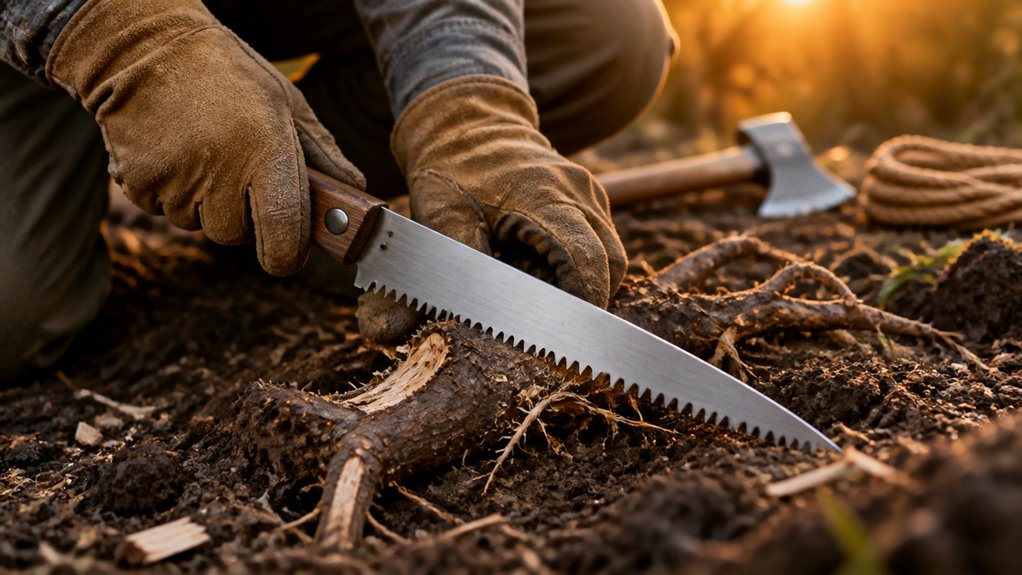
For smaller roots, bypass pruners or loppers work well. Larger roots demand a sharp pruning or root saw for controlled, precise cuts. Avoid jagged or ragged cuts, which can lead to poor healing and increased vulnerability.
Keep these points in mind: Use a single, continuous cut rather than multiple rough passes to reduce tissue trauma. Maintain tool sharpness and sterilize blades to lower infection risk. Position your cut to create a clean, angled edge that promotes faster wound closure.
Following these techniques guarantees healthier recovery and structural integrity.
How Much of the Root System Can You Safely Remove?
Once you’ve made clean, precise cuts on the roots, the next consideration is how much of the root system you can safely remove without compromising the tree’s health.
Avoid removing more than 25% of the root system at once to prevent stress and instability. For mature trees, staged pruning is safer. Also, avoid cutting roots close to the trunk, as these provide critical support.
| Root System Removal | Risk Level |
|---|---|
| Less than 10% | Low risk |
| 10% to 25% | Moderate risk |
| More than 25% | High risk |
| Close to trunk | Very high risk |
| Staged removal | Safer approach |
Keep these limits in mind to maintain tree stability and health.
How to Protect and Cover Roots After Cutting?
Covering the cut roots promptly with soil helps protect them from desiccation and physical damage.
Once you finish cutting, gently backfill the exposed area with the original soil to maintain root moisture and minimize air exposure.
After soil replacement, apply a 2- to 4-inch layer of organic mulch to stabilize temperature and retain moisture.
Avoid piling mulch directly against the trunk to prevent rot.
To protect and cover roots effectively:
Use sterilized tools and clean cuts to reduce disease risk.
Make certain soil is firmly but gently tamped to eliminate air pockets.
Monitor the area regularly for signs of stress or damage.
Following these steps promotes root recovery and tree health after root cutting.
How to Spot Trouble After Root Cutting?
Although root cutting can be necessary, you need to vigilantly watch your tree afterward for early signs of stress or decline.
Monitor the tree for symptoms like wilting leaves, chlorosis (yellowing), or premature leaf drop.
Look for dieback in branches, abnormal leaning, or instability, which may indicate compromised root anchorage.
Inspect the soil surface around the cut area for excessive dryness or fungal growth, as these can signal root damage or infection.
Regularly assess trunk health; cracks or oozing sap may reflect internal stress.
Early detection is critical. Spotting these indicators allows prompt intervention, such as supplemental watering or consulting an arborist.
Maintain routine monitoring for several months post-cutting, since root recovery and stress responses vary by species and environmental conditions.
Frequently Asked Questions
Can Root Cutting Affect Nearby Plants or Lawn Health?
Yes, root cutting can affect nearby plants or lawn health because roots often share resources like water and nutrients.
When you cut roots, you may reduce the tree’s ability to support itself, causing stress that can alter water uptake patterns.
This stress can indirectly affect adjacent plants by changing soil moisture or nutrient availability.
To minimize impact, you should carefully plan cuts, avoid excessive root removal, and monitor the area afterward for signs of decline.
How Does Soil Type Influence Root Cutting Techniques?
When it comes to root cutting, you can’t judge a book by its cover. Soil type plays a vital role.
Sandy soils drain quickly but offer little support, so you’ll need gentler excavation to avoid root damage.
Clay soils hold moisture and compact easily, requiring careful digging to prevent root crushing.
Loamy soils are ideal but still demand precise root exposure techniques.
Adjust your tools and cutting approach based on soil texture to protect tree health effectively.
What Are Signs of Root Disease Unrelated to Cutting?
You’ll notice root disease signs like reduced leaf size, yellowing or wilting foliage, and overall decline in tree vigor.
Roots might appear dark, soft, or rotten when exposed. You could also see fungal fruiting bodies near the base or soil surface.
Trees may lean or exhibit poor growth, even dieback. These symptoms indicate compromised root health unrelated to cutting, signaling the need for thorough inspection and possible intervention.
Can Animals Damage Exposed Roots Before Covering?
You mightn’t realize the risk, but yes, animals can damage exposed roots before you cover them. Rodents, rabbits, and even deer may gnaw or scratch at the vulnerable bark, causing wounds that invite disease.
To protect your tree, cover the roots promptly with soil and mulch. This barrier deters wildlife and reduces stress on the tree, helping it recover quickly and maintain its structural integrity.
Don’t delay this vital step.
Are There Legal Restrictions on Cutting Roots Near Property Lines?
Yes, you often face legal restrictions cutting roots near property lines. Local ordinances and homeowner association rules may limit root pruning to protect neighboring trees and prevent property damage.
You must check municipal codes and consult with neighbors before proceeding. In some areas, cutting roots that extend under a neighbor’s property without permission can lead to liability claims.
Always obtain necessary permits and follow regulations to avoid legal issues.
Cut Roots Carefully to Protect Tree Stability
When you carefully expose roots with the right tools, you’ll see exactly where to cut.
Clean, precise slices keep your tree steady. Imagine the roots as lifelines; every cut matters.
By measuring safe distances and limiting how much you remove, you protect stability beneath the surface.
After cutting, cover and shield those roots like a gardener tucking in seedlings.
Stay vigilant for signs of stress, ensuring your tree thrives long after the work is done.