Maple vs Pine Wood: Which Is Better?
If you want maximum hardness and durability, maple’s superior density (~44 lb/ft³) and Janka hardness (~1,450 lbf) outperform pine’s softer, lighter profile (~25 lb/ft³, ~380 lbf).
Maple offers tighter grain for refined finishes and lasting joinery but demands sharper tools and more effort to machine.
Pine’s rustic knots and easier workability lower your costs and handling effort.
Choosing between them depends on prioritizing strength, appearance, cost, and ease—details you’ll find ahead.
Key Takeaways
- Maple is significantly harder and more durable than pine, making it better for high-traffic or impact-prone applications.
- Pine is lighter and easier to handle, cutting down on labor and tool wear during construction.
- Maple’s tight, uniform grain offers a refined look but requires careful staining to avoid blotching.
- Pine’s open grain with knots gives a rustic appearance and absorbs stains unevenly.
- Maple costs nearly double pine, suiting premium projects, while pine fits budget-conscious or large-scale builds.
Maple vs Pine Wood Comparison: Hardness, Grain, Cost, and Best Uses
| Comparison Point | Maple Wood | Pine Wood | Best Choice |
|---|---|---|---|
| Wood Type | A dense hardwood with strong surface resistance | A softer softwood that is lighter and easier to handle | Depends on project needs |
| Hardness | Much harder, around 1,450 lbf Janka hardness | Softer, around 380 lbf Janka hardness | Maple for dent resistance |
| Density and Weight | Heavier, around 44 lb/ft³ | Lighter, around 25 lb/ft³ | Pine for easy handling |
| Durability | Better for high-traffic and impact-prone areas | Wears faster under repeated impact | Maple for long-term use |
| Grain Pattern | Tight, fine, and more uniform grain | Open grain with visible knots and growth rings | Maple for refined looks |
| Visual Style | Clean, smooth, and polished appearance | Rustic, casual, and natural character | Pine for rustic design |
| Workability | Harder to cut, machine, and sand | Easier to cut, drill, shape, and fasten | Pine for DIY projects |
| Finish Quality | Takes a smooth finish but may need careful staining | Absorbs stain unevenly because of porosity | Maple for premium finishing |
| Cost | Usually more expensive, often nearly double pine | More affordable for large or budget projects | Pine for lower cost |
| Best Uses | Flooring, cabinetry, furniture, and premium interiors | Shelving, trim, rustic furniture, and budget builds | Match to strength and budget |
Maple vs Pine: Which Is Harder and More Durable?

When comparing hardness and durability between maple and pine, you’ll find maple markedly outperforms pine, boasting a Janka hardness rating of about 1,450 lbf versus pine’s approximate 380 lbf.
This substantial difference means maple resists dents and surface impacts far better under heavy use, making it ideal for high-traffic areas.
You’ll notice pine wears down more quickly when subjected to repeated impacts or abrasion.
Maple’s superior hardness directly translates to longer-lasting surfaces, maintaining structural integrity and appearance over time.
In contrast, pine’s softness limits its suitability to lighter-duty applications where dent resistance is less critical.
If durability and resistance to surface damage are priorities, you’ll want to select maple to guarantee longevity and performance under demanding conditions.
Its higher density and stiffness contribute to greater mechanical strength and surface resilience compared to softer woods like pine.
Maple vs Pine: Density and Weight Differences
Although both maple and pine serve various woodworking needs, their density and weight differ markedly, impacting handling and structural performance.
Maple’s density typically measures about 44 lb/ft³, nearly double eastern white pine’s approximate 25 lb/ft³.
Maple’s density averages 44 lb/ft³, almost twice that of eastern white pine’s 25 lb/ft³.
This higher density gives maple a stronger, stiffer feel, making it ideal for applications requiring durability and load-bearing capacity.
Conversely, pine’s lower density reduces weight considerably, simplifying lifting, cutting, and installation, especially in large-scale projects.
Note that pine’s density varies widely among species, ranging roughly from 22 to 53 lb/ft³, while maple maintains a tighter, consistently high-density range.
When choosing between them, consider that maple’s greater weight correlates with enhanced strength.
However, pine’s lightness offers ease of use and transport, influencing your project’s structural demands and workflow efficiency.
Additionally, understanding the impact performance of different woods can further guide your material selection for specific applications.
Maple vs Pine: Grain Patterns and Appearance
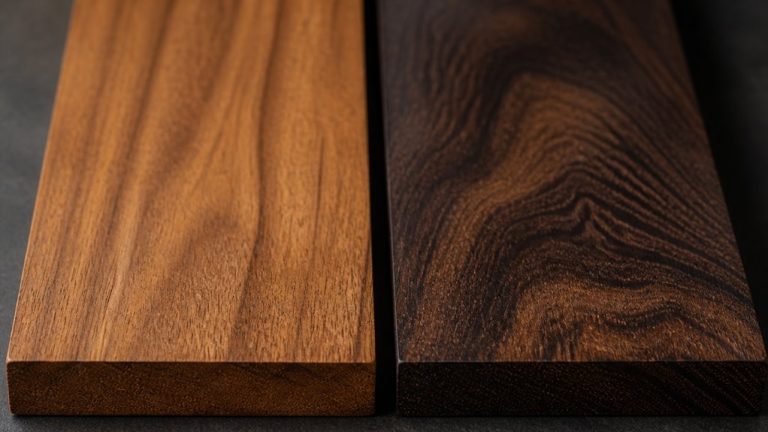
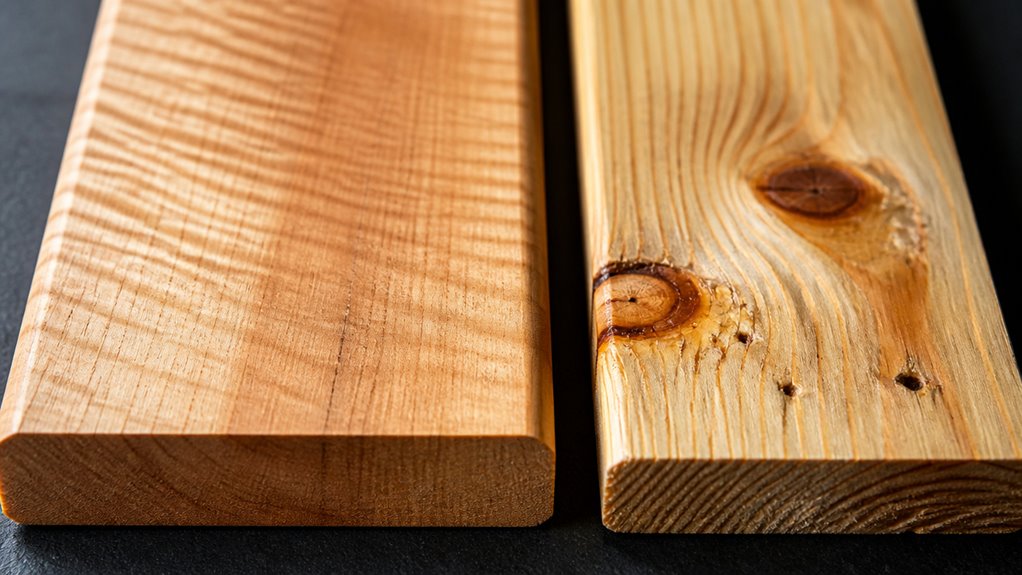
You’ll notice that maple has this tight, fine grain with a smooth, uniform texture. It really gives off a clean, refined look, doesn’t it?
On the other hand, pine is quite different. It showcases more pronounced growth rings and those visible knots, which really create a rustic, casual vibe.
When you think about it, understanding these grain patterns is super helpful. It can seriously guide you in choosing the right wood based on the visual appeal you’re after and the style of your project.
Maple’s fine, tight grain also contributes to its smooth finishes and durability, making it a great choice for refined furniture pieces.
Grain Texture Comparison
Since wood grain greatly influences both aesthetic appeal and finishing techniques, understanding the grain texture differences between maple and pine is essential for selecting the right material.
Maple features a tight, fine, and uniform grain structure, resulting in a smooth surface with minimal visible pores. This dense grain reduces stain absorption variability but demands precise finishing techniques to avoid blotching.
Conversely, pine exhibits a more open grain texture with pronounced growth rings and frequent knots, creating a coarser surface that readily absorbs stains and finishes unevenly. Its softer, porous fibers make pine easier to work with but less consistent in texture.
When choosing between them, consider maple’s refined, uniform grain for sleek projects and pine’s rustic, textured grain for casual or traditional woodworking.
Additionally, the difference in grain pore size between maple and pine significantly impacts how stains and finishes are absorbed and how the final appearance is achieved.
Visual Appeal Differences
When evaluating the visual appeal of maple and pine, you’ll notice that maple’s grain presents a consistently fine, tight pattern with minimal knots. This offers a sleek and polished look ideal for refined interior designs.
Pine, in contrast, displays more pronounced growth rings and frequent knots, lending a rustic and casual aesthetic.
Here’s how these differences manifest:
- Grain Uniformity: Maple’s uniform grain guarantees a smooth, clean surface. Pine’s irregular grain creates texture and character.
- Knot Presence: Pine features visible knots that add visual interest but can disrupt surface continuity. Maple’s knots are rare.
- Finish Quality: Maple’s tight grain demands careful finishing to avoid blotchiness. Pine absorbs stain unevenly due to variable porosity.
- Design Suitability: Choose maple for modern or formal spaces. Pine works well for traditional or rustic interiors.
Understanding these nuances helps you select wood that aligns with your visual goals. Additionally, maple’s higher Janka hardness rating compared to pine makes it more resistant to dents and wear, enhancing its durability in high-traffic areas.
Maple vs Pine: Workability Comparison
Although maple’s hardness can challenge your tools, it excels in holding precise joinery and maintaining sharp edges. This makes it ideal for detailed, high-quality woodworking.
Its dense, tight grain demands sharp blades and slower feed rates to avoid burnishing or tear-out. However, it rewards you with clean cuts and durable joints.
In contrast, pine’s softness allows you to cut, drill, and shape with less effort. This reduces tool wear and minimizes the risk of splitting.
You’ll find pine easier to sand and fasten, making it suitable for quicker or beginner-level projects. However, pine’s softness means it won’t hold fine details or edges as well as maple.
Ultimately, your choice depends on balancing tool demands, project complexity, and desired finish durability.
For sanding harder woods like maple, using a drum sander with a stronger motor can improve efficiency and surface finish quality.
Maple vs Pine Wood Cost Comparison
Because maple offers superior hardness and density, it generally commands a higher price per board foot compared to pine.
When budgeting, you’ll find maple typically costs between $13 and $15 per board foot, while eastern white pine averages under $8. This price gap reflects maple’s greater durability, tighter grain, and premium finish quality.
Consider these factors when comparing costs:
- Maple’s density (about 44 lb/ft³) increases material and shipping expenses.
- Pine’s softness reduces tool wear and labor time, lowering overall project costs.
- Regional availability affects both woods, but maple’s higher demand in fine woodworking keeps prices elevated.
- Pine’s lower cost suits budget projects or large-scale construction where durability is less critical.
Understanding these variables helps you balance cost against performance effectively. Maple’s high Janka rating also means it is more resistant to dents and scratches, adding long-term value despite the initial cost difference.
Best Uses for Maple Wood
When it comes to choosing wood, maple is a fantastic option, especially if you’re looking for durability and longevity. Its high hardness and density mean it can really stand up to dents and wear over time. So, if you want something that lasts, maple is a great pick!
Plus, the fine grain and smooth finish of maple give it a premium look, making it perfect for interior applications like flooring and cabinetry. It’s not just about looks, though; its strength means it can handle heavy use without losing that refined appearance, which is super important in upscale environments. So, if you’re aiming for both style and resilience, maple wood should definitely be on your list!
Maple floors can be refinished multiple times, making them a long-term investment with excellent refinishing potential.
Durability and Longevity
When selecting wood for projects that demand long-lasting performance, maple stands out due to its exceptional hardness and density. Its Janka hardness rating of about 1,450 lbf far exceeds pine’s 380 lbf, making maple highly resistant to dents and surface wear.
This durability guarantees your projects maintain structural integrity and appearance over time.
Consider these key factors:
- Maple’s density (~44 lb/ft³) provides superior stiffness and strength compared to pine.
- Its tight grain reduces susceptibility to surface damage and wear.
- Maple’s hardness supports precise joinery and edge retention for lasting craftsmanship.
- While harder to machine, maple’s durability pays off in high-traffic or impact-prone environments.
Choosing maple means investing in wood that endures heavy use without compromising quality. Like European Oak, maple’s tighter grain can enhance moisture resistance in certain applications.
Premium Interior Applications
Maple’s superior hardness and density make it the preferred choice for premium interior applications where durability and aesthetics must coexist.
You’ll find maple excels in flooring, cabinetry, and high-use furniture, providing outstanding dent resistance and a smooth, refined surface that withstands heavy wear.
Its tight, uniform grain enhances finish quality, though you’ll need to apply stains carefully due to low porosity.
Maple’s stiffness and strength support precise joinery, making it ideal for intricate designs requiring structural integrity.
While it demands sharper tools and more effort during machining, the long-term performance justifies the investment.
If your project prioritizes lasting durability combined with a clean, elegant look, maple outperforms softer woods like pine, especially in high-traffic or premium interior environments.
Additionally, engineered hardwood with a multilayer design similar to maple’s natural stability can enhance moisture resistance and dimensional stability in flooring applications.
When Pine Is the Better Option?
If your project calls for ease of handling and cost-efficiency, pine stands out as the better option.
Its lower density and softness make it easier to cut, drill, and shape, reducing labor time and tool wear. Pine’s affordability suits budget-conscious projects without sacrificing functionality.
Consider these advantages when choosing pine:
- Workability: Pine machines cleanly, minimizing splitting during construction.
- Weight: At roughly 25 lb/ft³, it’s lighter, simplifying transport and installation.
- Cost: Typically under $8 per board foot, pine is markedly cheaper than maple.
- Appearance: Its rustic grain with visible knots enhances traditional or casual aesthetics.
How to Choose Between Maple and Pine?
Selecting between maple and pine hinges on evaluating your project’s specific demands for durability, appearance, workability, and budget.
If you need superior hardness and long-term wear resistance, maple’s high density (around 44 lb/ft³) and 1,450 lbf Janka hardness make it ideal for flooring or furniture.
Conversely, choose pine for lighter-duty applications where ease of cutting, drilling, and lower weight (approximately 25 lb/ft³) matter.
Consider appearance: maple offers a fine, uniform grain and refined finish but can be challenging to stain evenly.
Pine’s rustic knots and visible growth rings suit casual aesthetics.
Budget also plays a role; maple typically costs nearly double pine’s price per board foot.
Match your choice to required strength, machining demands, visual style, and cost constraints to optimize material performance and project outcome.
Frequently Asked Questions
How Do Maple and Pine Woods React to Moisture and Humidity?
You’ll find that both woods absorb moisture, causing expansion and contraction, but pine reacts more noticeably due to its lower density and higher porosity.
Maple’s tighter grain reduces moisture absorption, so it swells less and maintains dimensional stability better.
In humid conditions, pine is more prone to warping and cupping, while maple resists these changes.
This makes maple preferable for environments where moisture fluctuation is a concern.
Are Maple and Pine Wood Suitable for Outdoor Use?
Neither maple nor pine wood is naturally ideal for outdoor use without treatment.
Maple’s density offers some resistance but can still absorb moisture, leading to warping or decay.
Pine, being softer and more porous, absorbs water more readily and deteriorates faster outdoors.
You’ll need to apply sealants, preservatives, or finishes to protect either wood from humidity, UV exposure, and insects if you want durable outdoor performance.
What Are the Environmental Impacts of Harvesting Maple Vs Pine?
You’ll find that harvesting pine generally has a lower environmental impact due to faster growth rates and more sustainable forest management practices.
Maple grows slower, requiring longer rotation periods, which can contribute to greater ecosystem disturbance and carbon release.
However, responsibly sourced maple from certified forests mitigates these effects.
Both species’ impacts depend heavily on harvesting intensity, reforestation efforts, and local biodiversity considerations.
You should prioritize sustainably managed wood to minimize environmental harm.
Can Maple or Pine Wood Be Safely Used for Kitchen Utensils?
When crafting kitchen utensils, you’re wielding Excalibur or a wooden spoon: maple or pine.
Maple’s hardness and tight grain make it safe and durable, resisting dents, stains, and bacteria buildup.
Pine’s softness risks dents and splinters, making it less ideal for food contact.
Maple’s density supports longevity and hygiene, while pine may absorb odors and wear quickly.
How Do Maple and Pine Woods Affect Indoor Air Quality?
You’ll find both maple and pine emit low levels of volatile organic compounds (VOCs), making them generally safe for indoor air quality.
However, pine can release more natural resins and terpenes, which might trigger sensitivities or allergies in some people.
Maple’s tighter grain reduces emissions and dust particles, benefiting air purity.
Proper sealing and finishing greatly minimize off-gassing from either wood, so your choice and treatment method directly impact indoor air quality.
Match Wood Type to Style, Cost, and Project Use
When choosing between maple and pine, remember, “Measure twice, cut once.”
Maple offers superior hardness, density, and durability, making it ideal for high-traffic furniture and flooring.
Pine, lighter and easier to work with, suits projects where cost-efficiency and ease matter more.
Your decision hinges on balancing strength, appearance, and budget.
By carefully evaluating your specific needs, you’ll select the wood that best meets both performance and aesthetic demands.