
Quartz Vs Cultured Marble: Which Is Better?
When choosing between quartz and cultured marble, consider that quartz combines natural quartz crystals with resin for a hard, durable, and low-maintenance surface that’s heat and scratch resistant.
Cultured marble uses crushed marble and resin, making it softer but great for seamless, budget-friendly designs with integral sinks or bowls.
Quartz costs more upfront but lasts longer, while cultured marble offers flexible shapes and easier installation.
Explore their differences further to find which material suits your style and practical needs best.
Key Takeaways
- Quartz is harder and more scratch-resistant, offering better durability and impact resistance than the softer, more chip-prone cultured marble.
- Cultured marble is more budget-friendly with lower upfront and installation costs compared to the higher-priced, labor-intensive quartz.
- Quartz requires minimal maintenance with no sealing needed, while cultured marble demands more frequent cleaning and occasional resealing.
- Quartz provides uniform color and sleek, contemporary aesthetics; cultured marble excels in seamless, integral designs like built-in sinks.
- Cultured marble has a lower environmental footprint during production and transport, but quartz’s durability may reduce long-term replacement impact.
Quartz vs Cultured Marble Comparison: Durability, Cost, and Design
| Comparison Point | Quartz | Cultured Marble | Best Choice |
|---|---|---|---|
| Material Composition | Made with natural quartz crystals and resin | Made with crushed marble dust and resin | Quartz for engineered strength |
| Durability | Offers high hardness and strong daily wear resistance | Softer and more likely to chip or crack | Quartz for heavy-use areas |
| Scratch Resistance | Better resistance to scratches and impact | Good, but weaker under rough daily use | Quartz for busy kitchens |
| Heat Resistance | Handles heat better with proper care | More sensitive to thermal stress | Quartz for heat-prone spaces |
| Cost | Higher upfront and installation cost | More budget-friendly for larger projects | Cultured marble for lower cost |
| Maintenance | Needs minimal upkeep and no sealing | May need more careful cleaning and resealing | Quartz for easy maintenance |
| Design Flexibility | Sleek, consistent patterns and modern finishes | Great for seamless molded sinks and bowls | Cultured marble for integral designs |
| Best Use Case | Countertops, high-use bathrooms, modern interiors | Vanities, shower surrounds, budget bathroom upgrades | Depends on project needs |
| Long-Term Value | Higher cost but better lifespan and durability | Lower cost but may need more repairs over time | Quartz |
What Are Quartz and Cultured Marble Made Of?

While both quartz and cultured marble surfaces serve similar aesthetic and functional roles in interior design, their compositions differ markedly.
Quartz and cultured marble offer similar design benefits but differ significantly in material composition.
Cultured marble primarily consists of about 75% crushed natural marble dust combined with polyester resin, which acts as a binder. This mixture is poured into molds, allowing for seamless, integral shapes like sinks and bowls.
On the other hand, quartz surfaces contain roughly 90% natural quartz crystals mixed with resin binders, resulting in a denser, engineered stone.
Both materials incorporate pigments and fillers to achieve a broad palette of colors and patterns, but quartz tends to offer more consistent color uniformity.
When choosing, consider how these foundational differences influence the look and feel of your space, alongside the design flexibility each material offers. Cultured marble’s controlled manufacturing process enables consistent colors and patterns, making it ideal for seamless bathroom installations.
Quartz vs Cultured Marble: Durability and Hardness
The composition differences between quartz and cultured marble markedly influence their durability and hardness, key factors in choosing the right surface for high-use areas.
Quartz, made of 90% natural quartz with resin, offers superior hardness and resists scratches, heat, and stains.
Cultured marble, composed mainly of crushed marble dust bonded with polyester resin, is softer and more prone to chipping or cracking under impact or thermal stress.
Both surfaces are non-porous, but quartz maintains structural integrity longer under daily wear.
| Property | Quartz | Cultured Marble |
|---|---|---|
| Hardness | Very high | Moderate |
| Scratch Resistance | Excellent | Good |
| Heat Resistance | High | Lower |
| Impact Resistance | Strong | Can chip/crack |
| Maintenance | Minimal | Requires resealing occasionally |
For surfaces exposed to frequent use, selecting materials with scratch and impact resistance similar to quartz can significantly extend their lifespan and reduce maintenance needs.
Quartz vs Cultured Marble Cost Comparison
When comparing quartz and cultured marble, cost plays a significant role in your decision-making process.
Cultured marble generally costs between $30 and $100 per square foot, making it a more budget-friendly option.
Cultured marble offers an affordable choice, priced between $30 and $100 per square foot.
Quartz, on the other hand, typically ranges from $50 to $150 per square foot, reflecting its superior hardness and durability.
If you’re considering large installations, cultured marble can be 30% to 50% less expensive than quartz, especially when purchased in bulk.
Installation costs for cultured marble average around $3,000 for 50 square feet, which is comparable to quartz.
While quartz demands a higher upfront investment, its longevity and minimal maintenance may justify the cost.
Ultimately, your choice hinges on balancing aesthetics, durability, and budget constraints to meet your project’s needs.
Additionally, considering the maintenance requirements of each material can help ensure long-term satisfaction and cost-effectiveness.
When Should You Choose Quartz Over Cultured Marble?
You should definitely go for quartz if durability and hardness are at the top of your list. It really stands out because it resists scratches and heavy impacts much better than cultured marble.
And if heat and stain resistance are important for your daily routine, quartz has you covered. It offers fantastic protection while still looking great. Plus, one of the best things about quartz is how little maintenance it needs. It’s perfect for anyone looking for a sleek, worry-free surface!
Additionally, quartz’s non-porous surface means it doesn’t require sealing, making upkeep even easier.
Durability And Hardness
Consider choosing quartz if your priority is long-lasting durability combined with superior hardness.
Quartz surfaces offer unmatched strength, making them ideal for high-traffic areas where wear resistance is vital.
Here’s why quartz stands out:
- Quartz ranks higher on hardness scales, resisting scratches and everyday impacts better than cultured marble.
- Its dense composition maintains structural integrity longer under daily use, preventing chips and cracks.
- Quartz’s engineered mineral content guarantees a tough surface that holds up to rigorous activity without degrading.
- Unlike cultured marble, quartz doesn’t soften over time, preserving its aesthetic and functional value.
If you want a countertop that combines elegant design with enduring toughness, quartz is the clear choice for lasting beauty and resilience.
Additionally, selecting materials with high abrasion resistance ensures your surfaces maintain their appearance despite frequent use.
Heat And Stain Resistance
Frequently, choosing the right surface material comes down to how well it handles heat and stains—two critical factors in kitchen and bathroom environments.
Quartz excels here, thanks to its composition of 90% natural quartz mixed with durable resin binders. This makes it highly resistant to heat damage, allowing you to place hot pans or pots directly on the surface without worry.
Its non-porous nature also guards firmly against stains from common kitchen substances like juice, coffee, or oils, preserving your countertop’s pristine appearance.
On the other hand, cultured marble, while non-porous, is more vulnerable to heat and acidic stains due to its polyester resin base.
If you prioritize long-lasting resistance to heat and staining, choosing quartz guarantees both functionality and aesthetic integrity over time.
Additionally, selecting materials with durability & longevity ensures your surfaces withstand daily wear and maintain their look for years.
Low Maintenance Needs
Often, low maintenance needs become a decisive factor when selecting between quartz and cultured marble for your surfaces.
You’ll find quartz stands out if you want minimal upkeep. Quartz doesn’t require sealing or resurfacing, saving you time and effort.
Cultured marble, while non-porous, demands more frequent cleaning to avoid stains and can be damaged by heavy creams or acids.
Here’s when you should choose quartz over cultured marble:
- You prefer virtually no sealing or special treatments.
- You want superior resistance to stains and scratches.
- You value a surface that endures daily wear without chipping.
- You seek consistent appearance without extra maintenance hassles.
Quartz offers a durable, elegant solution with minimal care. It’s ideal for busy lifestyles and high-use areas. Additionally, using non-toxic, pH-neutral cleaners can help maintain quartz surfaces effectively while preserving their finish and safety.
Maintenance Needs for Quartz and Cultured Marble
While both quartz and cultured marble offer non-porous surfaces that resist bacterial growth and liquid absorption, their maintenance requirements differ markedly.
Quartz demands minimal upkeep; you won’t need to seal or resurface it periodically, making it ideal for busy lifestyles. Simply clean quartz with mild soap and water to maintain its pristine look. Avoid harsh chemicals that could dull its finish.
Cultured marble, on the other hand, needs more frequent cleaning and occasional resealing to prevent stains and surface damage. You should avoid heavy creams or acidic substances on cultured marble, as these can erode its finish over time. For bathroom cabinetry near these surfaces, selecting paint with moisture resistance is essential to ensure durability in humid conditions.
Installation and Everyday Use: Quartz vs Cultured Marble
When you’re thinking about installation, cultured marble usually has a lower upfront cost, which can really catch your eye if you’re working with a budget. It’s definitely a go-to for many.
But then there’s quartz, which really shines in terms of durability. It can handle scratches, heat, and daily wear like a champ.
Additionally, choosing materials with durable finishes can significantly reduce maintenance and extend the lifespan of your surfaces.
Installation Cost Comparison
Because installation costs markedly impact your overall budget, understanding the financial differences between quartz and cultured marble is essential.
When planning your project, quartz typically demands higher installation fees due to its weight and the precision required for cutting and fitting.
Cultured marble, being lighter and mold-cast, allows for simpler, quicker installation, which lowers labor costs.
Consider these key points:
- Quartz installation averages higher costs, reflecting the need for specialized tools and skilled labor.
- Cultured marble installation is generally more affordable, often saving you 30-50% on labor expenses.
- Complex quartz layouts may increase installation time and cost, especially for intricate designs.
- Cultured marble’s integral shapes reduce additional fabrication, streamlining installation and minimizing errors.
Additionally, proper preparation and surface treatment techniques can significantly affect the longevity and appearance of your installation, emphasizing the importance of surface preparation.
Durability In Daily Use
As you consider materials for your countertops or bathroom surfaces, understanding how quartz and cultured marble hold up under daily use can guide your choice.
Quartz offers superior hardness, resisting scratches, stains, heat, and chipping. This makes it ideal for high-traffic areas.
Cultured marble, though non-porous, is softer and more susceptible to chipping or cracking under heavy impact or thermal stress.
Both resist bacterial growth, but quartz demands less maintenance without resealing. Your decision may hinge on balancing durability with aesthetic needs.
| Feature | Quartz | Cultured Marble |
|---|---|---|
| Hardness | Very high | Moderate |
| Scratch Resistance | Excellent | Moderate |
| Heat Resistance | High | Moderate |
| Maintenance | Minimal | Requires resealing |
| Impact Resistance | Strong | Prone to chipping/cracking |
Design Options With Quartz and Cultured Marble
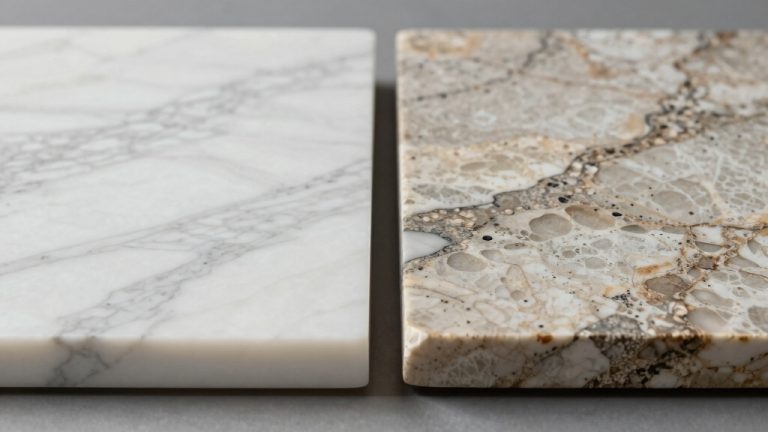
In exploring design options with quartz and cultured marble, you’ll find each material offers distinct aesthetic advantages that cater to different stylistic needs. Quartz delivers uniform patterns with high-resolution veining, ideal for sleek, contemporary looks. Cultured marble excels in seamless, integral designs, creating smooth shifts and molded shapes like sinks or bathtubs.
Consider these design factors:
- Quartz provides consistent color and texture across large surfaces, perfect for expansive countertops.
- Cultured marble allows custom molds, enabling unique shapes and built-in features.
- Quartz’s color palette is broad and stable, suitable for precise design schemes.
- Cultured marble mimics natural stone’s appearance but with less depth and variation.
How Do Quartz and Cultured Marble Affect the Environment?
When evaluating the environmental impact of quartz and cultured marble, you’ll notice distinct differences in their production and sustainability profiles.
Evaluating quartz and cultured marble reveals key differences in production methods and sustainability impacts.
Cultured marble consumes less energy during manufacturing compared to quarrying natural stone. Its lighter weight reduces transport emissions, which is especially beneficial for upper-floor installations.
Quartz surfaces often incorporate recycled materials, enhancing their eco-friendliness. However, the mining and processing of natural quartz remain energy-intensive.
Both materials rely on synthetic resins, marking them as non-renewable resources. If you prioritize a lower carbon footprint, cultured marble offers advantages due to its efficient production and lighter transport load.
However, quartz’s durability can mean less frequent replacement, indirectly influencing environmental sustainability. Understanding these factors helps you make an informed choice aligned with your environmental values and aesthetic goals.
Frequently Asked Questions
Can Cultured Marble Be Repaired if It Chips or Cracks?
Yes, you can repair cultured marble if it chips or cracks. You’ll want to use a specialized repair kit designed for polyester resin surfaces, which includes fillers and color-matched compounds to restore its seamless look.
Carefully clean the damaged area, apply the filler, and sand it smooth once cured. While it won’t be invisible, professional repairs can maintain your cultured marble’s aesthetic and functionality effectively.
Are There Any Health Concerns With Resin Binders in These Materials?
You’ll find that resin binders in both quartz and cultured marble are generally safe once fully cured, with minimal off-gassing.
However, during manufacturing, you might be exposed to volatile organic compounds (VOCs), which require proper ventilation.
After installation, these surfaces are inert and non-toxic, posing no health risks in everyday use.
Maintain good airflow during installation, and you’ll enjoy their beauty and durability without worry.
How Do Quartz and Cultured Marble Respond to UV Light Over Time?
You’ll find that quartz resists UV light well, maintaining its color and structural integrity over time.
This durability is thanks to its dense mineral content and resin formulation.
Cultured marble, however, tends to yellow or fade when exposed to prolonged sunlight.
Its polyester resin binder is more susceptible to UV degradation.
To keep your surfaces looking pristine, avoid direct sunlight on cultured marble or use UV-protective coatings to extend its aesthetic appeal.
What Are the Noise Levels When Cutting or Installing Each Material?
Imagine you’re cutting quartz for a sleek kitchen island; expect loud, high-pitched noise requiring ear protection. Quartz’s hardness demands diamond blades, generating more intense sound and dust.
Cultured marble, being softer, produces noticeably less noise and vibration during cutting and installation. While both need safety gear, cultured marble offers a quieter, less disruptive process. This is ideal if you value a calm work environment and want to minimize noise complaints during your project.
Do Either Quartz or Cultured Marble Surfaces Support Underfloor Heating?
You can use both quartz and cultured marble surfaces with underfloor heating, but quartz is generally better suited due to its superior heat resistance and structural stability.
Cultured marble can handle moderate warmth, but excessive heat might cause cracking or damage over time.
When installing, make certain the heating system’s temperature stays within recommended limits to protect your surface’s integrity while enjoying efficient warmth beneath your floors.
Final Verdict on Quartz Vs Cultured Marble
Choosing between quartz and cultured marble is like selecting the perfect canvas for your masterpiece.
Quartz, with its resilience and sleek finish, symbolizes enduring strength and modern elegance.
Cultured marble, warm and versatile, reflects timeless beauty and classic charm.
Understanding their unique qualities helps you craft a space that’s both functional and stunning.
Whichever you pick, you’re investing in a surface that supports your lifestyle and elevates your home’s aesthetic with lasting grace.