How to Prevent Backyard Flooding With Drains?
To prevent backyard flooding, you’ll want to start with proper soil grading, ensuring a minimum 2% slope away from your foundation and eliminating low spots.
Install French drains or dry wells to redirect excess water underground, plus swales or dry creek beds to channel surface runoff.
Manage roof runoff by maintaining clear gutters and extending downspouts away from structures.
Aerate your soil regularly and use permeable surfaces to enhance infiltration.
Maintaining all components reduces standing water risk and improves drainage. Explore how these strategies integrate for peak flood control.
Key Takeaways
- Grade the soil with a 2% slope away from structures to ensure proper drainage and prevent water pooling near your backyard.
- Install French drains or dry wells to redirect excess groundwater and reduce soil saturation and flooding risks.
- Maintain gutters and downspouts clear and use extenders to direct roof runoff away from the foundation and yard.
- Aerate and amend compacted soil to improve permeability and enhance water absorption in your backyard.
- Use permeable surfaces like gravel or spaced pavers to reduce runoff and promote natural infiltration.
Prevent Backyard Flooding With Proper Soil Grading

Although it may seem straightforward, proper soil grading requires careful calculation to guarantee water consistently flows away from your home’s foundation.
You need to establish a slope of at least 2%. That’s about a quarter inch per foot, extending a minimum of 10 feet outward.
This gradient makes certain gravity directs runoff away, preventing water accumulation near structural bases.
When grading, compact soil to reduce uneven settling but avoid excessive compaction that impedes infiltration.
Use a level or laser grading tool for accuracy. Identify and eliminate low spots where water can pool, adjusting the contour accordingly.
Finally, confirm that grading integrates with existing drainage systems to promote seamless water movement.
Precision here reduces hydrostatic pressure on your foundation and minimizes flood risks in your backyard.
Additionally, addressing groundwater intrusion is crucial to prevent moisture from entering basement and crawl spaces, which can exacerbate flooding issues.
Install French Drains to Redirect Water Away
You know, if you’re dealing with water pooling in your yard, installing French drains can really make a difference. They work by capturing and redirecting all that saturated groundwater, keeping your yard dry and happy.
The whole process is pretty straightforward. It starts with trenching, then you layer in some gravel, and finally, you position those perforated pipes just right to ensure everything flows smoothly.
Oh, and don’t forget about regular inspections! Keeping an eye on things and removing any debris will help your drain work efficiently for years to come. It’s a simple way to maintain a dry yard!
Additionally, ensuring proper moisture barrier installation in areas prone to water accumulation can further protect your property from flooding.
Benefits of French Drains
French drains provide an effective solution for managing saturated groundwater by capturing and redirecting excess water away from your property.
By installing a trench filled with loose stone and a perforated pipe, you create a controlled pathway that intercepts subsurface water before it accumulates near foundations or low-lying areas.
This reduces hydrostatic pressure against structures and prevents soil saturation that leads to erosion or flooding.
Additionally, French drains enhance soil stability and improve landscape usability by minimizing water pooling.
Their passive design requires minimal maintenance once properly installed, offering a durable, long-term drainage strategy.
You’ll also benefit from improved water flow management, as French drains integrate seamlessly with existing grading and surface drainage systems to efficiently channel water to designated outlets or infiltration zones.
Regular maintenance and inspection of drainage components are essential to prevent blockages and ensure effective water diversion.
Installation Steps Overview
When installing a French drain to redirect water away from your property, careful planning and precise execution guarantee peak performance and durability.
Begin by identifying the drainage pattern and determining the ideal trench location with a consistent slope, typically 1% to 2% grade, to ensure gravity-driven flow.
Excavate a trench about 6 to 12 inches wide and 18 to 24 inches deep. Line the trench with landscape fabric to prevent soil infiltration.
Add a 2- to 3-inch layer of coarse gravel, then position a perforated pipe with holes facing downward.
Cover the pipe with more gravel until the trench is nearly full. Fold excess fabric over the gravel to block sediment.
Finally, backfill with soil and compact it lightly. This method ensures efficient water capture and redirection away from vulnerable areas.
To enhance system performance and longevity, it is important to maintain a proper minimum 1% slope throughout the installation.
Maintenance Tips and Tricks
Once installed, maintaining your drain guarantees its long-term function and prevents costly repairs.
French drains rely on unobstructed flow through gravel and perforated pipe, so regular inspection is essential. You should:
- Clear debris and sediment from the trench entrance and exit points.
- Flush the pipe annually with water to detect blockages.
- Make certain soil grading around the drain directs surface water properly.
- Check for crushed or damaged pipe sections that impede flow.
- Remove invasive roots near the drain that can infiltrate and clog the system.
Additionally, installing a drain pipe can help direct water away from vulnerable areas to prevent accumulation and flooding.
Install Dry Wells as an Alternative to French Drains
If you’re looking to manage runoff without extensive trenching, installing dry wells offers an effective solution.
Dry wells capture excess water by directing runoff into an underground chamber filled with gravel or a prefabricated structure.
Dry wells manage excess runoff by channeling water into underground chambers filled with gravel or prefabricated materials.
This stored water then percolates slowly into the surrounding soil, reducing surface pooling and minimizing pressure on drainage systems.
Unlike French drains, dry wells require less excavation and are ideal for areas with limited space or high water tables where trenching is impractical.
When installing, make certain proper sizing based on runoff volume and soil infiltration rates to avoid overflow.
Position dry wells away from foundations to prevent structural damage.
Regular inspection and clearing of inlet pipes maintain functionality, making dry wells a reliable alternative for sustainable backyard drainage.
Proper maintenance and timely intervention help prevent issues such as blockages and backups that can lead to costly water damage.
Create Swales and Dry Creek Beds to Control Runoff
Although managing surface water can be challenging, creating swales and dry creek beds effectively directs runoff away from vulnerable areas in your yard.
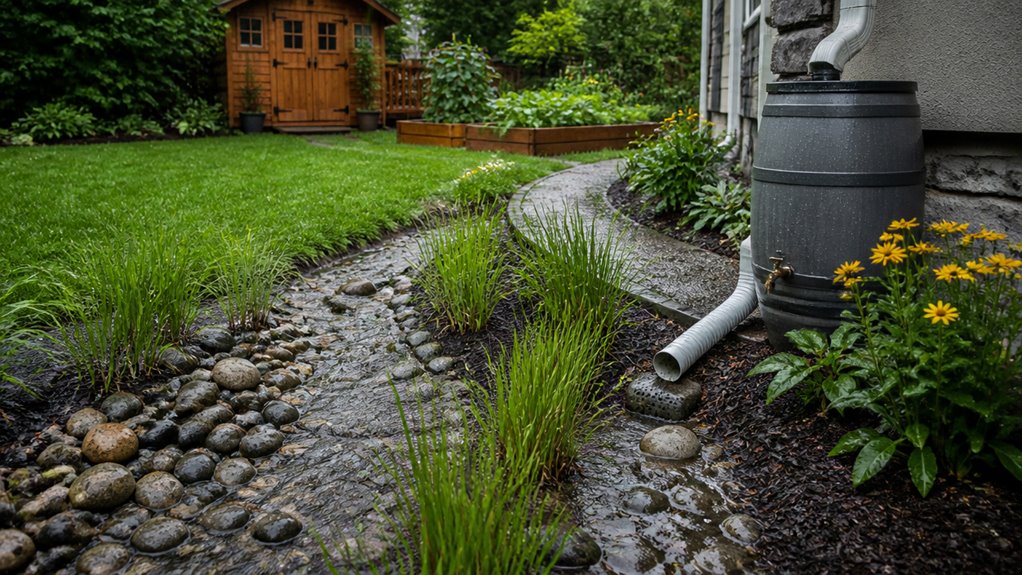
Swales are shallow, linear depressions that channel water, reducing pooling and soil erosion. Dry creek beds mimic natural drainage paths, guiding surface flow while promoting infiltration.
When implementing these features, consider:
- Aligning swales with natural contours to slow water velocity.
- Excavating to appropriate depths for expected runoff volume.
- Using permeable materials like gravel in dry creek beds for filtration.
- Ensuring outlets discharge to stable areas to prevent downstream erosion.
- Regularly inspecting for sediment buildup and clearing debris to maintain function.
To ensure long-term effectiveness, maintain these structures with regular inspection and maintenance similar to how proper floor preparation is critical for durability in polyurethane applications.
Manage Roof Runoff Using Downspouts and Extenders
Directing surface water through swales and dry creek beds helps manage runoff on the ground. However, controlling roof runoff requires targeted solutions to prevent water from saturating soil near your foundation.
Downspouts must remain clear and functional to channel roof water efficiently. Extenders push discharge farther from your home, reducing soil saturation risks that lead to basement flooding or foundation damage.
| Component | Purpose |
|---|---|
| Downspout | Channels roof water away from gutters |
| Extender | Extends downspout discharge distance |
| Gutter maintenance | Prevents blockage and overflow |
| Discharge location | Designed to avoid soil saturation |
| Regular inspection | Guarantees system integrity and function |
Maintain these elements to optimize runoff control and protect your foundation from water-related damage. Promptly addressing water intrusion is critical because wet drywall can soften and lose structural strength if moisture reaches your walls.
Collect Rainwater With Rain Barrels to Reduce Flooding
You know, one great way to tackle backyard flooding is by installing rain barrels. They’re perfect for capturing roof runoff before it has a chance to saturate the soil around your foundation. Plus, it’s a pretty straightforward solution!
Just keep in mind that proper placement and regular maintenance are key. This way, you ensure that your barrels are effective for water storage and that you don’t run into any overflow or clogging issues.
And here’s the bonus: using rain barrels not only helps reduce the risk of flooding, but they also give you a sustainable water source for all your irrigation needs. It’s a win-win!
To maximize effectiveness, place the barrels on high ground and ensure proper drainage away from your home’s foundation.
Benefits of Rain Barrels
How can you effectively reduce backyard flooding while conserving water?
Using rain barrels to collect roof runoff offers a practical solution. By capturing and storing rainwater, you prevent excess water from pooling near your foundation. This lowers flooding risk and soil saturation.
Key benefits include:
- Decreases stormwater runoff volume entering drainage systems
- Reduces soil erosion by limiting concentrated water flow
- Provides an alternative irrigation source, conserving potable water
- Minimizes pressure on municipal storm drains during heavy rain
- Helps maintain soil structure by preventing oversaturation around your home
Integrating rain barrels into your drainage strategy optimizes water management. It balances flood prevention with sustainable water use. Maintaining stable environmental conditions during water storage helps preserve water quality and system effectiveness.
Installation and Maintenance
While installing rain barrels may seem straightforward, ensuring proper setup and ongoing maintenance is essential for maximizing their effectiveness in flood prevention.
Position your rain barrel directly beneath a downspout, securing it on a stable, level platform. Attach a downspout diverter or modify the gutter to channel water efficiently.
Regularly clear gutters and downspouts to prevent clogging, which reduces barrel capacity and causes overflow near foundations. Inspect barrels for cracks or leaks and seal them promptly to maintain water retention.
Periodically clean the barrel interior to avoid sediment buildup that impedes flow. In colder climates, drain and disconnect barrels before freezing temperatures to prevent damage.
Use Sandbags for Temporary Flood Protection
When heavy rain threatens your backyard, sandbags can quickly shore up vulnerable areas to prevent flooding. You need to activate sandbags by wetting them before stacking; this causes expansion and creates a tighter seal.
Proper stacking technique improves barrier stability and effectiveness. Consider pyramidal stacking to maintain structural integrity under pressure. Sandbags are a temporary solution and must be removed once the threat subsides to avoid soil compaction.
Use pyramidal stacking for strong, stable sandbag barriers and remove them promptly to protect soil health.
Key practices for sandbag use include:
- Wet sandbags prior to placement to guarantee expansion and sealing.
- Stack in a pyramid formation for improved stability.
- Seal gaps tightly to prevent water seepage.
- Place sandbag barriers around low-lying or foundation-adjacent zones.
- Remove sandbags promptly after flooding risk passes to preserve soil health.
Choose Plants That Reduce Flooding Damage
When it comes to reducing flooding damage in your yard, it’s a good idea to focus on native plants that have deep root systems. These plants really help with soil stability and can absorb a lot of water, which is super important.
One effective strategy is to incorporate rain gardens. When you place them in the right spots, they can collect runoff and promote better water infiltration. This means less standing water in your yard, which is a win!
Native Plants Benefits
Selecting native plants with deep root systems greatly strengthens your yard’s ability to manage excess water and reduce flooding damage.
These plants improve soil structure, increase infiltration rates, and stabilize the ground, minimizing runoff and erosion.
When choosing species, focus on those adapted to your local climate and soil conditions to maximize their effectiveness and sustainability.
Key benefits include:
- Extensive roots anchor soil, reducing displacement during heavy rain.
- Enhanced soil porosity allows faster water absorption.
- Increased organic matter from native vegetation improves moisture retention.
- Roots create channels that facilitate deeper water penetration.
- Resilience to local pests and diseases guarantees long-term functionality.
Rain Gardens Role
Building on the advantages of native plants, rain gardens offer a targeted solution to manage runoff by capturing and absorbing excess water in low-lying areas.
You can strategically place rain gardens where water naturally accumulates, preventing pooling near foundations and reducing surface runoff.
Selecting plants with deep, fibrous root systems enhances soil infiltration rates, stabilizes soil, and mitigates erosion.
Species adapted to periodic saturation tolerate wet conditions and optimize water uptake.
Incorporating mulch further controls moisture retention and slows runoff velocity.
By designing rain gardens with appropriate soil amendments and grading, you facilitate efficient percolation and reduce flood risks.
When you integrate rain gardens into your landscape, you create a functional buffer that not only manages stormwater but also supports local ecology.
This minimizes flooding damage while maintaining soil and structural integrity.
Aerate Soil and Use Permeable Surfaces to Improve Drainage
When soil becomes compacted, it restricts water infiltration and increases surface runoff. This can exacerbate backyard flooding.
To improve drainage, you should aerate your soil regularly and incorporate permeable surfaces that allow water to penetrate.
Effective strategies include:
Dethatching and annual aeration to break up compacted layers and enhance soil porosity.
Using permeable surfaces like gravel or spaced pavers to reduce impervious areas.
Installing gravel strips along driveways to slow runoff and promote infiltration.
Avoiding full solid paving by opting for paving strips to maintain soil permeability.
Minimizing foot traffic on saturated areas to prevent re-compaction and preserve infiltration capacity.
Keep Gutters and Lawn Clear to Prevent Water Build-Up
Regularly clearing gutters and maintaining your lawn are critical steps to prevent water accumulation that leads to backyard flooding. Blocked gutters and downspouts impede roof runoff, causing water to pool near your foundation and increasing flood risk.
You should inspect gutters for debris, leaves, and sediment buildup. Ensure downspouts remain unobstructed and direct water at least several feet away from your house.
Similarly, keep your lawn free of thick thatch and debris that hinder soil infiltration. Aerate compacted soil and mow grass to recommended heights to promote absorption and reduce runoff.
Neglecting these tasks creates saturation zones and surface pooling, overwhelming drainage systems. By proactively maintaining gutters and lawn, you optimize water flow, prevent soil erosion, and reduce the likelihood of standing water that can damage your yard and property.
Frequently Asked Questions
How Often Should I Inspect My Foundation for Cracks?
You should inspect your foundation for cracks at least twice a year, ideally during spring and fall when temperature changes can cause expansion and contraction.
After heavy storms or significant ground movement, conduct an additional check.
Regular inspections help you identify early signs of water intrusion or structural issues.
Use a flashlight and magnifying glass for precision, documenting any findings for comparison over time to assess crack progression and necessary repairs promptly.
What Is the Best Way to Activate Sandbags Before Use?
You activate sandbags best by wetting them thoroughly before stacking. This hydration causes the bags to expand and conform tightly, creating a more effective seal against water intrusion.
Avoid using dry sandbags since they remain loose and less stable. Soaking them with water guarantees better compaction and structural integrity, enhancing their ability to block floodwaters.
Make sure to activate all sandbags evenly for consistent performance across the barrier.
Can Sprinkler Systems Contribute to Backyard Flooding?
Yes, sprinkler systems can contribute to backyard flooding if they’re poorly maintained or improperly set.
Overwatering saturates the soil, reducing its infiltration capacity and causing surface runoff.
Malfunctioning heads or leaks may create artificial pooling or saturation near low spots.
You should regularly inspect and adjust your sprinkler system to prevent excess water application.
This ensures it complements natural drainage rather than exacerbates flooding risks in your yard.
How Does Mowing Height Affect Lawn Drainage?
Think of mowing height like setting the sails on an ancient galleon; too low, and you lose control. When you mow your lawn below three inches, you reduce the grass blade’s ability to absorb water and slow runoff.
This causes poorer drainage and increased soil compaction. Keeping grass taller preserves root depth and soil structure, enhancing infiltration and reducing standing water.
When Should I Consider Installing Flood Vents in My Home?
You should consider installing flood vents when your home is located in a flood-prone area or a designated flood zone.
Flood vents help equalize water pressure on foundation walls during flooding, reducing structural damage risk.
If your basement or crawlspace frequently accumulates water or you anticipate rising floodwaters near your property, flood vents provide critical pressure relief.
Make certain vents comply with local building codes and are properly maintained for peak performance.
Prevent Backyard Flooding With the Right Drainage Plan
Did you know that improper yard grading causes up to 70% of backyard flooding issues?
By ensuring proper soil grading and installing systems like French drains or dry wells, you can greatly reduce water accumulation.
Managing roof runoff and maintaining clear gutters further control excess water flow.
Combining these techniques with strategic planting and permeable surfaces enhances drainage efficiency.
This helps you prevent costly water damage and maintain a healthy, flood-resistant backyard environment.