Is Birch Plywood Waterproof: Moisture Matters
You can’t rely on standard birch plywood to be waterproof since it uses urea-formaldehyde glue and absorbs moisture, causing swelling and delamination.
However, engineered waterproof birch plywood employs phenolic resin adhesives and precise manufacturing, resisting water penetration and maintaining integrity under prolonged exposure.
Its performance includes less than 8% thickness swelling after 72 hours underwater and durability against freeze-thaw cycles and salt spray.
To fully understand its properties and applications, there’s more detail to explore.
Key Takeaways
- Standard birch plywood is not waterproof and absorbs moisture, causing swelling, warping, and delamination due to urea-formaldehyde glue and exposed edges.
- Waterproof birch plywood uses phenolic resin adhesives and WBP glues to resist moisture penetration and maintain structural integrity under prolonged water exposure.
- Waterproof birch plywood typically swells less than 8% in thickness after 72 hours of submersion, showing high dimensional stability and fungal resistance.
- Proper edge sealing is essential for birch plywood to prevent water ingress through exposed end grains, which accelerate moisture damage.
- Marine-grade waterproof birch plywood features void-free cores and superior bonding, enabling durability in freeze-thaw, salt spray, and high-humidity environments.
What Does “Waterproof” Mean for Birch Plywood?

When we talk about “waterproof” in relation to birch plywood, it means the material can resist moisture penetration and maintain structural integrity under prolonged exposure to water.
You need to understand that waterproof birch plywood uses specific adhesives like waterproof phenolic resin, which prevent delamination and swelling.
The glue bonds between veneers are vital in blocking moisture ingress, especially at edges where end grain is exposed.
Additionally, waterproof variants undergo rigorous testing, including submersion, freeze-thaw cycles, and salt spray, to guarantee dimensional stability and resistance to fungal growth.
You’ll find that waterproof plywood maintains less than 8% thickness swelling after 72 hours underwater, which is essential for durability.
To enhance the lifespan and protection of wood surfaces, applying a suitable water-repellent sealer can be highly effective.
Why Standard Birch Plywood Isn’t Waterproof?
Although standard birch plywood offers moderate resistance to brief moisture exposure, it isn’t waterproof because its core materials and exposed edges readily absorb water. This absorption causes swelling, warping, and delamination.
The plywood’s layers are bonded with urea-formaldehyde glue, which lacks the moisture resistance of phenolic adhesives. This allows for water penetration and adhesive breakdown.
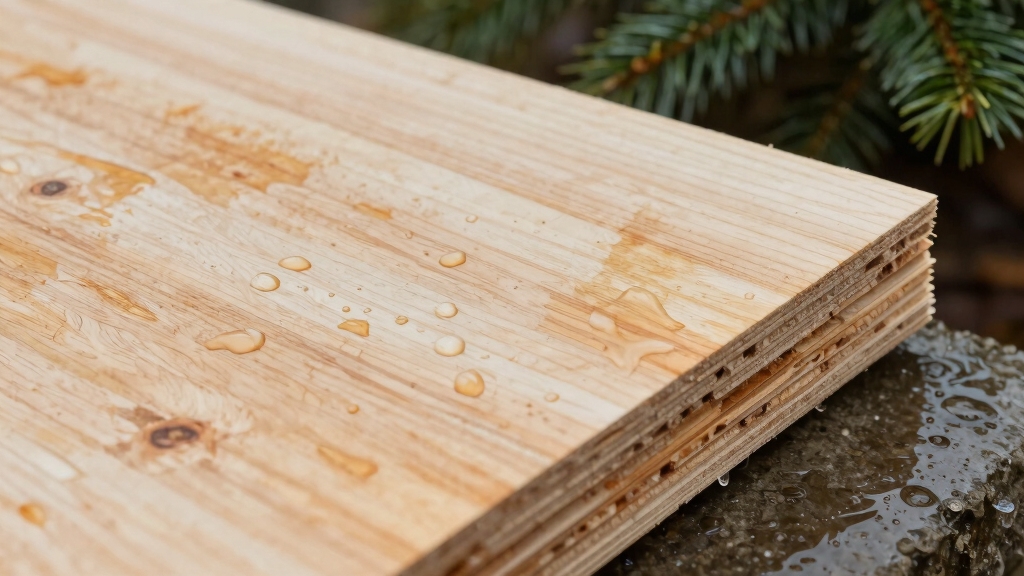
Additionally, the exposed end grain at plywood edges acts as a capillary pathway, accelerating water ingress into the core. Once moisture infiltrates, the wood fibers swell, disrupting the bond lines and structural integrity.
Without protective sealants or waterproof glues, standard birch plywood deteriorates under prolonged or repeated moisture contact. Consequently, despite moderate short-term resistance, you can’t rely on it for environments demanding sustained water exposure or high humidity without additional treatment.
Birch plywood’s phenolic adhesives and complete edge sealing are essential for achieving effective waterproof performance in outdoor or high-moisture applications.
How Birch Plywood’s Water Resistance Compares to Other Woods?
You’ll find that birch plywood generally holds up better against moisture than many softwood plywoods due to its denser, tighter grain and higher-quality adhesives.
Birch plywood resists moisture better than many softwood plywoods thanks to its dense grain and superior adhesives.
Its multi-ply construction with improved glue lines reduces water penetration compared to softwoods, which often use lower-grade adhesives prone to delamination.
However, birch plywood without phenolic or WBP adhesives still falls short of marine plywood, which features void-free cores and waterproof bonding, excelling in prolonged water exposure.
Compared to solid woods, birch plywood’s engineered layers provide more uniform moisture resistance but require sealing at edges to prevent swelling.
In contrast, solid hardwoods may absorb moisture unevenly, causing warping.
Proper moisture control with a vapor barrier is essential to protect plywood installations from moisture-related damage.
How Waterproof Birch Plywood Is Made?
Understanding the superior moisture resistance of marine-grade birch plywood raises the question of how manufacturers achieve this waterproof quality.
They start by selecting high-grade veneers with minimal voids to reduce water ingress points.
Then, they use phenolic resin-based WBP (Water Boil Proof) adhesives instead of urea-formaldehyde glue. This ensures the layers stay bonded under prolonged moisture exposure.
The plywood undergoes hot pressing under controlled heat and pressure to cure adhesives thoroughly, creating a robust, impermeable bond.
Additionally, manufacturers design the ply construction to optimize thickness and minimize grain exposure, especially at edges.
This combination of superior materials, adhesive technology, and precise manufacturing processes results in plywood that withstands prolonged water contact.
It resists swelling and prevents delamination, making it ideal for demanding wet environments.
Similar to cork flooring, using quality finishes and proper sealing enhances moisture resistance and durability in wet conditions, contributing to long-term performance. This makes cork a noteworthy waterproof flooring option in comparison.
Birch Plywood Types That Resist Moisture Best
When it comes to birch plywood, you’ll notice that some variants are specifically designed to resist moisture much better than the standard types.
For instance, waterproof birch plywood often uses phenolic resins and WBP adhesives. These materials really boost moisture resistance, making them a great choice if you’re looking for something that can handle wet conditions.
Another option to consider is marine-grade birch plywood. This type is notable for having fewer voids and superior bonding, which really enhances its durability when exposed to moisture over time.
To further improve moisture resistance, selecting materials with moisture barriers can help reduce water seepage and prolong the plywood’s lifespan.
Waterproof Birch Variants
While standard birch plywood struggles with moisture, waterproof variants employ specialized adhesives and treatments that enhance resistance to water exposure.
These variants primarily utilize WBP (Water Boil Proof) phenolic resins, which outperform the standard urea-formaldehyde glue by preventing delamination under prolonged wet conditions.
For example, birch phenolic boards and exterior-grade birch plywood combine phenolic glue with optimized lamination processes, ensuring dimensional stability and reduced swelling.
Baltic Birch Marine Plywood further refines this with fewer core voids and higher-grade veneers, offering superior moisture resistance validated by rigorous ASTM B117 salt spray and freeze-thaw tests.
If you need plywood for humid or wet environments, selecting these waterproof variants markedly improves durability and longevity compared to untreated birch plywood.
This is especially true when combined with proper edge sealing and finishing.
The manufacturing process involves hot pressing under controlled heat and pressure to activate adhesives and create durable bonds that enhance waterproof performance.
Marine Grade Advantages
When selecting birch plywood for applications demanding superior moisture resistance, marine-grade variants stand out due to their advanced construction and adhesive technology.
These plywoods employ waterproof phenolic resins (WBP glue) that prevent delamination and swelling, even under prolonged water exposure. Their core veneers exhibit minimal voids, enhancing structural integrity and reducing water ingress points.
Marine-grade birch plywood withstands rigorous testing, including 72-hour submersion and cyclic humidity cycles, showing less than 8% thickness swelling without delamination.
This durability translates into an 18+ year lifespan in humid or marine environments. If you need plywood for coastal furniture or wet-area cabinetry, marine-grade birch offers unmatched moisture resistance compared to standard or exterior-grade variants.
However, applying edge sealers and finishing treatments remains essential to maximize longevity. Despite these advantages, plywood may still be more susceptible to moisture-related issues than engineered hardwood with HDF core due to its layered construction.
How Waterproof Birch Plywood Holds Up in Tests?
You’ll find that waterproof birch plywood really stands out when it comes to performance. After being submerged for 72 hours, it shows less than 8% thickness swelling. That’s impressive and really speaks to its dimensional stability.
But that’s not all! This plywood also holds up well in cyclic freeze-thaw and humidity tests. So, if you’re in an area with fluctuating conditions, you can count on its structural integrity.
And here’s another cool thing: when exposed to salt spray according to ASTM B117 standards, it shows no signs of delamination. This makes it a great choice for marine environments.
Overall, waterproof birch plywood is a solid option for those who need durability and reliability! Its moisture resistance properties are comparable to those found in high-quality laminate flooring cores, enhancing its performance in damp conditions.
Thickness Swelling Resistance
Because thickness swelling directly impacts plywood’s dimensional stability and structural integrity, it serves as a critical measure of waterproof birch plywood’s performance under moisture exposure.
When tested, high-quality waterproof birch plywood, especially variants bonded with waterproof phenolic resins, exhibit thickness swelling below 8% after 72-hour water immersion. This demonstrates excellent resistance to moisture-induced deformation.
This minimal swelling guarantees the material maintains strength and flatness, preventing warping or delamination.
Conversely, standard birch plywood with urea-formaldehyde glue shows significantly higher swelling due to core water absorption and edge vulnerability.
You should note that plywood’s multilayer 7-ply construction and void-free cores in marine-grade products further reduce thickness swelling. Proper adhesive selection and edge sealing critically influence swelling resistance, making these factors decisive in guaranteeing dimensional stability during prolonged moisture exposure.
Additionally, the choice of urethane adhesive can enhance the moisture resistance and overall durability of plywood in demanding environments.
Freeze-Thaw Durability
Although freeze-thaw cycles impose significant stress on building materials, waterproof birch plywood demonstrates remarkable durability under such conditions.
You’ll find that plywood bonded with WBP phenolic adhesives resists delamination and structural degradation during repeated freezing and thawing.
Tests show minimal thickness swelling, typically under 8%, even after prolonged moisture exposure combined with cyclic temperature fluctuations.
The phenolic glue’s water-repellent properties prevent moisture ingress, which otherwise causes swelling and fiber breakdown when frozen water expands.
However, you must make certain edges are properly sealed, as exposed end grains remain vulnerable to moisture penetration and freeze damage.
Overall, waterproof birch plywood’s performance in freeze-thaw testing confirms its suitability for environments experiencing temperature swings and moisture exposure.
It outperforms standard plywood which lacks such adhesive and protective treatments.
Proper storage practices for plywood and adhesives can further enhance durability by minimizing moisture and temperature effects before installation.
Salt Spray Performance
When subjected to salt spray testing per ASTM B117 standards, waterproof birch plywood demonstrates exceptional resistance to corrosion and moisture ingress. This testing simulates harsh marine environments, exposing the plywood to a continuous saline mist for extended periods.
You’ll find that plywood bonded with WBP (Water Boil Proof) adhesives, especially marine-grade variants, exhibits negligible delamination and swelling under these conditions. The phenolic resin glue effectively seals wood fibers, preventing moisture penetration and preserving structural integrity.
In contrast, standard birch plywood with urea-formaldehyde glue shows significant degradation, including surface blistering and core swelling. For applications exposed to salt-laden air or coastal conditions, choosing waterproof birch plywood with proven salt spray resistance secures durability and longevity.
Proper edge sealing further enhances performance by blocking vulnerable grain exposure.
Best Applications for Waterproof and Standard Birch Plywood
In selecting the best applications for waterproof and standard birch plywood, you need to take into account the material’s moisture resistance and structural properties.
Standard birch plywood, bonded with urea-formaldehyde glue, suits interior projects with low humidity, like furniture and cabinetry.
Avoid direct water exposure, as it’s vulnerable at edges and to prolonged moisture. Use it where occasional dampness occurs but sealing is possible.
Waterproof birch plywood, employing WBP or phenolic adhesives, excels in high-moisture environments.
You can confidently install it in kitchens, bathrooms, and laundry rooms. Marine-grade variants withstand coastal conditions and prolonged water contact.
These are ideal for outdoor furniture, sheds, or workshops. Its low swelling and resistance to delamination under cyclic moisture stress make it your best choice for demanding applications requiring durability and dimensional stability.
How to Protect Birch Plywood From Water Damage?
Protecting birch plywood from water damage requires proactive measures that address its inherent vulnerability to moisture absorption, especially at exposed edges and core layers.
Effective birch plywood protection demands proactive sealing of edges and core layers against moisture absorption.
You should apply edge sealers or epoxy coatings to block water infiltration through end grain and core voids.
Using polyurethane, spar varnish, or high-quality exterior paints on all surfaces enhances moisture resistance and UV protection.
Sealants with A-Bond glue formulations help prevent expansion and delamination by reinforcing adhesive bonds.
Avoid prolonged direct water exposure on standard birch plywood; instead, opt for waterproof variants with phenolic resin glue in high-moisture environments.
Regular maintenance and reapplication of protective coatings assure long-term durability.
Frequently Asked Questions
Can I Use Waterproof Birch Plywood Outdoors Without Any Sealant?
You shouldn’t rely on waterproof birch plywood outdoors without applying a sealant.
Even though it uses WBP adhesives and phenolic resins for moisture resistance, prolonged exposure to weather still risks edge absorption and surface degradation.
Sealants like polyurethane or spar varnish are essential to prevent swelling, warping, and delamination.
Proper finishing greatly extends durability, so skipping sealants compromises the plywood’s performance and lifespan in outdoor conditions.
How Long Does Waterproof Birch Plywood Last in Coastal Environments?
You can expect waterproof birch plywood, especially marine grade, to last over 18 years in coastal environments.
This durability comes from phenolic resin adhesives and minimal voids that resist delamination and swelling under constant moisture and salt exposure.
Proper sealing and maintenance extend its lifespan by preventing edge absorption and UV degradation.
Is Phenolic Glue Safe for Indoor Air Quality?
Phenolic glue is generally safe for indoor air quality because it emits very low volatile organic compounds (VOCs) compared to urea-formaldehyde adhesives.
You won’t face significant off-gassing issues with phenolic-bonded plywood, making it suitable for indoor use.
However, ensure proper ventilation during installation to minimize any minor emissions.
Can I Paint Over Waterproof Birch Plywood Without Sanding?
You can paint over waterproof birch plywood without sanding if the surface is clean and slightly rough.
Studies show that coatings adhere best when the substrate has at least 15-20 microns of surface irregularity. Waterproof birch often has a smooth phenolic resin finish, which is slick.
Light sanding or a chemical deglosser improves paint adhesion markedly. Skipping this step might cause poor bonding and peeling over time.
What Is the Cost Difference Between Standard and Marine-Grade Birch Plywood?
You’ll find marine-grade birch plywood costs roughly 2 to 3 times more than standard birch plywood due to its superior adhesives, fewer voids, and enhanced durability.
While standard plywood uses urea-formaldehyde glue, marine-grade employs waterproof phenolic resin, increasing production expense.
This premium investment offers long-term moisture resistance and structural integrity, justifying the higher price for applications requiring prolonged water exposure or outdoor use.
Balancing Durability and Moisture Resistance with Birch Plywood
While standard birch plywood isn’t exactly your go-to for full water immersion, it does offer a modest level of resilience against moisture. If you need something more robust, waterproof variants treated and engineered for damp conditions are your best bet.
By understanding these subtle distinctions and applying proper protective measures, you can confidently select and maintain birch plywood that gracefully withstands the occasional splash. This ensures durability without the drama of water damage.