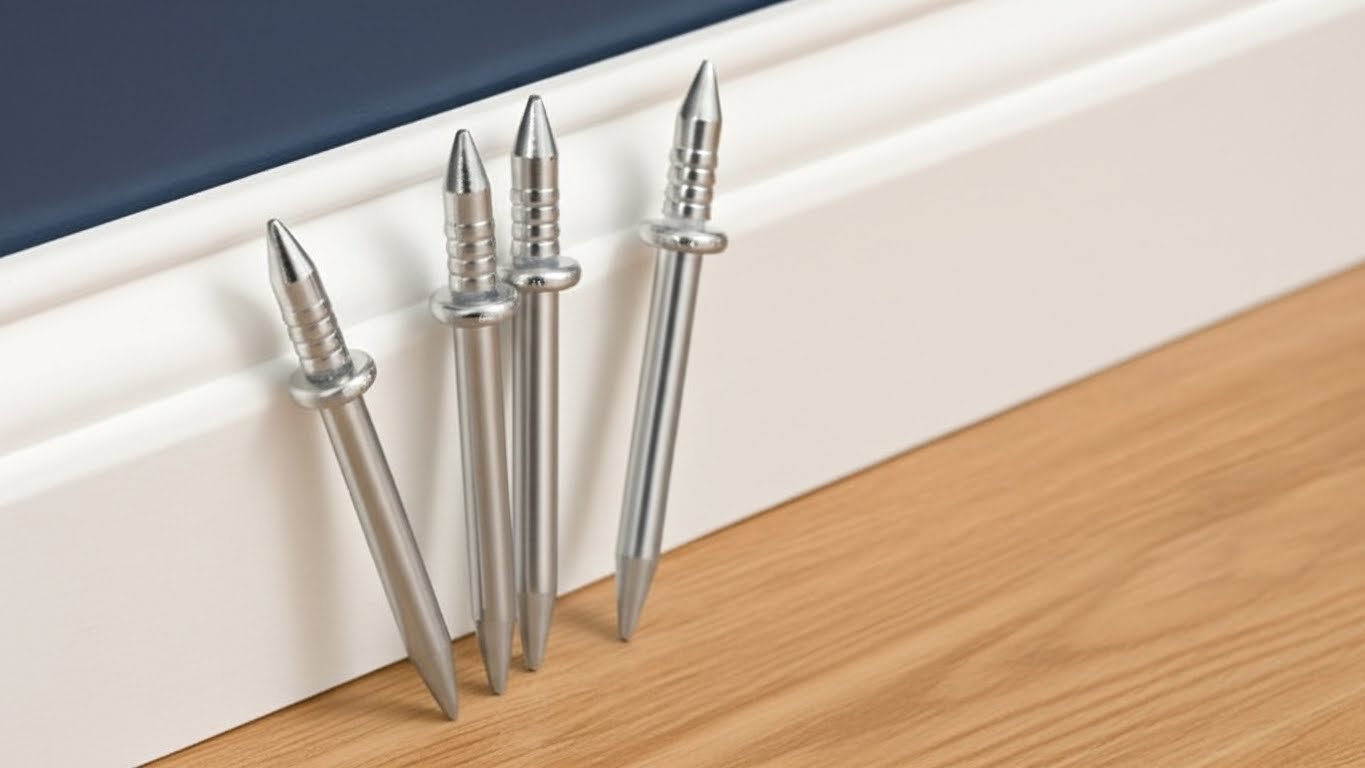
What Size Nail for Baseboards: Save Time and Prevent Damage
When choosing nails for your baseboards, pick a length about 2.5 times the thickness of the board. Typically, this means using 1.5″ to 2″ nails for standard 3/4″ baseboards. Use 15 or 16-gauge finish nails for strong holding power without splitting.
For thinner boards, 1.25″ to 1.5″ nails with 16-18 gauge work best. Make sure your nails are suited for your wall type and baseboard material. Keep going to uncover tips on selecting the perfect nail gauge and installation techniques.
Key Takeaways
- Use 1-1/2″ to 2″ finish nails for standard 3/4″ thick baseboards for a secure hold.
- Choose 15-16 gauge nails for strength; 18 gauge for thinner or delicate baseboards.
- Nails should be about 2.5 times the thickness of the baseboard for proper penetration.
- Pre-drill holes on hardwood or delicate baseboards to prevent splitting during nailing.
- Match nail gauge to your nailer and consider corrosion-resistant nails in moist areas.
Understanding Baseboard Thickness and Nail Length
When you’re installing baseboards, choosing the right nail length is essential and depends largely on the thickness of the baseboard itself.
Most traditional baseboards range between 9/16″ and 5/8″ thick, with some thicker options reaching up to 1″. It is also important to consider the type of wall substrate to ensure the nail provides a secure hold without damaging the surface beneath.
Traditional baseboards typically measure between 9/16″ and 5/8″ thick, with thicker styles up to 1″ available.
Thicker baseboards, like those from 3/4″ to 1″, require longer nails to ensure a secure hold. This is especially important since they create a more substantial visual impact and often accompany taller ceilings.
MDF baseboards usually have uniform thickness, while wood options can vary slightly, affecting your fastening needs. Remember, the nail must penetrate both the baseboard and the wall substrate sufficiently without splitting the material.
Matching nail length to baseboard thickness helps avoid installation issues and guarantees a clean, professional finish.
Choosing MDF or wood also influences nail selection since MDF offers a uniform, flat appearance preferred in modern design. Using the right maintenance techniques can also help preserve the appearance and integrity of your baseboards over time.
Choosing the Right Nail Gauge for Your Baseboards
Although selecting the right nail length is essential, choosing the appropriate nail gauge is equally important for a secure and clean baseboard installation.
Nail gauge measures thickness; lower numbers mean thicker nails. For standard or heavy baseboards, 15-gauge nails provide the strongest hold and resist pullout, making them ideal for dense hardwood.
If you want a balance between strength and minimizing wood splitting, 16-gauge nails are a solid choice for most installations. Proper installation techniques also help prevent damage to the wood.
For thin or delicate baseboards, 18-gauge nails work best but offer less durability.
Remember, your nailer must match the gauge. 15- and 16-gauge nailers suit baseboard work, while 18-gauge nails need a brad nailer.
Proper nailing provides a sturdy, inflexible attachment that enhances the final appearance, especially since walls are often not perfectly straight or at perfect angles, making nailing crucial.
Types of Nails Suitable for Baseboard Installation
Selecting the right type of nail plays a crucial role in guaranteeing your baseboards stay secure and look professional.
You’ll primarily choose between finish nails, brad nails, pin nails, or corrosion-resistant options, each suited to specific baseboard types and installation needs. Here’s what to consider:
Finish nails (15-16 gauge) offer strong holding for thick, heavy baseboards but leave visible holes. Their gauge size provides the necessary strength to penetrate dense materials without bending.
Brad nails (18 gauge) work well for lighter trims, causing less splitting and minimal hole visibility. Pin nails (21-23 gauge) suit delicate moldings, requiring glue for strength and leaving nearly invisible holes.
Corrosion-resistant nails like galvanized or stainless steel prevent rust and staining, ideal for moist areas.
Matching the nail type to your baseboard ensures durability and a clean finish. It is also important to use nails of the correct length to ensure proper penetration into the wall studs or substrate for a secure, stable baseboard.
Tips for Installing Baseboards With the Correct Nails
Nailing baseboards properly starts with matching the nail size and type to your specific trim and wall conditions.
First, identify wall stud locations to ensure nails penetrate solid framing, preventing loosening over time.
Choose nails about 2.5 times the baseboard thickness; typically 2-inch nails for standard 3/4-inch boards will secure without piercing through. Using the correct nail length helps avoid damage to the wood fibers beneath the surface.
Use 15 or 16-gauge finish nails for strong holds with minimal hole size.
Opt for 18-gauge nails on thinner trim to reduce visible holes and touch-up.
Pre-drill holes when working with delicate or hardwood baseboards to avoid splitting.
Set nail depth carefully to fasten fully without damaging the surface.
Confirm nail gauge to your nailer to avoid jams and ensure smooth installation.
Using the correct nail size is crucial for a professional finish and reputation.
These steps guarantee a clean, durable baseboard finish.
Practical Nail Size Recommendations for Different Baseboards
For different baseboard thicknesses, choosing the right nail size is crucial to guarantee a secure hold without damaging the trim.
For standard 3/4 inch baseboards, 1-1/2 inch finish nails work well, while 2 inch nails offer extra grip into studs. Using the appropriate nail size also helps reduce the need for frequent maintenance, similar to how regular vacuuming frequency can maintain hardwood floors.
Thinner baseboards (under 3/4 inch) benefit from 1-1/4 inch or 1-1/2 inch nails with 16 or 18-gauge to reduce splitting. Using the correct nail size also helps provide a clean finish by concealing nail heads easily with filler or paint.
Thicker or decorative baseboards need 2 to 2-1/2 inch nails, preferably 15-gauge, for strong, lasting attachment.
Remember these key points: match nail length to baseboard thickness and wall backing. Use thicker (lower gauge) nails for denser materials.
Pre-drill thick baseboards to prevent splitting. Choose galvanized or stainless steel nails for durability. Picking the right size ensures a neat, secure installation every time.
Frequently Asked Questions
Can I Use Finishing Nails for Crown Molding as Well as Baseboards?
Think of finishing nails as the quiet artists behind a masterpiece’s frame. They work perfectly for both crown molding and baseboards.
You can definitely use them for both since they offer a clean finish and strong hold. Just choose the right gauge and length based on the molding’s thickness.
For heavier crown molding, go for 15- or 16-gauge nails; for lighter pieces, 18-gauge works.
Angle your nails and use a nail set for a flawless look.
How Do I Remove Nails From Baseboards Without Damaging Them?
To remove nails from baseboards without damage, flip the molding to access nails from the back.
Use linesman or end-cutting pliers for a firm grip and leverage. Apply a rolling motion, rocking the pliers side-to-side to avoid snapping nails.
Protect the trim by placing wooden shims or a metal glazier’s bar beneath the pliers. If needed, cut caulk lines first to ease removal and prevent paint chipping.
Are Pneumatic Nailers Better Than Manual Hammers for Baseboard Installation?
Imagine trying to plant a seed with a rock versus a precision trowel.
Pneumatic nailers are that trowel for your baseboards—faster, cleaner, and more precise than manual hammers.
You’ll avoid dents and splinters, and nails sit flush, saving you time on filling holes. Plus, pneumatic tools speed up your work dramatically, especially on bigger projects.
What Type of Nail Filler Works Best for Hiding Nail Holes?
You’ll want to use wood filler for hiding nail holes on baseboards. It’s durable, sands smoothly, and blends nicely with wood surfaces, making repairs nearly invisible.
For quick fixes on small holes, water-based fillers work well because they dry fast and clean up easily. Avoid drywall spackles; they crumble and don’t hold up.
If you need extra durability or are working outdoors, solvent-based fillers or Bondo are good choices, but wood filler is usually your best bet.
How Does Humidity Affect Nail Holding Strength in Baseboards?
Humidity weakens nail holding strength in your baseboards by increasing wood moisture, causing it to swell and expand. This expansion stresses nails, making them more prone to loosening or bending, especially if moisture exceeds 14%.
Over time, repeated humidity changes can cause nail pops or fastener failure. To prevent this, you should acclimate wood before installation, use corrosion-resistant nails, and avoid installing baseboards with high moisture content to maintain strong hold.
Avoid Loose Fits and Splintered Wood With the Right Nail Length
Choosing the right nail size for your baseboards might seem minor, but it makes all the difference between a secure fit and a frustrating redo. Using nails that are too short won’t hold, while oversized ones risk splitting the wood.
By matching nail length and gauge to your baseboard thickness, you’ll save time and avoid damage. Small details like these turn a good project into a professional finish because precision matters, even in something as simple as nails.