Does Laminate Flooring Need to Be Acclimated Properly?
Yes, you need to acclimate laminate flooring before installation to match the room’s temperature and moisture levels. This prevents warping, buckling, or gaps caused by uneven expansion or shrinkage.
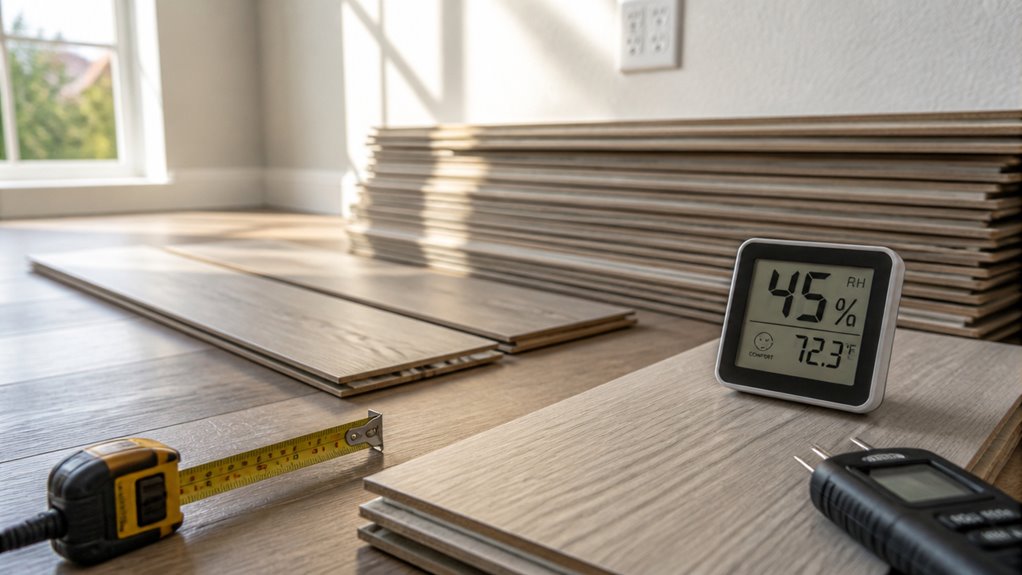
Keep the flooring sealed, flat, and in the installation area for at least 48 hours under stable conditions. The ideal temperature range is 59°F–80°F and humidity between 35%–65%.
Proper acclimation guarantees structural integrity and long-term performance. Understanding the correct timing, storage, and environmental factors will help every step go smoothly.
Key Takeaways
- Laminate flooring must be acclimated to match site moisture and temperature for structural integrity and long-term performance.
- Acclimation prevents warping, buckling, and gapping caused by moisture and temperature changes after installation.
- Most manufacturers recommend a minimum 48-hour acclimation period in sealed packaging, placed flat with air circulation.
- Ideal acclimation conditions include stable room temperature (59°F–80°F) and relative humidity (35%–65%) to avoid expansion or contraction.
- SPC flooring is an exception and typically does not require acclimation due to its moisture-resistant core.
Why Does Laminate Flooring Need Acclimation?

Because laminate flooring is manufactured in controlled environments, it needs to acclimate to the specific moisture and temperature conditions of your installation site.
Laminate flooring must acclimate to your home’s unique moisture and temperature before installation.
This process allows the flooring materials to physically adjust, preventing dimensional changes once installed.
Without acclimation, differences between factory and room conditions can cause warping, gapping, or buckling due to expansion or contraction.
You must keep the flooring sealed and unopened during acclimation to maintain its moisture balance.
The acclimation step isn’t optional; it’s essential for ensuring the flooring’s structural integrity and long-term performance.
By allowing the material to stabilize under your room’s humidity and temperature, you minimize post-installation issues and protect your investment.
Proper acclimation safeguards the laminate’s durability and appearance in your specific environment.
Additionally, using the correct underlay thickness during installation complements acclimation by providing necessary protection and stability.
What Happens If You Skip Acclimation?
Neglecting to acclimate your laminate flooring can lead to significant installation problems. When you skip this essential step, the flooring won’t properly adjust to the room’s moisture and temperature, causing critical issues post-installation. Here’s what can happen:
- Warping: Boards may distort as they absorb or lose moisture unevenly.
- Gapping: Planks can shrink, creating unsightly and structurally weak gaps.
- Buckling: Expansion without room to adjust can cause boards to lift or buckle.
- Structural failure: Continuous stress from improper acclimation compromises overall floor integrity.
Skipping acclimation often results in costly repairs or replacement. To guarantee durability and performance, always follow manufacturer guidelines for proper acclimation before installation. Proper acclimation involves maintaining consistent humidity levels and temperature to ensure the flooring adjusts correctly to its environment.
How Long Should You Acclimate Laminate Flooring?
When preparing to install laminate flooring, you should acclimate the materials for a minimum of 48 hours to make certain they adjust properly to the room’s moisture and temperature.
Acclimate laminate flooring for at least 48 hours to ensure proper adjustment to room moisture and temperature.
Most manufacturers recommend this minimum period to prevent post-installation issues like warping or gapping.
Ideally, you’ll maintain stable conditions: temperatures between 59°F and 80°F and relative humidity between 35% and 65% during acclimation.
In some cases, such as with waterproof laminate or new concrete subfloors, extending acclimation to 72 hours or even up to 7 days guarantees peak board stability.
Keep the flooring sealed and placed flat in the installation room, allowing air circulation between packs.
Always follow specific manufacturer instructions, as requirements can vary depending on the product and environmental factors.
Proper acclimation is essential because skipping it can lead to flooring failure and may void warranties.
How Do You Know When Laminate Flooring Is Ready to Install?
You’ll know your laminate flooring is ready to install when the planks feel dry, cool, and stable to the touch. This is a good sign that they’ve acclimated properly.
Make sure to check the room temperature and humidity levels, too. They should have stayed steady within the ranges recommended by the manufacturer throughout the acclimation period.
And don’t forget about the subfloor! It’s important to verify that its moisture levels are closely aligned with the flooring’s moisture content. This helps prevent any issues after installation.
Additionally, proper acclimation helps ensure the flooring maintains stability and performance once installed.
Signs of Proper Acclimation
Typically, laminate flooring shows clear signs that it has acclimated properly and is ready for installation. You’ll notice stability in both the material’s moisture content and physical condition.
To confirm proper acclimation, check for:
- Boards feel dry and cool to the touch, indicating moisture equilibrium.
- No visible warping, cupping, or swelling on any plank surfaces.
- Flooring packages remain unopened, flat, and spaced to allow air circulation.
- Room conditions, temperature and humidity, have stayed consistent within recommended ranges throughout the acclimation period.
Maintaining consistent temperature and humidity during acclimation is essential to prevent expansion or contraction issues after installation.
Environmental Condition Checks
Although proper acclimation is essential, confirming that environmental conditions meet specific criteria guarantees your laminate flooring is truly ready for installation. You must verify stable room temperature, humidity, and subfloor moisture levels throughout the acclimation period.
Additionally, keep packs sealed and stored correctly to prevent moisture absorption or warping.
Selecting an underlayment with a built-in moisture barrier can further protect your flooring from subfloor dampness during and after installation.
| Condition | Ideal Range | Why It Matters |
|---|---|---|
| Room Temperature | 59°F – 80°F (15°C-27°C) | Prevents board expansion or shrinkage |
| Relative Humidity | 35% – 65% | Controls moisture balance |
| Subfloor Moisture | ≤ 3% | Avoids moisture damage |
| Storage Placement | Center of room | Ensures even acclimation |
| Packaging | Sealed, flat stacks | Protects from environmental changes |
Confirm these parameters before installation to ensure durability and stability.
How to Store Laminate Flooring During Acclimation?
When storing laminate flooring during acclimation, place unopened packages in the center of the installation room to guarantee consistent exposure to ambient temperature and humidity.
Keep the boxes flat and avoid stacking them unevenly to prevent warping. Maintain small gaps between packs to allow air circulation and prevent moisture buildup.
Keep boxes flat and evenly stacked with small gaps to ensure air circulation and prevent warping or moisture buildup.
Do not open or remove plastic wrapping until acclimation completes.
Follow these key steps:
- Position unopened packages centrally on a flat surface.
- Stack boxes in a grid pattern with small air gaps.
- Avoid placing flooring near walls, vents, or direct sunlight.
- Keep packaging sealed until the full acclimation period elapses.
These procedures assure your laminate adjusts uniformly, minimizing post-installation issues related to moisture and temperature changes. Proper moisture and stability tests before installation can help ensure the floor’s suitability and longevity.
What Are the Best Temperature and Humidity Conditions for Acclimation?
To ensure your laminate flooring acclimates properly, aim for a room temperature between 59°F and 80°F.
This range helps the flooring adjust to its new environment.
Also, keeping the relative humidity stable is key.
Ideally, you want it between 35% and 65%.
This helps prevent any expansion or contraction issues down the line.
Proper acclimation is essential for maintaining the flooring’s structural integrity and long-term performance.
Optimal Temperature Range
To make certain laminate flooring acclimates properly, maintain the room temperature between 59°F and 80°F (15°C to 27°C), with a prime range often cited as 64°F to 86°F (18°C to 30°C).
You should:
- Keep heating systems stable at a comfortable temperature during acclimation.
- Avoid placing flooring near walls, vents, or direct sunlight to prevent rapid temperature changes.
- Maintain the room at normal living temperature to reflect actual installation conditions.
- Monitor temperature consistently to verify no sudden fluctuations disrupt the acclimation process.
Adhering to these precise temperature guidelines verifies the laminate adjusts physically to the environment.
This minimizes risks of warping, buckling, or gapping after installation.
Additionally, ensuring proper acclimation helps maintain the laminate’s durability and longevity by preventing moisture-related damage during installation.
Ideal Humidity Levels
Although temperature plays a pivotal role, maintaining ideal humidity levels during laminate flooring acclimation is equally important to prevent expansion or contraction issues.
You should keep relative humidity between 35% and 65%, with 50% to 60% being optimal. High humidity causes board expansion, while low humidity leads to contraction and gaps.
Avoid storing flooring near freshly painted or plastered walls, as fluctuating moisture affects acclimation. Also, test subfloor moisture to ensure it’s within 2% to 3% of the flooring plank moisture content.
SPC flooring, unlike engineered hardwood, does not require acclimation due to its high moisture resistance and stable core composition.
| Humidity Condition | Effect on Laminate Flooring |
|---|---|
| Below 35% | Contraction, gapping |
| 35% to 50% | Acceptable, minor contraction |
| 50% to 60% | Ideal, stable acclimation |
| 60% to 65% | Slight expansion risk |
| Above 65% | Expansion, warping |
Frequently Asked Questions
Can Acclimation Prevent Laminate Flooring Damage in High-Moisture Areas?
Yes, acclimation markedly reduces laminate flooring damage in high-moisture areas by allowing the material to adjust to the room’s humidity and temperature.
You’ll need to maintain stable conditions, ideally 35% to 65% relative humidity, and keep packs sealed for 48 to 96 hours. This prevents warping, buckling, and expansion.
However, acclimation alone won’t eliminate all risks. You must also ensure proper subfloor moisture levels and follow specific manufacturer guidelines for peak results.
Is It Necessary to Acclimate Laminate in All Climate Zones?
Yes, you need to acclimate laminate flooring in all climate zones. Regardless of your local conditions, the flooring must adjust to the room’s stable temperature and humidity to prevent warping, gapping, or buckling.
Even in dry or consistently humid climates, acclimation guarantees the material adapts properly. Follow manufacturer guidelines closely, maintain recommended temperature and humidity levels, and keep packs sealed during the acclimation period for peak installation results.
How Does Acclimation Affect Warranty Coverage for Laminate Flooring?
Acclimation directly impacts your laminate flooring warranty coverage.
Most manufacturers require you to properly acclimate the flooring for 48 to 72 hours under specified temperature and humidity conditions.
If you skip or improperly perform this step, you risk voiding the warranty.
Always keep packs sealed during acclimation and follow manufacturer guidelines precisely.
Proper acclimation prevents issues like warping or buckling, ensuring your warranty remains valid and your flooring performs as intended.
Can You Acclimate Laminate Flooring Outdoors or in a Garage?
You shouldn’t acclimate laminate flooring outdoors or in a garage because those environments lack stable temperature and humidity control.
Acclimation requires consistent indoor conditions—typically 59°F to 80°F and 35% to 65% relative humidity—to prevent warping or damage.
Outdoor or garage fluctuations can cause uneven moisture absorption, risking expansion or contraction.
Always store unopened packages flat, indoors, in the actual installation room for the recommended 48 to 72 hours.
What Tools Are Best for Measuring Acclimation Conditions Accurately?
You’ll want a digital hygrometer to measure room humidity accurately, keeping it between 35% and 65%.
Use a reliable infrared thermometer or a digital room thermometer to monitor temperature within the 59°F to 80°F range.
For subfloor moisture, a moisture meter designed for wood or concrete is essential to make sure levels stay within 2%-3%.
Combining these tools helps you maintain the precise conditions laminate flooring needs for proper acclimation.
Final Thoughts on Laminate Flooring Acclimation
Think of acclimating laminate flooring like letting dough rest before baking. It guarantees stability and peak performance.
Skipping this step can lead to gaps, warping, or buckling after installation. To avoid costly mistakes, acclimate your flooring for at least 48 hours in a controlled environment with 60-80°F temperature and 30-50% humidity.
Proper storage and monitoring moisture levels confirm readiness, giving you a durable, flawless floor that stands the test of time.