Is Carbon Fiber Lighter? Full Weight Guide
You’ll find carbon fiber markedly lighter than aluminum and steel, boasting densities around 1.5–1.6 g/cm³ compared to aluminum’s 2.7 and steel’s 7.8 g/cm³.
This can mean up to 40–50% weight savings versus aluminum and over five times lighter than steel.
However, final part weight depends on design factors like thickness and reinforcement, not density alone.
Carbon fiber’s superior stiffness-to-weight ratio offers performance benefits you’ll appreciate across multiple applications. Explore these to understand the full potential.
Key Takeaways
- Carbon fiber is approximately 40–50% lighter than aluminum and about five times lighter than steel by volume.
- Despite lower density, carbon fiber parts may vary in weight due to thickness and reinforcement needs.
- The anisotropic nature allows tailoring fiber orientation for optimal stiffness-to-weight performance.
- Carbon fiber’s exceptional stiffness-to-weight ratio enables lighter, stronger structures than comparable metals.
- Final weight savings depend on design, layup complexity, and structural requirements, not density alone.
Weight Comparison: Carbon Fiber vs Aluminum and Steel

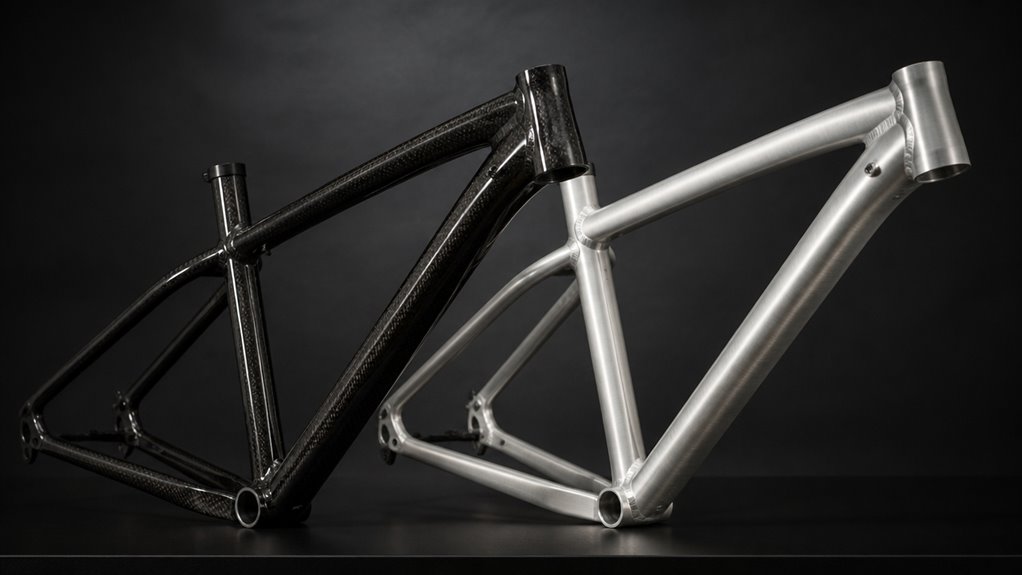
When comparing materials for weight-sensitive applications, carbon fiber stands out as markedly lighter than both aluminum and steel.
Carbon fiber excels as a significantly lighter choice compared to aluminum and steel for weight-sensitive uses.
You’ll find carbon fiber composites have a density around 1.5–1.6 g/cm³, considerably less than aluminum’s 2.7 g/cm³.
This means carbon fiber is roughly 40–45% lighter than aluminum by volume. Compared to steel, with a density near 7.8 g/cm³, carbon fiber is over five times lighter.
These density differences translate directly to potential weight savings in design. If your priority is minimizing mass while maintaining strength, carbon fiber offers a substantial advantage.
However, keep in mind these figures represent material density alone, not final part weight, which depends on specific design and structural requirements.
Still, carbon fiber’s low density makes it ideal for aerospace, automotive, and high-performance applications where weight reduction is critical.
Why Density Isn’t the Whole Story for Part Weight?
You can’t just rely on density to figure out part weight. It’s not that simple!
Material thickness can change based on the specific load requirements for a part. For instance, carbon fiber parts might need extra layers or reinforcements. This can really alter their overall mass, even though they’ve a lower density.
Similarly, in tool design, factors like weight and ergonomics play a critical role beyond just material density to reduce user fatigue during extended use.
Material Thickness Variations
Accounting for material thickness variations is essential to understanding why density alone doesn’t determine a part’s final weight.
Even if carbon fiber has a lower density than aluminum, you often need to adjust thickness to achieve equivalent strength or stiffness.
Carbon fiber composites rely on layered fiber orientations and resin matrices, which may require additional thickness in certain areas to handle stress or impact.
Unlike isotropic metals, these variations aren’t uniform, so your design must consider local reinforcement zones.
This means a carbon fiber part might be thicker or thinner than its metal counterpart, influencing overall mass.
Ultimately, you can’t assume a fixed weight reduction simply because density is lower; thickness and layup complexity play pivotal roles in the actual weight and performance results.
Similarly, in wood materials like white oak, cutting methods such as rift sawn versus quarter sawn significantly affect dimensional stability and material performance.
Load Requirements Impact
Although carbon fiber’s density is markedly lower than metals like aluminum and steel, the actual weight of a finished part depends heavily on the specific load requirements it must meet.
You can’t rely solely on density because structural demands dictate thickness, fiber orientation, and layup complexity.
For example, a carbon fiber component designed for high tensile loads may require additional plies or resin, increasing weight beyond simple density-based calculations.
Conversely, non-structural panels can exploit carbon fiber’s low density more fully, achieving significant weight savings.
When you design for equivalent stiffness or strength, the volume of material needed often varies, altering the final mass.
Similar to engineered hardwood installation, where load requirements impact the choice between glue and nails, composite part design must balance material use with performance needs.
How Design Choices Impact Carbon Fiber’s Weight Savings?
You know, the way we lay up carbon fiber really impacts its weight. It all comes down to fiber orientation and resin distribution, which play a huge role in determining stiffness and strength.
But here’s the catch: structural requirements can sometimes call for extra reinforcement. This can lead to increased thickness, which might offset some of those weight savings we’re aiming for.
Balancing material properties like hardness and toughness is crucial to optimize performance without unnecessary weight.
Layup Techniques Matter
When you design with carbon fiber, the layup technique directly influences the weight savings you achieve.
By strategically orienting fiber layers, you optimize strength and stiffness where needed, minimizing excess resin and fiber volume.
Unidirectional layups maximize load-bearing efficiency along specific axes but may require additional layers for multidirectional stresses.
Conversely, woven or multidirectional layups provide balanced properties but add weight due to increased resin content and overlapping fibers.
You must carefully select ply orientation and sequence to tailor mechanical performance while reducing mass.
Precision in layup reduces unnecessary material, ensuring that the composite meets performance targets with minimal weight.
Therefore, your layup choices critically affect the actual weight savings carbon fiber offers compared to traditional materials, going beyond simple density differences.
Additionally, controlling process variables with precise timing and preparation ensures optimal bonding and structural integrity in composites.
Structural Requirements Influence Weight
Selecting the right layup technique sets the foundation, but structural requirements ultimately dictate how much material carbon fiber parts need.
When you design for load-bearing applications, you must account for stress distribution, stiffness, and impact resistance. This often leads to thicker or more complex layups.
Even though carbon fiber’s density is lower, meeting equivalent strength or stiffness can minimize weight savings. Parts with multi-directional fiber orientations or added reinforcement layers increase material usage, reducing the theoretical weight advantage.
Conversely, non-structural components can leverage simpler layups and thinner sections, maximizing carbon fiber’s lightness.
Ultimately, your design choices balance required mechanical properties against minimal material. This governs the final weight, sometimes narrowing carbon fiber’s advantage compared to metals despite its inherently lower density.
For example, just as choosing between 15-gauge and 16-gauge nails involves balancing strength and finishing needs, carbon fiber design requires weighing performance against material use.
Carbon Fiber’s Stiffness-to-Weight Ratio and Performance
Many engineers prioritize carbon fiber’s exceptional stiffness-to-weight ratio, which markedly outperforms metals like aluminum and steel.
This ratio means you get more rigidity per unit mass, enabling lighter structures without compromising strength.
Carbon fiber’s anisotropic nature lets you tailor fiber orientation to optimize load paths, enhancing mechanical efficiency.
Unlike isotropic metals, you can design composites to resist specific stresses with minimal material.
However, the final performance depends on fiber volume fraction, resin type, and layup configuration.
While aluminum offers uniform stiffness, carbon fiber achieves higher modulus-to-density ratios, often doubling stiffness at substantially lower weight.
You must balance these advantages against factors like impact resistance and cost.
Ultimately, carbon fiber’s stiffness-to-weight benefits provide superior structural performance in applications where minimizing mass and maximizing rigidity are critical.
Similar to how surface preparation is critical for optimal bonding in materials like PVC, proper processing and treatment of carbon fiber composites are essential to fully realize their mechanical advantages.
Applications Benefiting From Carbon Fiber’s Weight Advantage
Understanding carbon fiber’s superior stiffness-to-weight ratio helps explain why industries focused on performance and efficiency prioritize its use.
When you replace aluminum or steel with carbon fiber composites, you achieve significant weight reductions.
Carbon fiber can be up to 40–50% lighter than aluminum and about five times lighter than steel.
This translates directly into improved fuel efficiency in aerospace and automotive sectors, where every kilogram saved reduces energy consumption and emissions.
In racing, you gain enhanced acceleration and handling due to lower mass and maintained structural integrity.
Sporting goods like bicycles and tennis rackets benefit from reduced fatigue and increased responsiveness.
Even in robotics and prosthetics, the weight advantage enables greater mobility and endurance.
Additionally, selecting materials with durability and stability similar to carbon fiber ensures long-lasting performance under constant use.
Key Tradeoffs Between Carbon Fiber and Metals
While carbon fiber offers outstanding weight savings and stiffness, it also introduces tradeoffs that you must carefully consider compared to metals like aluminum and steel.
Carbon fiber’s anisotropic nature demands precise fiber orientation for peak strength, unlike the isotropic behavior of metals. Additionally, you’ll face higher costs and more complex fabrication methods with carbon fiber.
Metals remain easier to machine, weld, and recycle, often offering better impact resistance and repairability.
Galvanized pipes, for instance, demonstrate how coatings can significantly improve corrosion resistance and durability compared to untreated metals.
| Aspect | Carbon Fiber | Metals (Aluminum/Steel) |
|---|---|---|
| Weight | ~40–80% lighter | Heavier |
| Fabrication | Complex, layup sensitive | Easier machining and welding |
| Cost & Repairability | Higher cost, limited repair | Lower cost, easier repair |
You must weigh these factors based on your application priorities.
Frequently Asked Questions
How Does Carbon Fiber Resist Corrosion Compared to Metals?
You’ll find carbon fiber resists corrosion much better than metals because it’s a composite material with inert carbon fibers embedded in resin.
Unlike aluminum or steel, it doesn’t oxidize or rust when exposed to moisture or chemicals.
However, the resin matrix can degrade under UV exposure or harsh chemicals, so you need proper coatings or maintenance.
What Environmental Impacts Result From Carbon Fiber Production?
Imagine a smoky factory where raw materials transform into carbon fiber strands.
You’ll face significant environmental impacts: high energy consumption, toxic chemical use, and carbon emissions during production.
The precursor materials, often petroleum-based, add to fossil fuel depletion.
Waste management is tricky since recycling carbon fiber composites remains challenging.
While you benefit from its lightweight strength, you must weigh these environmental costs when choosing carbon fiber in sustainable design.
Can Carbon Fiber Be Recycled Effectively After Use?
You can recycle carbon fiber, but it’s challenging and less efficient than metals.
Current methods like pyrolysis or solvolysis recover fibers, but quality degrades, limiting reuse in high-performance applications.
Recycling processes are energy-intensive and costly, so recycled fibers often end up in lower-grade composites.
Advances in chemical recycling and mechanical shredding aim to improve this, but effective, large-scale carbon fiber recycling still faces technical and economic hurdles you need to take into account.
How Does Carbon Fiber Perform Under Extreme Temperatures?
Carbon fiber performs well under extreme temperatures, maintaining stiffness and strength up to about 250°C (482°F).
Beyond this, the resin matrix can degrade, reducing mechanical properties. You’ll need specialized high-temperature resins for applications exceeding this range.
Unlike metals, carbon fiber composites resist thermal expansion, offering dimensional stability. However, thermal cycling can cause microcracking in the matrix.
Design considerations must address temperature fluctuations to guarantee durability.
What Are the Typical Costs of Carbon Fiber Versus Metals?
Imagine you’re replacing aluminum parts in a sports car with carbon fiber.
You’ll notice carbon fiber costs markedly more, typically 3 to 10 times higher per kilogram.
This premium reflects complex manufacturing, specialized raw materials, and labor-intensive processes.
Metals like aluminum and steel benefit from established, efficient production.
While carbon fiber offers unmatched strength-to-weight ratios, you’ll need to justify its higher upfront cost against performance gains and long-term benefits.
Final Answer: Is Carbon Fiber Lighter?
When you compare carbon fiber to aluminum and steel, you’ll see it’s not just about density. It’s about how design and material properties combine to save weight.
Carbon fiber’s superior stiffness-to-weight ratio lets you build lighter, stronger parts that excel in performance.
But remember, every advantage comes with tradeoffs.
Think of carbon fiber as a finely tuned instrument: powerful yet delicate, offering unmatched potential if you play it right.