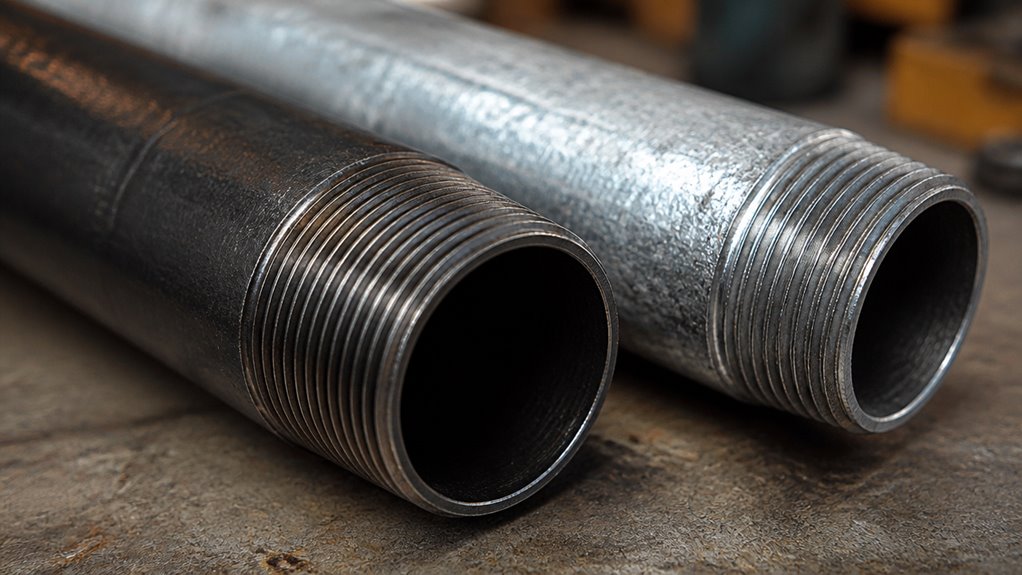
Black Pipe Vs Galvanized: Strength, Cost & Durability
You’ll choose black pipe when cost savings and high-temperature gas systems matter, as it handles up to 350°C and pressures to 32 MPa without coating.
Galvanized pipe excels for water and outdoor use, offering a zinc-iron alloy coating that prevents corrosion and lasts 40–80 years maintenance-free.
Black pipes rust quickly without regular painting, while galvanized pipes self-heal minor damage.
Understanding these differences helps optimize material choice for your specific application and environment.
Key Takeaways
- Galvanized pipes have a zinc-iron alloy coating that prevents corrosion, while black pipes have only a thin iron oxide layer prone to rust.
- Black pipes withstand higher temperatures (up to 350°C) and pressures (up to 32 MPa) compared to galvanized pipes.
- Galvanized pipes are ideal for outdoor and water systems due to superior corrosion resistance and longer service life (40–80 years).
- Black pipes cost about 50% less upfront but require frequent maintenance and replacement due to limited corrosion resistance.
- Galvanized pipes should be avoided for gas lines to prevent zinc fume hazards; black pipes are preferred for gas and fire sprinkler systems.
Black Pipe or Galvanized Pipe: Key Differences at a Glance
| Feature | Black Pipe | Galvanized Pipe |
|---|---|---|
| Material | Mild steel with iron oxide finish | Steel coated with zinc |
| Surface Finish | Matte black | Silvery-gray metallic |
| Corrosion Resistance | Low | Excellent |
| Rust Protection | Requires painting or coating | Zinc coating provides long-term protection |
| Best For | Gas lines, fire sprinkler systems | Water supply and outdoor plumbing |
| Maximum Temperature | Up to 350°C | Up to 200°C |
| Maximum Pressure | Up to 32 MPa | Up to 28 MPa |
| Outdoor Use | Not recommended without protection | Excellent |
| Water Systems | Not recommended | Ideal |
| Gas Systems | Preferred choice | Generally not recommended |
| Service Life | Around 5–8 years in humid conditions | Around 40–80 years |
| Maintenance | Requires regular rust prevention | Minimal maintenance |
| Weight | Lighter | Slightly heavier due to zinc coating |
| Initial Cost | Lower (about 50% less) | Higher |
| Long-Term Cost | Higher because of maintenance and replacement | Lower due to longer lifespan |
| Main Advantage | Affordable, strong, and ideal for high-temperature gas applications | Superior corrosion resistance and long-lasting durability |
| Main Drawback | Rusts quickly if exposed to moisture | Higher upfront cost and lower temperature tolerance |
Choosing Between Black and Galvanized Pipes: What You Need to Know?

When deciding between black and galvanized pipes, you need to take into account their distinct manufacturing processes, corrosion resistance, and intended applications.
Galvanized pipes undergo hot-dip galvanizing, where a zinc layer forms a protective 80–120 μm thick zinc-iron alloy. This process provides a silvery-gray metallic finish.
Galvanized pipes feature an 80–120 μm zinc-iron alloy coating, giving a durable silvery-gray finish.
Black pipes, produced from mild steel without coatings, develop a thin iron oxide scale under 5 μm, appearing uniformly dark.
Galvanized pipes prevent direct steel exposure to moisture, whereas black pipes rely solely on minimal iron oxide passivation.
Manufacturing steps differ: galvanized pipes require cleaning, pre-heating, and zinc immersion. Black pipes are formed by stretching or welding steel tubes.
These fundamental differences influence durability, visual inspection, and suitability for specific fluids and environments. This guides your choice based on technical requirements.
It is important to note that exposure to moisture can significantly impact the longevity of pipes, making protective coatings a key consideration in choosing the right type.
Why Galvanized Pipes Resist Corrosion Better Than Black Pipes?
Although both black and galvanized pipes are made of steel, galvanized pipes resist corrosion far better due to their protective zinc coating. This coating acts as a sacrificial anode and physical barrier.
The zinc layer, typically 80–120 μm thick, forms a stable zinc-iron alloy that prevents direct exposure of steel to oxygen and moisture. This coating oxidizes preferentially, protecting the underlying steel even if scratched.
In contrast, black pipes rely solely on a thin iron oxide scale, less than 5 μm thick, which provides minimal corrosion resistance. Salt spray tests show galvanized pipes endure over 27 times longer before rust appears compared to black steel.
Additionally, galvanized pipes require no active maintenance, as the zinc layer self-heals minor damages. This ensures extended service life in corrosive environments.
For metal coatings, proper surface preparation is critical to ensure adhesion and durability, preventing peeling or flaking over time.
Which Pipes Are Best for Water and Gas Systems?
Selecting the appropriate pipe material for water and gas systems hinges on their distinct chemical and operational requirements.
For water systems, galvanized pipes are best due to their zinc coating, which prevents internal rust contamination and guarantees long-term corrosion resistance.
They maintain structural integrity in wet environments without requiring maintenance, supporting municipal and residential water supply reliably.
Conversely, black pipes suit gas systems because they lack zinc, eliminating risks of zinc fumes during welding and combustion hazards.
Black steel handles higher pressures and temperatures typical in gas delivery, especially for propane and natural gas.
You should avoid galvanized pipes for gas lines to prevent zinc combustion.
To summarize, use galvanized pipes for water transport and black pipes for gas systems, aligning their protective properties and safety standards with system demands.
Regular inspection and maintenance, such as using waterproof sealants, can help preserve the integrity of pipe installations in harsh environmental conditions.
How Temperature and Pressure Impact Black and Galvanized Pipes?
When it comes to the temperature tolerance of black and galvanized pipes, there’s quite a difference. Black pipes can handle temperatures up to 350°C, which is pretty impressive! On the other hand, galvanized pipes, thanks to their zinc coating, are capped at around 200°C. So, if you’re working in a high-temperature environment, black pipes might be the way to go.
Now, let’s talk about pressure. Black pipes are quite robust and can take on pressures up to 32 MPa. That’s a lot! In contrast, galvanized pipes are a bit more limited, operating safely at about 28 MPa. It’s worth noting that they do experience some strength reduction at those higher pressures.
These differences really matter when you’re considering which type of pipe to use for specific applications, especially if you’re dealing with high temperatures or pressures.
Temperature Resistance Comparison
When operating under high temperatures and pressures, you must consider the distinct limits of black and galvanized pipes to guarantee safety and performance.
Black pipes withstand temperatures up to 350°C, making them suitable for applications involving elevated heat, such as steam and fire sprinkler systems.
In contrast, galvanized pipes have a maximum temperature limit around 200°C, as the zinc coating degrades and loses protective properties beyond this point.
Exposure above this threshold can cause zinc layer deterioration, leading to accelerated corrosion and reduced mechanical integrity.
Consequently, if your system involves temperatures exceeding 200°C, black pipes provide better thermal resilience.
Keep in mind that the zinc coating on galvanized pipes also influences their thermal expansion and corrosion resistance under heat.
Selecting the correct pipe type based on precise temperature requirements is critical for long-term reliability.
Additionally, improper venting or inadequate ventilation in systems using these pipes can lead to safety hazards such as carbon monoxide buildup that must be carefully managed.
Pressure Handling Capabilities
Temperature limits directly influence pressure handling capabilities, as both factors dictate the pipe’s structural integrity under operating conditions.
Black pipes withstand higher temperatures up to 350°C and can handle pressures reaching 32 MPa. This makes them suitable for high-pressure gas lines and industrial applications.
In contrast, galvanized pipes have a lower temperature limit of 200°C and operate safely up to 28 MPa. The zinc coating on galvanized pipes slightly reduces their pressure tolerance due to its impact on the steel’s mechanical properties.
When operating near temperature or pressure limits, black pipes maintain superior strength. However, galvanized pipes offer sufficient capacity for typical water supply and outdoor uses.
Select black steel for demanding high-temperature, high-pressure environments. Galvanized steel suits moderate conditions prioritizing corrosion resistance.
Proper material selection is crucial, much like choosing the right fastener type ensures optimal performance and durability in assembly applications.
Best Applications for Black and Galvanized Pipes Indoors, Outdoors, and Industrial Settings
Although both black and galvanized pipes serve essential roles across various environments, their distinct material properties dictate their best application indoors, outdoors, and in industrial settings.
You’ll find black pipes most suitable for indoor use, especially in dry environments where humidity remains below 60%. They excel in high-pressure gas delivery, fire sprinkler systems, and industrial steam lines due to their higher temperature and pressure limits (up to 350°C and 32 MPa).
Conversely, galvanized pipes are ideal outdoors and in municipal water systems, where corrosion resistance is critical. Their zinc coating guarantees decades of maintenance-free service against moisture and atmospheric exposure.
In industrial settings, galvanized pipes support water supply and protective structural elements, while black pipes handle gas transmission and fire-resistant applications. Selecting the right pipe depends on environmental conditions and fluid type.
Proper maintenance and regular inspection help prevent corrosion buildup that can compromise pipe performance over time.
Cost and Long-Term Durability of Black vs Galvanized Pipes
When it comes to costs, black pipes really stand out—they’re about 50% cheaper than galvanized pipes right off the bat. This makes them a great choice if you’re looking for something economical for short-term use.
But here’s the catch: they don’t hold up well against corrosion. You’ll find yourself needing to do regular maintenance, like repainting, to keep them from deteriorating too quickly.
On the flip side, galvanized pipes are a bit pricier upfront, but they offer fantastic long-term durability. Thanks to their zinc coating, they require minimal upkeep, which can save you headaches down the road.
Additionally, choosing materials with proper fire resistance ratings can enhance safety in installations where fire hazards are a concern.
Initial Material Cost
When choosing between black and galvanized pipes, understanding initial material cost is essential for balancing budget and project requirements.
Black pipes typically cost about 50% less than galvanized pipes, with prices around ¥28.5/m compared to ¥42.8/m for galvanized steel.
This difference arises because galvanizing adds 15–30% to the base steel cost due to the zinc coating process.
The zinc layer not only increases material expenses but also slightly adds weight, about 4–7%.
If your project prioritizes upfront savings and operates in dry, controlled environments, black steel offers economical advantages.
However, for applications demanding extended service life without frequent maintenance, galvanized pipes justify their higher initial cost by providing long-term durability and corrosion protection.
This reduces replacement and upkeep expenses over time.
Selecting corrosion-resistant materials is crucial to maintaining strength and preventing premature failure in outdoor or harsh environments.
Corrosion Resistance Impact
Beyond initial costs, corrosion resistance profoundly influences the total expenditure and lifespan of black and galvanized pipes.
Galvanized pipes feature a zinc coating that acts as a sacrificial anode, preventing steel oxidation and extending service life to 40–80 years in urban atmospheres without maintenance.
In contrast, black pipes rely solely on a thin iron oxide layer, which offers minimal protection and rusts within months in humid environments unless regularly painted.
This limited resistance reduces black pipe durability to 5–8 years, increasing replacement frequency and indirect costs.
Furthermore, galvanized pipes withstand aggressive conditions, including saline exposure and high humidity, far better than black pipes.
Consequently, while black pipes have lower upfront costs, their inferior corrosion resistance results in higher long-term expenses and shorter functional lifespan compared to galvanized alternatives.
Applying protective coatings and regular maintenance can significantly enhance black pipe longevity by preventing moisture infiltration and corrosion corrosion protection techniques.
Maintenance and Longevity
Maintaining black and galvanized pipes involves distinct challenges that directly affect their longevity and overall cost.
You’ll find galvanized pipes require minimal maintenance due to their zinc coating, which offers sacrificial anode protection and barrier defense. This extends service life up to 40–80 years in urban atmospheres without active intervention.
Conversely, black pipes rely on a thin iron oxide layer, necessitating regular anti-rust paint applications every two years. This prevents rapid corrosion and structural degradation, limiting lifespan to 5–8 years in humid conditions.
While black pipes cost approximately 50% less initially, ongoing maintenance and shorter replacement cycles increase total expenses.
Galvanized pipes, despite higher upfront costs and 4–7% additional weight, provide superior long-term durability and reduced maintenance. This makes them more cost-effective for outdoor or moisture-exposed applications.
Additionally, galvanized steel’s resistance to moisture penetration and oxidation significantly reduces the risk of mold growth and corrosion-related damage over time.
How to Maintain Black and Galvanized Pipes for Longer Life?
Extending the service life of black and galvanized pipes requires tailored maintenance strategies that address their distinct corrosion protection mechanisms.
Effective pipe longevity depends on maintenance strategies that respect their unique corrosion defenses.
For black pipes, apply anti-rust paint coatings every two years to prevent rapid oxide scale deterioration and corrosion. Inspect surfaces regularly for paint degradation or rust formation, especially in humid environments.
For galvanized pipes, active maintenance is minimal due to the zinc sacrificial layer’s self-healing properties. However, if welding damages the zinc coating, re-galvanizing or applying zinc-rich paint is essential to restore corrosion resistance.
Avoid prolonged exposure to highly acidic or alkaline conditions to maintain zinc integrity. In both cases, ensure proper drainage and ventilation to reduce moisture accumulation, which accelerates corrosion processes and compromises pipe longevity.
Frequently Asked Questions
What Manufacturing Standards Apply to Black and Galvanized Pipes?
You should refer to EN ISO 1461 for galvanized pipes, which governs hot-dip galvanizing standards. This ensures zinc coating quality and thickness.
For black pipes, manufacturing typically follows standards for mild steel seamless or welded tubing. These specify chemical composition and mechanical properties, although no specific coating standard applies.
You must also consider ASTM or ISO standards relevant to pipe dimensions, pressure ratings, and steel grades. This is essential to secure compliance with intended industrial applications.
How Does Zinc Coating Thickness Affect Galvanized Pipe Performance?
You’ll find that zinc coating thickness directly enhances galvanized pipe performance by extending corrosion resistance and service life.
A thicker zinc layer, typically around 80–120 μm, provides a robust sacrificial barrier, preventing rust for decades. In urban environments, this can mean protection lasting up to 40–80 years.
Thinner coatings reduce protection, shortening lifespan and increasing maintenance needs.
Ensuring adequate zinc thickness is vital for durability, especially in harsh atmospheric or saline conditions.
Can Galvanized Pipes Be Safely Welded Without Damaging the Coating?
Think of the zinc coating as a castle’s protective moat.
When you weld galvanized pipes, you’re breaching that moat, exposing the steel to rust.
So, you can weld them, but you’ll damage the zinc layer locally.
To keep corrosion at bay, you must promptly repair the weld area with cold galvanizing paint or re-galvanize.
Without this, the protective barrier fails, risking premature corrosion and reduced pipe lifespan.
What Environmental pH Levels Are Suitable for Black Versus Galvanized Pipes?
You should use black pipes in environments where the pH is neutral to slightly alkaline.
Avoid corrosive atmospheres, as their iron oxide scale offers minimal protection.
Galvanized pipes perform well across a broader pH range, specifically from 3 to 11, due to their zinc coating’s sacrificial protection.
This makes galvanized pipes more suitable for acidic or mildly alkaline conditions, especially in outdoor or humid settings where corrosion resistance is critical.
Are There Alternative Coatings Besides Galvanizing for Corrosion Protection?
Yes, you can use alternative coatings like electro-zinc plating and zinc flake coatings for localized corrosion protection.
Metallization is another method, often applied to threaded or small areas.
For severe environments, duplex galvanizing combines zinc with organic coatings, enhancing durability.
In extreme cases, stainless steel is preferred due to its superior corrosion resistance.
Each method suits different applications, balancing cost, protection level, and environmental conditions effectively.
The Key Differences Between Black and Galvanized Pipes
Choosing between black and galvanized pipes is like picking the right tool for a job: each excels under specific conditions.
You’ll want galvanized pipes for corrosion resistance in water systems and black pipes for gas lines needing strength under pressure.
Consider your environment, temperature, and budget carefully. Proper maintenance extends both types’ longevity, ensuring peak performance.
By understanding their distinct properties, you can make an informed, cost-effective choice tailored to your system’s needs.