Playground Mulch vs Wood Chips: Smarter Final Choice
When choosing between playground mulch and wood chips, consider safety, durability, and compliance.
Playground mulch is engineered wood fiber, free of bark and debris, offering certified impact absorption and ADA compliance with consistent cushioning.
Wood chips provide a natural look and slower decomposition but may include sharp edges and bark, raising splinter risks. Mulch needs yearly replenishment, while wood chips require regular raking.
Understanding these differences helps you select the ideal surface tailored to your play area’s demands and safety standards.
Key Takeaways
- Playground mulch is engineered wood fiber, free of bark and debris, designed for superior cushioning and ASTM-certified impact absorption.
- Wood chips are shredded hardwood pieces with natural bark and twigs, offering a rustic look but higher splinter and injury risks.
- Mulch requires consistent 6–8 inch depth and annual replenishment to maintain safety and ADA-compliance, while wood chips need regular raking and debris removal.
- Wood chips decompose slower and last longer but may shift and require frequent redistribution, whereas mulch biodegrades steadily and needs yearly topping.
- Playground mulch costs more upfront but ensures certified safety and uniformity; wood chips are more economical but less consistent and potentially less safe.
Comparison Table for Playground Mulch vs Wood Chips
| Feature | Playground Mulch (Engineered Wood Fiber) | Wood Chips |
|---|---|---|
| Material Composition | Engineered wood fiber, bark-free, debris-free | Shredded hardwood with bark, twigs, and natural debris |
| Safety Level | High safety, ASTM F1292 certified impact absorption | Moderate safety, higher risk of splinters and sharp edges |
| Surface Consistency | Uniform and smooth | Irregular and less consistent |
| Cushioning Performance | Excellent shock absorption, designed for impact protection | Basic cushioning, less consistent impact absorption |
| ADA Compliance | Yes, supports accessibility standards | Not typically ADA-compliant |
| Maintenance Needs | Annual replenishment (2–3 inches), depth monitoring | Frequent raking, debris removal, occasional redistribution |
| Durability | Good but requires yearly topping due to biodegradation | Longer natural lifespan but shifts and degrades unevenly |
| Decomposition Rate | Faster biodegradation (needs replenishment) | Slower decomposition, lasts longer |
| Cost | Higher upfront cost ($25–$45 per cubic yard) | Lower cost (~$30 per cubic yard) |
| Safety Hazards | Minimal splinters, fewer injuries | Higher risk of splinters, uneven surfaces |
| Appearance | Clean, uniform, engineered look | Natural, rustic appearance |
| Best Use Areas | Swings, slides, high-impact play zones, ADA areas | Open playfields, trails, low-impact zones |
What Playground Mulch and Wood Chips Are Made Of?
Playground mulch and wood chips differ primarily in their composition and processing.
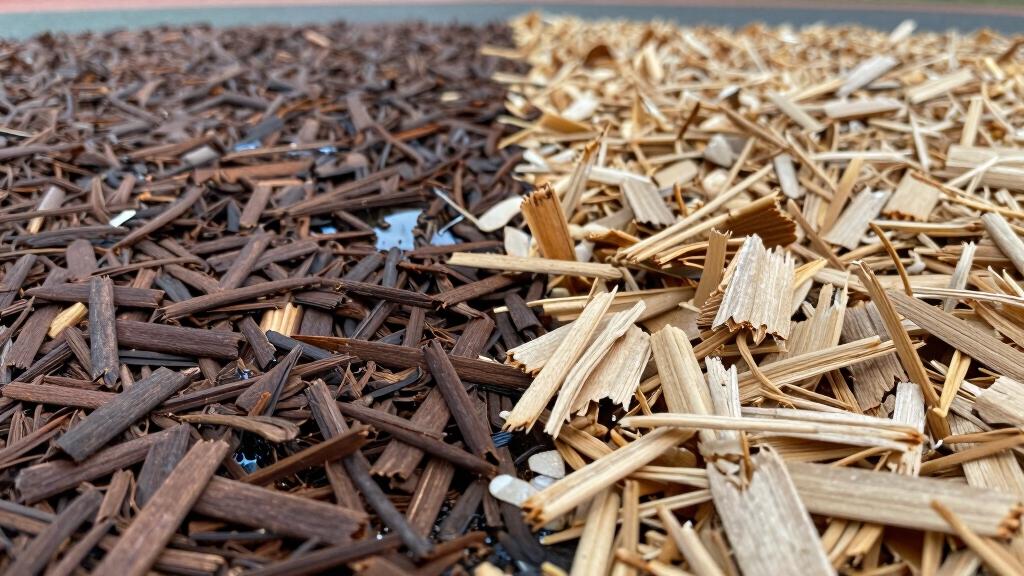
When you choose playground mulch, you get a refined product: engineered wood fiber (EWF) that’s free of bark, twigs, and foreign debris. This produces a clean, uniform surface.
These fibers are precisely sized and tumbled to remove sharp edges, guaranteeing a smooth, cushioned texture.
In contrast, wood chips consist of shredded hardwood pieces, ranging 15-30 mm, often including bark or small sticks. Though less processed, playground wood chips are carefully selected for consistent sizing and rounded corners to reduce hazards.
Regular garden mulch isn’t suitable for play areas due to its bark content and decomposition tendencies.
Wood chips offer long-lasting ground cover and decompose more slowly, making them durable but less suitable for areas requiring frequent replacement.
Playground Mulch Vs Wood Chips: Safety Differences
Although both playground mulch and wood chips provide cushioning, their safety profiles differ markedly due to material processing and design.
Playground mulch undergoes careful processing to remove bark, twigs, and debris. This results in a cleaner, splinter-free surface that meets ASTM F1292 impact absorption standards.
Playground mulch is meticulously processed for a clean, splinter-free surface that complies with ASTM F1292 impact standards.
Wood chips, often less refined, may contain sharp edges or foreign materials, increasing injury risks.
Consider these safety distinctions:
- Playground mulch features rounded particles, reducing cuts and abrasions.
- Its fibrous structure flexes on impact, enhancing shock absorption.
- Wood chips offer slip resistance but may harbor splinters from bark or sticks.
- Certified mulch is regularly tested for consistent fall protection, unlike basic wood chips.
You’ll find playground mulch delivers superior safety through engineered design and rigorous quality control. Additionally, playground mulch’s durability and slow decomposition help maintain consistent cushioning performance over time.
Why Certified Playground Mulch Is Safer Than Basic Wood Chips?
Safety stands as the foremost consideration when selecting surfacing materials for play areas. Certified playground mulch outperforms basic wood chips in this regard.
Certified mulch undergoes rigorous processing to remove bark, twigs, and foreign debris. This creates a cleaner, more uniform surface. Its engineered fibrous structure absorbs impact efficiently, meeting ASTM F1292 standards and reducing injury risk from falls.
In contrast, basic wood chips often contain sharp edges and inconsistent sizing. This increases splinter and cut hazards.
Certified mulch also flexes upon impact, providing superior cushioning. Its regular testing guarantees consistent safety performance.
When you choose certified playground mulch, you’re selecting a surface engineered for peak protection and accessibility. This far exceeds the slip-resistant yet variable qualities of basic wood chips.
Additionally, using adhesives with waterproof and weather-resistant properties ensures the durability and safety of playground installations over time.
Durability and Longevity of Playground Mulch and Wood Chips
You’ll notice that playground mulch really holds up well under heavy foot traffic. This is mainly because of its uniform sizing and the absence of foreign materials.
On the other hand, wood chips tend to degrade more slowly, which is a plus. However, they do need more frequent maintenance to keep up with decomposition and ensure safety.
Selecting materials with proven durability and wear resistance can help maintain safety and functionality over time.
Resistance to Wear
Playground mulch withstands heavy foot traffic and repeated impacts with minimal shifting, ensuring consistent coverage and cushioning over time.
When choosing between playground mulch and wood chips, consider these resistance factors:
- Uniform particle size in playground mulch maintains structural integrity under stress.
- Wood chips resist breakdown longer but may shift more, requiring frequent redistribution.
- Engineered wood fiber’s fibrous composition flexes on impact, reducing displacement.
- Certified playground mulch excludes bark and debris, minimizing wear from foreign elements.
You’ll find playground mulch offers superior durability for safety-critical areas. Wood chips balance natural aesthetics with moderate wear resistance.
Regular maintenance prolongs both materials’ performance. If you want a stable, long-lasting surface, playground mulch’s engineered consistency provides better resistance to wear. Additionally, selecting materials with moisture and decay resistance can further enhance longevity in outdoor settings.
Biodegradation Rates
Alongside resistance to wear, understanding biodegradation rates helps determine how long playground mulch and wood chips will maintain their effectiveness.
Playground mulch, especially engineered wood fiber, biodegrades steadily due to its bark-free, fibrous composition. This necessitates annual replenishment to preserve safety and cushioning.
Its uniform size and absence of foreign materials optimize durability but don’t eliminate natural decomposition.
Conversely, wood chips exhibit slower biodegradation because of their denser hardwood content and occasional bark presence. This offers longer-lasting coverage under foot traffic.
However, their irregular shapes and occasional twigs can compromise structural integrity over time.
You’ll find that both materials rely on natural microbial activity and environmental exposure. Playground mulch requires more frequent top-offs to maintain impact absorption standards, while wood chips provide a moderately extended lifespan with less frequent intervention.
It is also important to consider that the decomposition rates of these materials affect soil enrichment and maintenance frequency in landscaping applications.
Maintenance Frequency
Although both playground mulch and wood chips offer durable cushioning surfaces, their maintenance frequency varies markedly due to differences in material composition and biodegradation rates. You’ll need to stay attentive to specific upkeep tasks to preserve safety and longevity.
- Playground mulch demands a consistent depth of 6–8 inches. It requires annual topping with 2–3 inches of fresh material to compensate for decomposition.
- Wood chips decompose more slowly but require regular raking to prevent compaction. Periodic removal of weeds and foreign objects is also necessary.
- Engineered wood fiber, a type of playground mulch, needs yearly replenishment to maintain impact absorption and ADA compliance.
- Neglecting maintenance accelerates material breakdown. This reduces cushioning effectiveness and increases hazards.
- Choosing materials with biodegradation rates suited to your maintenance schedule can help optimize safety and reduce labor over time.
Best Playground Surface Choices for Different Play Areas
When selecting surfaces for different play areas, you’ll want to match materials to activity types and safety requirements.
For high-impact zones like swings and slides, playground mulch offers superior cushioning with ASTM F1292-certified impact absorption.
Engineered wood fiber suits ADA-compliant spaces, providing firmness and wheelchair accessibility without compromising safety.
If you prefer a natural aesthetic with excellent drainage, wood chips are ideal for open playfields and nature trails.
Avoid regular garden mulch due to bark and decomposition risks.
For pathways or dog runs, choose certified playground chips with uniform sizing and rounded edges to guarantee consistent coverage and injury prevention.
Each surface demands proper depth and maintenance to maintain performance.
Selecting the right material aligns safety, durability, and functional design with your play area’s unique demands.
Regular maintenance and monitoring of surface conditions are essential to preserve impact absorption and safety over time.
Cost Comparison of Playground Mulch and Wood Chips
Understanding the cost differences between playground mulch and wood chips is essential for budgeting your play area project effectively.
Playground mulch, particularly engineered wood fiber, tends to be pricier due to its processing standards and safety certifications. Wood chips offer a more economical alternative but may lack consistent safety features.
Consider these factors:
- Engineered playground mulch ranges from $25 to $45 per cubic yard, reflecting its refined quality.
- Standard playground wood chips cost about $30 per cubic yard, offering cost efficiency.
- Premium playground bark mulch can reach $80 to $120 per cubic meter, reflecting certification costs.
- Maintenance-related topping usually requires 2-3 inches annually, influencing ongoing expenses.
Additionally, choosing materials with moisture-resistant cores can help extend the lifespan and reduce maintenance costs of playground surfaces.
Maintenance Tips for Playground Mulch and Wood Chips
Regularly maintaining playground mulch and wood chips is essential to preserving their safety and functionality. You’ll want to monitor depth, remove debris, and prevent compaction to maintain impact absorption.
Annual top-offs refresh cushioning and compensate for biodegradation.
| Task | Playground Mulch | Wood Chips |
|---|---|---|
| Depth Maintenance | Keep 6-8 inches, replenish yearly | Check and maintain consistent depth |
| Debris Removal | Remove twigs, bark, foreign material | Remove sticks, weeds, and trash |
| Surface Conditioning | Rake to prevent compaction | Rake to maintain springiness |
Using protective mats and maintaining proper surface conditions can further enhance the durability and safety of playground surfaces.
With precise upkeep, you guarantee long-lasting performance and safety compliance. Neglect accelerates breakdown and reduces protective qualities. Stay proactive for peak playground conditions.
Choosing Between Playground Mulch and Wood Chips for Your Space
Maintaining the right depth and surface quality sets the foundation for selecting the best material for your playground or outdoor area.
Proper depth and surface quality are essential for choosing the ideal playground or outdoor material.
You’ll want to evaluate safety, durability, aesthetics, and cost to make an informed choice between playground mulch and wood chips.
- Safety: Playground mulch offers ASTM-certified impact absorption and minimizes splinters due to its bark-free, uniform fibers.
- Durability: Wood chips resist decomposition longer but may contain bark or twigs, affecting surface consistency.
- Aesthetics: Mulch provides a cleaner, uniform look, while wood chips emphasize a natural, rustic appearance.
- Cost: Wood chips generally cost less upfront but require regular maintenance. Premium playground mulch demands a higher initial investment for certified safety.
Assess your priorities to select the material that aligns best with your space’s functional and visual needs.
Frequently Asked Questions
Can Playground Mulch or Wood Chips Be Used for Garden Landscaping?
You can use wood chips for garden landscaping since they provide good drainage and a natural aesthetic.
Playground mulch isn’t ideal because it’s designed for cushioning, lacks bark, and decomposes faster, which may not enrich your soil adequately.
For long-term garden health, choose hardwood chip mulch. They resist breakdown better and improve soil over time.
Make sure to monitor decomposition and replenish mulch to maintain soil quality and appearance.
How Do Environmental Conditions Affect Mulch and Wood Chip Decomposition Rates?
Like a timekeeper’s dance, environmental conditions dictate mulch and wood chip decomposition rates.
You’ll find warmer, moist climates speed up breakdown, as microbes thrive and accelerate decay.
Conversely, cold, dry environments slow this process, preserving material longer.
Wood chips resist decomposition better than regular mulch due to density, but both require monitoring.
You’ll need to replenish surfaces periodically, depending on exposure to sun, rain, and temperature fluctuations.
Are There Eco-Friendly Disposal Methods for Old Playground Mulch or Wood Chips?
You can eco-friendly dispose of old playground mulch or wood chips by composting them, turning them into nutrient-rich material for gardens.
Make certain they’re free from contaminants like plastics or metals first.
Another method is using them as ground cover in landscaping or erosion control, preventing waste and promoting soil health.
Avoid landfill disposal, as these materials biodegrade naturally but contribute to waste buildup if not repurposed thoughtfully.
What Are the Best Tools for Spreading and Maintaining Playground Mulch?
Want to tame chaos into order? Use a sturdy landscape rake and a flat shovel for even spreading. A wheelbarrow helps you transport mulch efficiently.
A garden hoe can break up clumps to guarantee uniform depth. Regularly use a leaf blower or broom to clear debris.
These tools combined give you precise control, maintaining consistent cushioning and preventing compaction. This is vital for playground safety and durability.
Can Pets Safely Play on Playground Mulch or Wood Chip Surfaces?
Yes, pets can safely play on playground mulch or wood chip surfaces, but you need to choose carefully.
Engineered playground mulch, free of bark and sharp edges, reduces splinters and cuts, making it safer for paws.
Wood chips offer a softer, slip-resistant cushion but might contain twigs or bark that can cause minor injuries.
Always inspect the surface regularly, maintain proper depth, and avoid toxic additives to ensure your pet’s safety and comfort.
Making the Right Call: Mulch vs. Wood Chips Conclusion
When choosing between playground mulch and wood chips, you want safety, durability, and cost-efficiency all in one package. Certified playground mulch offers superior protection and longevity, making it the gold standard for any play area.
While wood chips might seem like a budget-friendly option, they often fall short on safety and maintenance. Don’t settle for less; your playground deserves a surface that’s as reliable and resilient as a fortress.
Choose wisely to keep playtime safe and fun.