Siding Nailer vs Framing Nailer: Make the Right Choice
You’ll want a siding nailer for lightweight, precise nailing on thin materials like cedar siding, thanks to its adjustable depth control and flat tips that prevent surface damage.
A framing nailer is built for heavy-duty work, driving longer, ring-shank nails deep into dense lumber with high-impact force but risks marring soft siding.
While you can use a framing nailer on siding with care, siding nailers aren’t suited for framing tasks. Understanding these differences helps you pick the right tool for each project.
Key Takeaways
- Framing nailers drive longer, ring-shank nails for structural framing, while siding nailers use shorter, corrosion-resistant nails for exterior siding.
- Siding nailers are lighter (~5 lbs) with adjustable depth control to prevent surface damage, ideal for precision nailing on thin siding materials.
- Framing nailers deliver higher impact and fixed depth for deep penetration into dense lumber, making them heavier (8–9 lbs) and more durable.
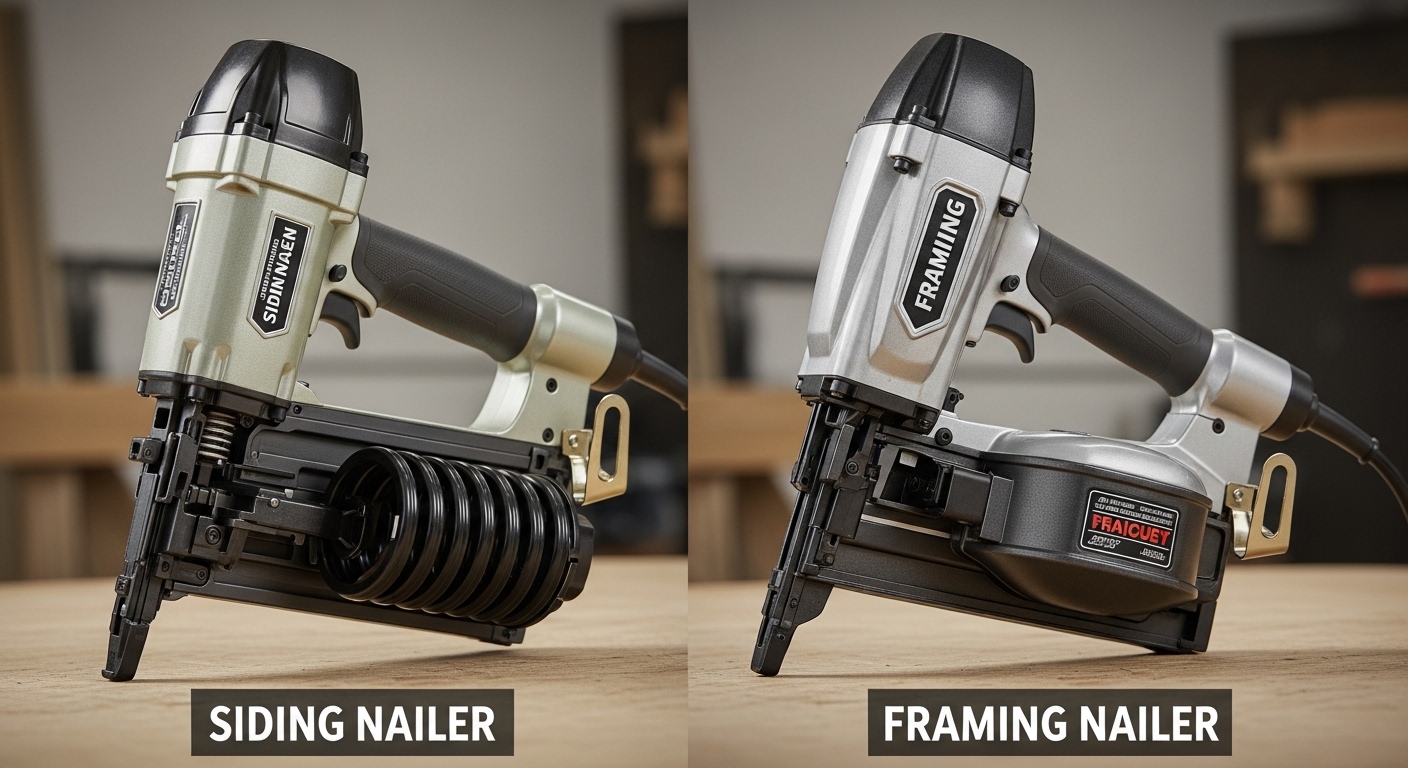
- Siding nailers typically use coil-fed nails for longer runs and a flat tip design to protect siding surfaces from marks and damage.
- Framing nailers can be used on siding if the correct shorter nails and protective measures are applied, but siding nailers are unsuitable for framing tasks.
Siding Nailer or Framing Nailer: Side-by-Side Comparison
| Feature | Siding Nailer | Framing Nailer |
|---|---|---|
| Primary Use | Exterior siding, thin materials | Structural framing, heavy-duty lumber |
| Nail Length | 1-1/4″ to 2-1/2″ | 3″ to 3-1/2″+ |
| Power & Impact | Moderate, controlled precision | High-impact, deep penetration |
| Weight | Lightweight (~5 lbs) | Heavier (8–9 lbs) |
| Nail Type | Galvanized or stainless, corrosion-resistant | Ring or screw shank for strong grip |
| Feeding System | Coil-fed (high capacity, fewer reloads) | Stick-fed (common) or coil-fed |
| Tip Design | Flat tip to protect surfaces | Spiked tip for grip and stability |
| Depth Control | Adjustable for clean finishes | Fixed, optimized for power |
| Best For | Precision work, softwoods, siding panels | Framing, decking, structural builds |
| Limitations | Not suitable for structural tasks | Can damage delicate siding materials |
Key Differences Between Siding and Framing Nailers
While both siding and framing nailers drive nails efficiently, their design differences reflect distinct applications and materials.
Framing nailers use longer nails, typically 3-1/2” or more, with ring or screw shanks to guarantee structural integrity in heavy-duty framing tasks.
Siding nailers, on the other hand, handle shorter nails from 1-1/4″ to 2-1/2″, often galvanized or stainless steel with a 15-degree bevel, suited for attaching thin siding planks without damaging the surface.
Weight and ergonomics also differ: siding nailers are lighter, around 5 lbs, optimized for overhead and ladder use.
Framing nailers are heavier, 8-9 lbs minimum, built for high-impact nailing into dense lumber. These key differences guarantee each tool performs best in its intended role.
Cordless nailers with features like tool-free depth adjustment offer enhanced precision and ease of use for finish work, which can be beneficial in siding applications.
Choosing the Right Nailer for Your Project
When you’re picking a nailer for your project, it’s super important to match the tool to what you need. Think about things like nail size, how heavy the tool is, and how it feeds nails.
For example, framing nailers are great because they deliver a lot of power and can handle longer nails, which is perfect for structural tasks. On the other hand, if you’re working on finish work, siding nailers are the way to go. They’re lighter and offer more precision.
Additionally, considering tool weight and ergonomics can significantly reduce user fatigue and improve accuracy during extended use.
Project Requirements Overview
When selecting a nailer, consider the specific demands of your project to guarantee peak performance and finish quality. Assess the material thickness, nail length, and holding strength required.
For attaching thin siding boards, a lighter siding nailer with shorter, corrosion-resistant nails and adjustable depth control guarantees clean finishes without surface damage.
For framing tasks involving structural lumber, choose a framing nailer capable of driving longer, ring-shank nails with high velocity for maximum grip and durability.
Factor in tool weight and ergonomics based on your work environment. Lighter siding nailers reduce fatigue on ladders, while heavier framing nailers handle intense impacts.
Also, nail feeding mechanisms matter. Coil-fed siding nailers support longer runs with fewer reloads, while stick-fed framing nailers suit intermittent heavy-duty use.
Match your tool to these requirements for peak results.
Additionally, understanding the correct staple or cleat size for your material thickness ensures optimal holding strength and long-term stability.
Tool Performance Comparison
Selecting the right nailer hinges on understanding how each tool performs under specific project conditions. A siding nailer excels at precision nailing with adjustable depth, preventing damage to softwoods. In contrast, a framing nailer delivers high-impact power for structural tasks, driving longer nails with ring or screw shanks.
Weight and ergonomics also differ, affecting fatigue during extended use.
Proper tool use also involves safety precautions such as wearing protective gear and working in well-ventilated areas to prevent injury.
| Feature | Siding Nailer | Framing Nailer |
|---|---|---|
| Nail Length | 1-1/4″ to 2-1/2″ | 3-1/2″ or longer |
| Weight | ~5 lbs, lightweight for ladders | 8-9 lbs, built for heavy tasks |
| Nail Feeding | Coil-fed, high capacity | Stick or coil, fewer nails per load |
| Tip Design | Flat tip to protect siding | Spiked tip for tight grip |
Choose based on nail size, precision, and workload demands.
Nail Size and Type Differences in Siding vs Framing Nailers
When it comes to framing nails, you’ll usually see them ranging from 3-1/2 inches or longer. They often have ring or screw shanks, which really help with a strong structural hold. It’s all about making sure everything stays put when you’re building.
On the other hand, siding nails are a bit shorter, typically between 1-1/4 inches and 2-1/2 inches. They’re often made from galvanized or stainless steel and come with a 15-degree bevel to help prevent corrosion. This is super important, especially if your project is exposed to the elements.
For projects requiring both strength and precision, choosing the right nail gauge, such as 15-gauge nails or 16-gauge nails, can make a significant difference in holding power and finishing quality.
Nail Length Variations
Understanding nail length variations is crucial for matching the right fastener to your project’s demands.
Framing nailers typically use nails 3-1/2 inches or longer, designed for deep penetration and structural strength in framing lumber like 2x4s.
In contrast, siding nailers accommodate shorter nails, generally ranging from 1-1/4 to 2-1/2 inches, tailored to secure thin siding boards without splitting or damage.
While there’s some overlap, framing nailers can drive shorter nails suitable for siding sheathing. Siding nailers lack the power and length capacity for framing tasks.
Choosing the correct nail length guarantees adequate holding force and prevents material damage.
Using framing-length nails in siding nailers risks over-penetration, while using siding-length nails in framing applications compromises structural integrity.
Always match nail length to both your nailer’s capacity and the material thickness for peak performance.
For hardwood flooring projects, it is recommended to use nails that achieve at least two-thirds penetration into the subfloor to ensure proper grip and stability.
Shank Types and Coatings
Although nail length plays a key role, the shank type and coating markedly affect nail performance and durability in siding and framing applications.
Framing nails typically use ring or screw shanks to maximize holding power in structural connections. This ensures long-term stability under load.
In contrast, siding nails often have smooth shanks but feature galvanized or stainless steel coatings to resist corrosion. These coatings prevent rust on exterior surfaces.
They are essential when fastening softer woods like cedar, reducing the risk of staining or material degradation.
When you choose nails for framing, prioritize mechanical shanks for grip. For siding, focus on corrosion resistance and surface protection.
Understanding these differences helps you select the right nails, optimizing your tool’s effectiveness and the longevity of your project.
Additionally, selecting materials with proper moisture resistance can prevent long-term issues such as warping or rust, enhancing project durability.
Weight and Ergonomics of Siding and Framing Nailers
Typically, siding nailers weigh around 5 pounds, making them easier to handle during extended use, especially when working on ladders or overhead.
Framing nailers, by contrast, weigh 8-9 pounds due to their heavy-duty build designed for high-impact applications like connecting 2x4s.
You’ll notice siding nailers prioritize lightweight ergonomics for upright operation, while framing nailers focus on durability and power.
Some lighter framing models offer balance for versatility but still weigh more than siding tools.
Many tools in woodworking and construction, including nailers, benefit from durable materials such as heat-treated steel or anodized aluminum to enhance longevity and reliability.
| Nailers | Weight Range | Ergonomic Focus |
|---|---|---|
| Siding Nailer | ~5 lbs | Lightweight, ladder use |
| Framing Nailer | 8-9 lbs | Heavy-duty, impact force |
| Lightweight Framing | ~6-7 lbs | Balanced for multiple tasks |
Nail Feeding Systems in Siding vs Framing Nailers
When choosing between siding and framing nailers, consider their nail feeding systems, as they directly impact efficiency and reload frequency.
Siding nailers typically use coil-fed nails, which hold a larger number of nails per magazine. This reduces the need for frequent reloads during extended jobs.
This system suits repetitive fastening on siding boards, boosting productivity. In contrast, framing nailers generally rely on stick-fed nails, which accommodate fewer nails per load.
This requires more frequent reloading. While some framing nailers can accept coil nails, the standard stick feed is optimized for handling longer, heavier nails needed for structural framing.
Understanding these differences helps you pick the right tool for your workload, balancing faster feed rates with siding nailers and the power and nail size support of framing nailers. Additionally, considering the fastener compatibility of your nailer can ensure optimal performance and reduce the risk of jams during use.
Tip Design and Material Protection in Siding and Framing Nailers
Since siding often involves softer woods like cedar, siding nailers use flat tips to prevent surface impressions and damage.
This design minimizes driver marks by evenly distributing force across the wood surface.
In addition, siding nailers include front protective features to shield the material from repeated contact during use.
On the other hand, framing nailers employ spiked tips to grip wood firmly, aiding in tight corners and toenailing but risking surface damage on finished materials.
They generally lack protective caps, so you’ll want to avoid sensitive surfaces when using them.
If your work requires precision and material preservation, especially on delicate siding, flat-tipped siding nailers offer the best balance of protection and effective fastening without compromising wood integrity.
Additionally, maintaining proper indoor humidity levels during installation helps prevent wood warping and damage caused by moisture fluctuations.
Depth and Velocity Control in Siding and Framing Nailers
Although framing nailers rely on high velocity to drive nails deeply into dense timber, siding nailers offer adjustable depth control for uniform, clean finishes on softer materials.
With siding nailers, you can fine-tune the nail depth to avoid surface damage. Framing nailers sacrifice depth adjustment for powerful, consistent driving force.
This difference ensures framing nailers handle structural work effectively, while siding nailers excel in finish quality.
| Feature | Siding Nailer | Framing Nailer |
|---|---|---|
| Depth Control | Adjustable for precision | Fixed, high velocity |
| Velocity | Moderate, controlled | High-impact, powerful |
| Surface Impact | Minimal | Can cause marks |
| Material Suitability | Softwoods, delicate siding | Dense timber, framing |
| Trigger | Adjustable depth settings | Simple, durable design |
When Can You Use a Framing Nailer for Siding Projects?
Framing nailers deliver the power needed to drive nails deeply into dense wood.
You can also use them for siding projects if you select the proper nail length. When using a framing nailer for siding, consider these points:
- Choose siding-appropriate nail lengths (1-1/4″ to 2-1/2″) to avoid splitting thin siding boards.
- Use ring or screw shank nails for better holding strength on sheathing and siding.
- Apply framing nailers on dense sheathing or thick siding where deep penetration is essential.
- Be cautious of the framing nailer’s spiked tip, which may mar softer siding surfaces without protective measures.
Why Aren’t Siding Nailers Suitable for Framing Tasks?
When you try to use a siding nailer for framing tasks, you’ll quickly find it lacks the necessary power and nail length to secure structural components effectively.
Siding nailers fire shorter nails, typically 1-1/4″ to 2-1/2″, which aren’t long enough to penetrate thick framing lumber like 2x4s.
Their lower driving velocity and lighter build are optimized for delicate siding materials, not the impact needed to embed ring-shank framing nails deeply for strong load-bearing connections.
Additionally, siding nailers feature flat tips designed to avoid surface damage, lacking the spiked tips framing tools use for gripping and toenailing in tight framing joints.
Using siding nailers on framing risks weak fastener holding and compromised structural integrity, making them impractical and unsafe for framing applications.
Frequently Asked Questions
Can I Use Framing Nails in a Siding Nailer?
You generally shouldn’t use framing nails in a siding nailer because framing nails are longer and heavier.
They’re designed for deep penetration into thick studs.
Siding nailers are built for shorter, thinner nails to avoid damaging delicate siding materials.
Using framing nails could jam your tool or cause improper fastening.
Stick to nails specified for siding nailers to guarantee proper function, clean finishes, and avoid tool damage or compromised siding integrity.
How Do Weather Conditions Affect Siding Nailer Performance?
Weather conditions impact your siding nailer’s performance by affecting air pressure, lubrication, and material behavior.
Cold temps can thicken lubricants, causing sluggish nail driving and potential jams.
Moist or humid conditions risk corrosion on metal components, reducing lifespan.
You should regularly lubricate, use weather-resistant nails, and adjust air pressure for consistent depth control.
Extreme heat may soften siding, requiring careful depth settings to avoid surface damage during nailing.
What Maintenance Is Required for Framing Nailers?
You need to regularly clean your framing nailer’s air inlet and exhaust to prevent debris buildup.
Lubricate the tool with pneumatic oil before each use to keep internal parts moving smoothly.
Check and tighten screws and bolts frequently to maintain structural integrity.
Inspect the driver blade and replace worn parts to avoid misfires.
Store the nailer in a dry place to prevent rust and always drain moisture from the air compressor to protect your tool.
Are There Cordless Options for Both Siding and Framing Nailers?
Yes, cordless options exist for both siding and framing nailers. You can find battery-powered siding nailers designed for lightweight, precise work on ladders, offering portability without sacrificing control.
Cordless framing nailers deliver the necessary power for heavy-duty tasks and deeper penetration, ideal for structural framing. These tools use lithium-ion batteries for extended runtime and quick recharging, helping you work efficiently without being tethered to an air compressor or power cord.
How Do Nailer Brands Compare in Durability and Warranty?
You’ll find that brands like DeWalt, Paslode, and Hitachi offer durable nailers with robust metal housings and corrosion-resistant finishes.
Warranty coverage typically ranges from 1 to 3 years, with some extending to lifetime on parts.
Choose a brand with easy access to replacement parts and responsive customer service to minimize downtime.
Investing in reputable brands guarantees your nailer withstands heavy use and maintains performance over time.
Siding Nailer vs Framing Nailer: Expert Comparison
When choosing between siding and framing nailers, it’s vital to match the tool to your task.
While some believe a framing nailer can substitute for siding work, this often risks damaging delicate materials due to its heavier impact and larger nails.
Conversely, siding nailers lack the power for structural framing. Understanding these distinctions guarantees precision, efficiency, and material protection.
So don’t compromise your project by using the wrong nailer. Always pick the right tool for the job.