How to Measure Drawer Slide Length: Precision Matters
To measure drawer slide length, start by removing the drawer and measuring the drawer box length from the front edge (excluding the drawer front) to the back, using outside dimensions.
Match your slide length to this measurement, rounding undermount slides to 3-inch increments and side- or center-mount slides to the nearest 2-inch increment.
Also measure cabinet depth, adjusting for drawer front type and overlays, guaranteeing proper clearance for smooth operation.
Keeping these details tight helps guarantee reliable slide fit and function. Learning how to select the right slides and account for weight follows naturally.
Key Takeaways
- Remove the drawer completely and measure the drawer box length from the front edge (excluding front thickness) to the back using outside dimensions.
- Match slide length to drawer box length, rounding undermount slides to the nearest 3-inch increment and side- or center-mount slides to the nearest 2-inch increment.
- Measure inside cabinet depth from back wall to inside front frame, adjusting for overlay or inset drawer fronts to ensure slide length compatibility.
- Ensure the chosen slide length fits the cabinet depth allowing full drawer retraction without obstruction.
- Confirm slide type (side-mount, undermount, center-mount) to apply correct measurement and rounding rules for slide length selection.
Measuring Your Drawer Box for Slide Length
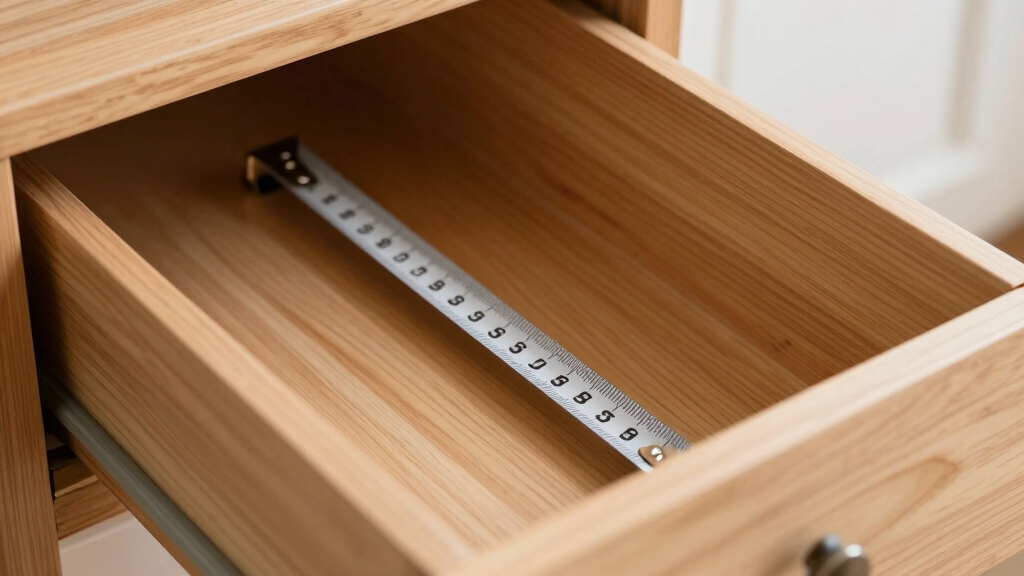
Measuring your drawer box accurately is essential for selecting the correct slide length.
Accurate drawer box measurements are crucial for choosing the right slide length and ensuring smooth operation.
First, remove the drawer completely to access a flat surface.
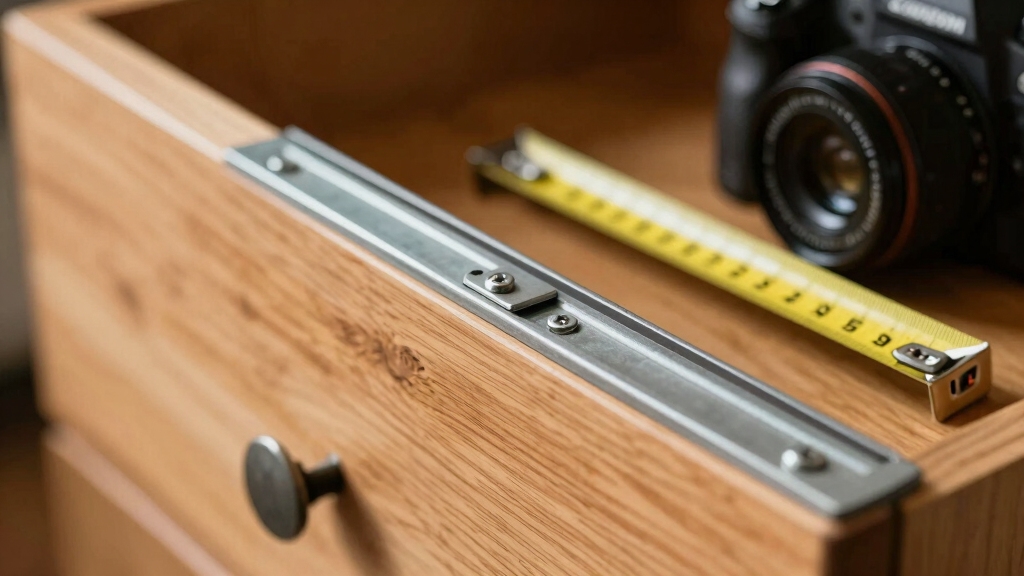
Use a tape measure to record the drawer box length from the front edge (excluding the drawer front) to the back, taking the outside dimensions only. This precise length is vital because undermount slides must match the drawer box length in three-inch increments.
Next, measure the drawer’s height and width to assess clearance requirements within the cabinet.
Avoid including the drawer front thickness in your length measurement, as it affects slide compatibility differently.
For optimal performance, ensure proper installation precision when fitting undermount slides, as they require accurate calibration to prevent binding and enhance smooth operation.
Checking Cabinet Depth for Slide Fit
To make sure your drawer slides fit properly, start by evaluating the inside depth of your cabinet from the back wall to the front frame.
Use a tape measure, placing it flat against the back wall and extending to the inside edge of the front cabinet frame.
If your drawer fronts overlay the cabinet, subtract 1 inch from this measurement. For inset drawer fronts, subtract the thickness of the drawer front itself.
This adjusted cabinet depth must accommodate the slide length you plan to install.
Round down the final cabinet depth measurement to the nearest whole inch to avoid fit issues.
Confirm this dimension aligns with your chosen slide length, ensuring the slide will fully retract without obstruction inside the cabinet.
Proper cabinet preparation is essential to ensure smooth installation and long-lasting drawer performance.
Accounting for Width and Clearance in Measurements
When fitting drawer slides, you need to carefully account for width and clearance to guarantee smooth operation.
The drawer’s width must match the cabinet opening minus the slide clearance to prevent binding or looseness. Here’s what you should do:
- Deduct 1-1/16 inches from the cabinet opening for side-mount slides, ensuring adequate space for the hardware and smooth extension.
- For undermount slides, subtract between 3/8 and 5/8 inch from the cabinet opening depending on drawer thickness (1/2-inch or 5/8-inch thick).
- Allow a minimum 1/8-inch width difference for full-extension guides to function properly without friction.
Proper clearance and subfloor preparation are essential factors that impact the long-term performance and smooth operation of hardware installations.
Adjusting Measurements for Drawer Front Types
After accounting for width and clearance, you’ll need to adjust measurements based on the type of drawer front you’re working with.
For overlay drawer fronts, subtract 1 inch from the cabinet’s internal depth to accommodate the front’s overlap on the cabinet frame.
Inset drawer fronts require a different approach; subtract the drawer front’s thickness from the cabinet depth to make sure the slide fits flush.
These adjustments are vital because the drawer front affects how the drawer sits relative to the cabinet.
Failing to take into account front type can result in improperly sized slides that either won’t fully extend or won’t fit inside the cabinet.
Always measure cabinet depth after removing the drawer front or factoring in its thickness and overlay to verify your slide length matches the adjusted space accurately.
Consider that maintaining consistent thickness is crucial for proper fitting and alignment, as variations can cause unevenness and functional issues with the drawer mechanism, similar to principles used in matching engineered hardwood floors.
Identifying Your Drawer Slide Type
How can you tell which drawer slide type you have? Start by inspecting the drawer and cabinet carefully. Here’s a straightforward way to identify your slide type:
- Side-mount slides attach to the sides of the drawer and cabinet. You’ll see metal rails when the drawer is open.
- Undermount slides are installed underneath the drawer, hidden from view. Check the drawer’s underside for rails.
- Center-mount slides use a single rail beneath the drawer center, visible only when the drawer is removed.
If unsure, measure the existing slide’s width and length. Remove the drawer to closely examine the cabinet interior and the slide mounting points. This identification makes certain you measure accurately for replacement or upgrade. Proper measurement and fitting ensure smooth operation and long-lasting functionality of your drawer slides.
Choosing the Right Drawer Slide Length
When it comes to choosing the right drawer slide length, it’s all about getting the measurements just right. You’ll want to match the slide length precisely to your drawer box measurement, sticking to the standard increments for your specific slide type.
Next up, don’t forget to check the cabinet depth. It’s important to make sure the slide fits without any obstructions. Oh, and remember to subtract allowances for overlays or inset fronts.
Finally, let’s talk about clearances. You’ll need to factor in some space for smooth operation, which includes rear space and width adjustments based on the slide style you’re using.
Keeping these details in mind will help ensure everything works seamlessly! Proper installation and choosing the right fastener size, such as the recommended 2-inch 6d hardened nails, can also impact the durability of cabinetry components.
Match Slide To Drawer
When selecting the right drawer slide length, matching the slide to the exact drawer box length is critical for smooth operation and durability. You’ll want to measure the drawer box from front edge to back edge, excluding the drawer front, to get an accurate length.
Here’s how to match the slide precisely:
- For undermount slides, choose a length equal to the drawer box length in 3-inch increments.
- Side-mount and center-mount slides require rounding down the drawer length to the nearest 2-inch increment.
- Always make certain the slide length allows for necessary clearance, like the ½-inch rear space for undermount slides.
Additionally, ensuring a stable and level base is essential for proper slide function and longevity.
Consider Cabinet Depth
In selecting the right drawer slide length, considering the cabinet depth is essential to guarantee proper fit and function.
Start by measuring the inside depth of your cabinet from the back wall to the front frame. If your drawer has an overlay front, subtract one inch from this measurement to accommodate the overlay.
For inset drawer fronts, subtract the thickness of the drawer front instead. This adjusted depth ensures your slide length won’t exceed the cabinet’s internal space.
Always round down the cabinet depth to the nearest whole inch to avoid tight fits. By confirming that the slide length fits comfortably within this dimension, you prevent installation issues and ensure smooth drawer operation without obstruction or binding inside the cabinet.
It is also important to maintain consistent environmental conditions such as temperature and humidity to prevent wood expansion that could affect drawer slide performance.
Account For Clearance
After determining the cabinet depth and adjusting for overlays or inset fronts, the next step is to factor in clearance requirements for your drawer slides.
Proper clearance guarantees smooth operation and prevents binding. You’ll need to:
- Allow rear clearance: For undermount slides, leave about ½ inch at the back to accommodate hardware and movement.
- Account for width differences: Deduct 5/8 inch from the cabinet opening for ½-inch thick drawers with undermount slides, or 1-1/16 inches for side-mount slides.
- Consider full-extension guides: These require an additional 1/8-inch width clearance to function properly.
For the best long-term performance, ensure that your drawer slide installation accounts for material thickness and the proper penetration depth of fasteners.
Considering Drawer Weight and Slide Durability
Since drawer weight directly impacts slide performance, you should select slides rated for the expected load to guarantee durability and smooth operation.
Check the manufacturer’s load rating, typically measured in pounds, and match it to the total drawer weight, including contents. For heavy-duty drawers, opt for slides with higher load capacities and robust materials like steel.
Consider slide extension type. Full-extension slides may reduce load capacity slightly compared to 3/4-extension. Also, make certain the slide’s length and mounting style support the weight distribution evenly to prevent premature wear or binding.
Regularly inspect slides for signs of stress or damage, replacing them when necessary. Accounting for drawer weight ensures reliable function, extends slide lifespan, and maintains smooth, consistent drawer action under typical use conditions.
Additionally, choosing components with adjustable depth controls can help achieve optimal performance and durability by ensuring precise fit and alignment.
Frequently Asked Questions
Can I Install Drawer Slides Without Removing the Drawer?
You generally can’t install drawer slides accurately without removing the drawer first.
Removing it lets you measure the drawer box length and cabinet depth precisely, ensuring the slide fits perfectly.
Installing slides while the drawer’s in place risks misalignment and improper clearance, which affects smooth operation.
For undermount or side-mount slides, you need clear access to attach brackets inside the cabinet and drawer, so removing the drawer is essential.
How Do I Lubricate Drawer Slides for Smoother Operation?
Lubricating drawer slides is as essential as oiling a rocket engine for smooth flight.
Start by fully extending the slides, then clean off dirt and old grease with a cloth.
Apply a silicone-based or lithium grease lubricant sparingly along the slide rails and ball bearings.
Avoid WD-40; it’s a cleaner, not a lubricant.
Work the drawer back and forth several times to evenly distribute the grease, ensuring quieter, smoother operation.
What Tools Are Needed for Drawer Slide Installation?
You’ll need a tape measure for precise measurements.
A screwdriver (Phillips or flathead depending on your slide screws) is essential.
A drill with appropriate bits to pre-drill holes is also necessary, along with a pencil for marking positions.
A level helps guarantee proper alignment.
Optionally, a power driver speeds up installation.
Having clamps can stabilize the drawer or cabinet during work.
These tools will make your drawer slide installation accurate and efficient.
How Do I Fix a Drawer Slide That Is Misaligned?
Just like a knight tightening armor, you’ll want to realign your drawer slide carefully.
First, remove the drawer and loosen the screws holding the slide.
Check for bent or damaged parts, then reposition the slide so it’s parallel to the cabinet side, ensuring smooth movement.
Tighten screws firmly but don’t overtighten.
Test by sliding the drawer in and out.
Adjust as needed until the drawer glides effortlessly without sticking or wobbling.
Are There Drawer Slides Suitable for Outdoor Use?
Yes, you can find drawer slides designed specifically for outdoor use.
Look for stainless steel or coated slides that resist corrosion and moisture damage.
These slides often feature sealed ball bearings and weatherproof finishes to handle humidity and temperature changes.
When selecting, make certain the load capacity suits your drawer weight.
Proper installation and regular maintenance will extend their lifespan in outdoor environments, preventing rust and guaranteeing smooth operation despite exposure.
Measure Right, Slide Smooth: The Secret to Perfect Drawer Performance
When measuring drawer slide length, accuracy is key. Did you know that 85% of slide failures stem from improper sizing?
By precisely measuring your drawer box, cabinet depth, and accounting for clearance, you safeguard smooth operation and durability.
Always identify your slide type and consider weight capacity to select the right length. Taking these technical steps prevents costly mistakes and guarantees a professional fit every time.
Your careful measurements directly impact performance and longevity.