
How Long Does It Take to Install Hardwood Floors: Perfection
You can expect hardwood floor installation to take roughly one to four weeks, depending on your project’s size, wood species, and complexity.
Engineered hardwood acclimates in 1–3 days and installs faster, while solid wood may need up to two weeks just for acclimation plus additional sanding and finishing days.
Site prep and subfloor repairs add time, as do intricate layouts or multiple rooms. Scheduling buffers and finishing stages also impact your timeline. Understanding these factors will help you plan accordingly.
Key Takeaways
- Installation for a 1,000 sq ft hardwood floor typically takes 3 to 5 days, longer for complex layouts or larger areas.
- Solid hardwood floors require 5 to 14 days for acclimation and installation, while engineered hardwood needs 1 to 3 days less.
- Subfloor preparation, including inspection and repairs, can add 1 to 3 days before actual installation begins.
- Two-person crews generally install 750 to 1,000 sq ft per day under normal conditions, with slower rates for complex rooms.
- Additional buffer time of 1 to 2 days is recommended to handle unforeseen delays or moisture issues during installation.
Typical Overall Timeline for Hardwood Floor Installation

While the total hardwood floor installation process can vary widely, you can generally expect it to take between 7 and 17 days from start to finish, excluding the delivery wait.
For a typical 1,000 square foot area, installation usually completes within 3 to 5 days, depending on layout and complexity. The condition of the sub-floor is crucial, as unexpected issues can add 1–2 additional days to the timeline. Proper subfloor preparation and leveling are essential to avoid delays and ensure a stable base.
Installation of hardwood floors in a 1,000 square foot area typically takes 3 to 5 days.
Residential projects often extend to 3–4 weeks, especially for larger or intricate jobs. Installation speed depends on factors like floor type, room size, and method. Prefinished floors and floating installations accelerate progress.
Larger areas over 2,000 square feet or complex patterns, such as herringbone, increase duration substantially. Post-installation finishing phases add 2 to 5 days if site-finishing is required.
Time Required for Wood Acclimation
After understanding the overall timeline for hardwood floor installation, you should consider the necessary acclimation period for the wood itself.
Engineered hardwood typically requires 24–72 hours, while solid hardwood demands 5–14 days. Wide planks sometimes need two weeks or more. You must follow manufacturer-specific instructions, as they override generic guidelines. Proper acclimation is essential for maintaining the durability and longevity of the flooring.
Acclimation occurs best in a controlled environment of 60–80°F and 30–50% relative humidity, with HVAC running steadily. Cross-stack opened boxes and use fans to promote airflow. In humid climates, acclimation may need to extend to a full week to ensure proper moisture balance.
Use a calibrated moisture meter to track wood moisture daily, aiming for equilibrium moisture content within ±2% of the subfloor. Avoid installing until moisture readings stabilize over several days.
Special conditions like new construction or wide planks can extend acclimation. Proper acclimation prevents future wood movement and guarantees a durable installation.
Duration of Site Preparation and Subfloor Repairs
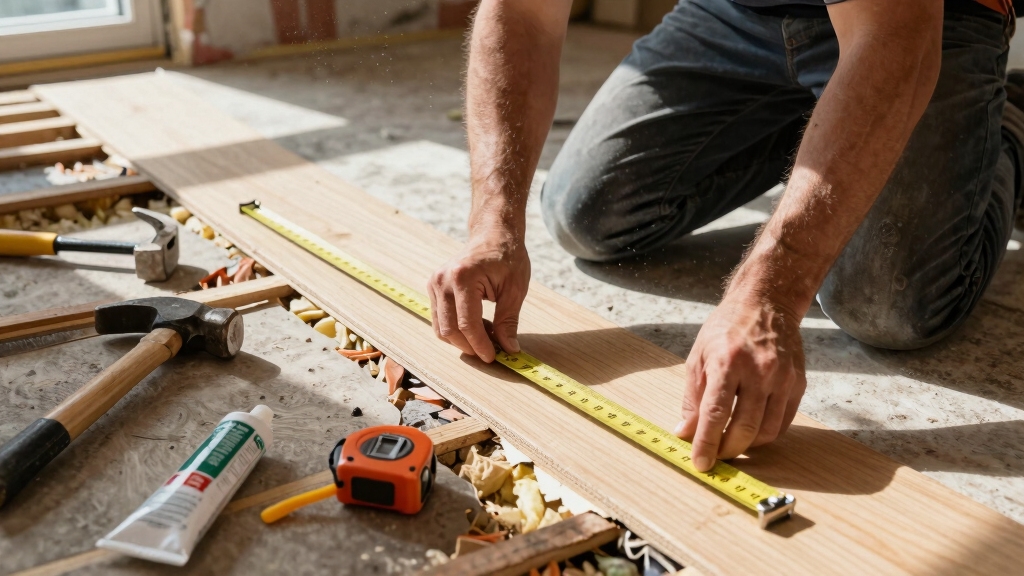
Because a solid foundation is critical for hardwood flooring, preparing the site and repairing the subfloor can take anywhere from a few hours to several days depending on the extent of work needed.
You’ll start with a thorough subfloor inspection to identify unevenness, damage, or moisture issues. Minor cleaning and sanding typically take a couple of hours, ensuring a level surface. Sometimes, this process involves removing quarter round moldings to improve access and achieve a uniform finish.
However, if you encounter major damage, replacing sections or extensive leveling can add one to two extra days. Removing existing flooring and baseboards also impacts your timeline and requires careful dust containment.
Environmental controls, like running HVAC systems for several days, stabilize moisture levels before installation. Maintaining room temperature between 60°F and 80°F and relative humidity between 30% and 50% helps prevent wood warping during installation, so contractors typically monitor these environmental conditions.
Finally, installing vapor barriers or underlayments follows subfloor repairs, completing your site preparation efficiently and precisely.
Installation Speed Based on Crew Size and Flooring Type
When you’re getting ready for your hardwood installation, it’s really important to think about how many people you have on your crew. You see, the size of your crew can make a big difference in how much flooring you’ll be able to cover in a day.
For example, if you have two installers working on straightforward prefinished planks, they can typically get through about 750 to 1,000 square feet in a single day. Using experienced professionals following industry best practices ensures the installation is done efficiently and maximizes the floor’s durability.
But it’s not just about the crew size—what kind of flooring you’re using matters too. Prefinished engineered hardwood usually goes down quicker compared to site-finished solid wood. Why? Well, solid wood needs extra steps like sanding and curing, which can really add to the timeline.
Additionally, having a flat, dry subfloor ready can significantly speed up the installation process by minimizing preparation time.
Crew Size Impact
Understanding how crew size influences installation speed is essential for planning hardwood floor projects efficiently.
A two-person crew typically covers 750 to 1000 square feet per day, handling up to 5000 square feet within 1 to 3 days depending on layout complexity. It is important to ensure proper ventilation during and after installation to maintain a safe working environment.
For smaller jobs under 1000 square feet, two installers can complete work in a day or two, especially in open spaces with minimal cuts.
Larger crews offer efficiency gains by dividing tasks. Skilled teams accelerate measurements, placements, and handling of expansive areas, particularly beyond 1000 square feet.
Scaling crew size aligns with open floor plans or complex layouts, reducing overall project duration and mitigating delays. Proper subfloor preparation is critical before installation to ensure a smooth process and avoid delays.
Your choice of crew size directly impacts speed, balancing labor costs against desired completion timelines for ideal project management.
Flooring Type Variations
Although crew size plays a critical role in installation speed, the type of hardwood flooring you choose greatly affects project timelines as well.
Solid hardwood demands nail-down installation plus on-site sanding and finishing, adding 2–4 days compared to prefinished options. The nail installation method allows immediate weight-bearing capability, which can slightly reduce downtime after installation.
Engineered hardwood, particularly click-lock, installs faster, reducing labor by roughly 25–30%. Crews can install roughly 750–1,000 sq ft per day with a two-person team in open areas, which impacts overall project duration.
Prefinished planks eliminate drying and curing, saving 2–5 days versus unfinished boards requiring multiple finish coats.
Installation methods matter too; floating or click-lock systems speed up the process, allowing 500–1,000 square feet per day. However, glue-down installations may add extra time due to adhesive drying requirements.
Nail-down or glue-down approaches increase labor and cure times, sometimes adding 1–3 days. Exotic or wide-plank species also extend timelines by 1–2 days due to additional acclimation and cutting precision.
Productivity Benchmarks
A 2-person crew typically installs hardwood flooring at rates varying from 750 to over 1,500 square feet per day, depending on project complexity and layout openness. Choosing the right underlayment can also impact installation speed by simplifying subfloor preparation and moisture control.
On average projects of 1,000-1,500 square feet, expect 750-1,000 square feet daily. Open layouts without obstacles allow exceeding 1,500 square feet.
Installation speed varies by flooring type. Solid hardwood averages 100-250 square feet daily due to labor-intensive nail or staple-down methods. This often requires 3+ days for larger areas plus additional sanding and finishing time.
Engineered hardwood, especially prefinished, installs faster at 150-400 square feet daily using floating or glue-down methods and eliminating on-site finishing.
Crew efficiency depends on tools like nail guns, subfloor condition, and pattern complexity. Simpler patterns and flat subfloors accelerate progress, while intricate designs and uneven surfaces slow it down. Additionally, subfloor preparation including removal, repair, and leveling can add 1–3 days before installation begins.
Additional Time Needed for Finishing Processes
Since finishing processes involve multiple coats and curing periods, you’ll need to allocate significant additional time beyond installation.
Finishing isn’t just applying coats; it requires drying, buffing, and curing steps to guarantee durability and appearance. Maintaining proper inter-coat discipline by never skipping grits or rushing drying windows is crucial to achieving a high-quality finish.
Choosing the appropriate polyurethane type can also significantly impact drying times and final durability. Here’s what you should plan for:
- Oil-based polyurethane demands 8-12 hours drying per coat, totaling 2-3 days for 2-3 coats.
- Water-based finishes dry faster (2-3 hours), but full curing can take up to 14 days.
- Inter-coat buffing or de-nibbing takes 30-60 minutes between coats to guarantee smoothness.
- Optional stain application adds at least one day, and environmental factors like humidity can extend drying times.
Impact of Complex Layouts and Multiple Rooms
When you dive into complex patterns like herringbone or parquet, be ready for installation to take a lot longer than usual.
Why’s that? Well, these designs require a whole lot of precision when it comes to layout and cutting. Additionally, ensuring the subfloor is properly prepared before installation is critical to avoid delays and complications.
Plus, if you’re coordinating multiple rooms, things get even trickier. You have to juggle acclimation schedules, figure out the right sequence for installation, and manage any transitions between different spaces. Typically, professional installers complete around 500–700 sq ft per day under normal conditions, but this can slow down significantly with complexity.
All of these factors can really add up, pushing project timelines out and making careful planning super important. Consistency and efficiency become your best friends in this process!
Time Extensions for Patterns
Although straightforward hardwood floor installations typically take 1-2 days per 500 sq. ft., incorporating complex patterns like herringbone, chevron, or parquet can considerably extend your project timeline.
These patterns demand greater precision, increased cutting time, and meticulous alignment, markedly impacting labor hours and workflow. Proper staggering is essential in these designs to enhance structural integrity and prevent weak points.
Consider these time extension factors:
Herringbone: Adds 2-3 days due to diagonal cuts and intricate plank interlocking.
Chevron: Extends project by 30-50%, requiring angled 45-degree cuts and skilled labor.
Parquet: Demands custom milling and layout planning, adding 3-5 days or more.
Complex layouts: Can double labor time compared to straight lay, pushing 1-3 day projects to 3-7 days.
Additionally, larger project sizes over 1,000 sq. ft. typically require 3+ days for installation, which can further extend timelines when combined with complex patterns. Proper management of expansion gaps in these larger and intricate installations is critical to prevent buckling and ensure floor longevity.
Multi-Room Coordination Challenges
Guiding multi-room hardwood floor installations demands careful coordination, as each additional space introduces complexity that can substantially extend your project timeline.
You’ll find that installers typically cover 750-1000 square feet daily with a two-person team. However, projects spanning multiple rooms, especially over 2000 square feet, require 5-7 days minimum.
Complex layouts with cabinets, fireplaces, or staircases add significant time, as do irregular room shapes that slow navigation and sequencing.
Preparation multiplies effort, with subfloor inspections, furniture clearing, and moisture checks across rooms potentially adding 1-2 unexpected days. The room dimensions and overall project size directly impact how long the entire installation will take.
Since installation and finishing phases repeat per room, you should expect phased progress rather than parallel work. Engaging experienced professionals helps optimize efficiency, but multi-room coordination inherently increases total duration beyond simple single-room projects.
How Product Type and Installation Method Affect Timeline?
Since the timeline for installing hardwood floors hinges on both product type and installation method, understanding their interplay is essential for accurate project planning.
Solid hardwood demands 7 days of acclimation and additional time if unfinished, extending total installation to 10-15 days. Engineered hardwood, especially prefinished, installs 25-30% faster due to reduced acclimation and no on-site finishing.
Installation methods further influence timing; floating floors install quicker than nail-down or glue-down, while intricate patterns triple installation time.
Your choice directly impacts project length and workflow efficiency. Additionally, the size of the space significantly affects how long the installation will take, as installers typically complete 750–1,000 square feet per day with a two-person team.
Scheduling Tips and Time Contingencies for Hardwood Projects
When scheduling your hardwood floor project, you’ll want to prioritize acclimation immediately after material delivery to prevent delays caused by improper humidity adjustment.
Solid hardwood requires 3-7 days to acclimate, while engineered flooring needs less time, so confirm with manufacturer guidelines.
Plan for 1-2 days of space clearing and subfloor inspection, including repair and curing. Keep in mind that subfloor preparation such as leveling or moisture barriers can add additional time.
Build buffer time for unexpected issues like subfloor complications or inventory delays, which can add 1-2 days. Installation duration depends on size and complexity; expect 1-5 days for 200-1,000 square feet. Allow 2-3 days for finishing, including drying.
Frequently Asked Questions
What Maintenance Is Required After Hardwood Floor Installation?
You’ll need to sweep or dust-mop daily to prevent scratches and vacuum weekly with a soft brush attachment.
Clean spills immediately using a dry or slightly damp cloth.
Use microfiber mop pads for routine cleaning and avoid excess water.
Place walk-off mats, use felt protectors on furniture, and keep humidity between 35-55%.
Polish quarterly with water-based products and deep clean periodically using hardwood-specific cleaners to maintain your floor’s appearance.
How Do Weather Conditions Affect Hardwood Floor Installation Quality?
Did you know that hardwood begins swelling above 55% humidity?
Weather conditions directly impact hardwood installation quality. If humidity’s too high, wood planks swell, causing buckling or cupping.
Too low, and boards shrink, creating gaps and cracks. You’ll want to maintain 35%-55% relative humidity and 60°F-80°F temperature range, acclimating wood for 7-14 days beforehand.
Proper moisture control and expansion gaps prevent damage and guarantee a stable, durable floor.
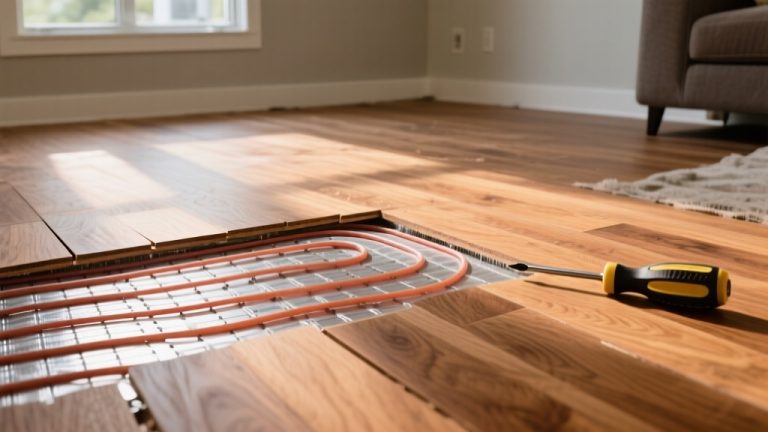
Can Hardwood Floors Be Installed Over Radiant Heating Systems?
Yes, you can install hardwood floors over radiant heating systems, but engineered hardwood is your best bet due to its dimensional stability.
Solid hardwood generally isn’t recommended, especially over in-slab systems.
You’ll need to guarantee proper moisture equilibrium and acclimation before installation.
Carefully manage temperature ramps to avoid thermal shock.
Choose installation methods that prevent damage to heating elements.
Follow manufacturer guidelines strictly for peak compatibility and performance.
What Are the Common Causes of Hardwood Floor Installation Delays?
You’ll face delays mainly from subfloor issues like unevenness, moisture, or debris that require fixing.
Skipping proper wood acclimation, which takes 3-7 days, also stalls progress due to warping risks.
Moisture problems without adequate vapor barriers or ventilation cause setbacks.
Installation mistakes, such as incorrect expansion gaps or fastening errors, further slow you down.
Rushing the process or having inexperienced installers compounds these delays.
Prioritize thorough prep and acclimation to avoid hold-ups.
How Does Hardwood Flooring Installation Impact Indoor Air Quality?
Hardwood flooring installation can improve your indoor air quality by reducing allergens and dust mites trapped in carpets.
However, during installation, adhesives and finishes might release VOCs like formaldehyde, temporarily impacting air quality.
To minimize this, you should opt for low-VOC materials and ventilate the space thoroughly with fans and open windows.
Proper sealing also helps control moisture, preventing mold growth and maintaining a healthier indoor environment over time.
No Shortcuts, Just Results: The Key to Lasting Hardwood Floors
Installing hardwood floors can feel like a marathon, but with the right prep and team, you’ll see results faster than you think. Remember, wood acclimation, subfloor prep, and finishing steps all add essential time. Skipping them isn’t an option if you want lasting quality.
By understanding how your product choice and layout complexity impact the schedule, you’ll avoid surprises and keep your project on track. Plan carefully, and you’ll enjoy beautiful floors without endless delays.