Best Way to Cut Polycarbonate Sheet: Precision and Perfection
To cut polycarbonate sheets effectively, match your tool to the sheet thickness: use sharp utility knives or hollow ground blades for thin sheets under 1/8 inch.
For medium sheets 0.125–0.5 inches, use circular saws with triple chip grind carbide blades. For thicker sheets, opt for table saws or band saws with fine-toothed blades.
Maintain steady feed rates and adjust blade depth just beyond thickness. Secure your workpiece firmly to avoid chipping or melting.
Proper preparation and technique guarantee clean edges. Explore precision methods and finishing tips for optimized results.
Key Takeaways
- Use a sharp utility knife with repeated scoring and snapping for thin polycarbonate sheets under 1/8 inch thick.
- For medium sheets (0.125–0.5 inch), use circular saws with triple chip grind (TCG) carbide-tipped blades for clean, smooth edges.
- Employ table circular saws or band saws with fine-toothed blades for thick sheets over 0.5 inch to ensure precision and stability.
- Apply masking tape along cut lines and secure sheets firmly to minimize splintering and improve cut quality.
- Maintain controlled feed rates and adjust blade depth just beyond sheet thickness to reduce heat buildup and prevent melting or chipping.
Choosing the Right Tool for Cutting Polycarbonate

Selecting the right tool for cutting polycarbonate hinges on the sheet’s thickness, desired cut type, and precision requirements.
For thinner sheets under 0.1 inches, you’ll want hollow ground panel blades or even a utility knife for simple cuts.
When working with medium thickness, between 0.125 and 0.5 inches, opt for circular saws equipped with triple chip carbide blades to maintain edge quality.
For medium-thickness polycarbonate, use circular saws with triple chip carbide blades to ensure clean, high-quality edges.
If your task involves long, straight cuts on sheets over 0.5 inches, table circular saws deliver the necessary precision and stability.
For curved or intricate shapes, you’ll rely on jigsaws with fine-toothed blades or band saws suited for thicker materials.
Always match blade tooth count and speed to prevent melting or chipping, ensuring clean, accurate cuts tailored to your polycarbonate’s specific dimensions and geometry.
For added precision and smooth finishes in woodworking tasks, consider tools with precision-machined aluminum bases to enhance control and reduce snagging.
Cutting Thick Polycarbonate: Best Saws and Blades
When you’re cutting thick polycarbonate, it’s important to use the right tools. Think about using saws that are designed for both precision and power, like table circular saws or band saws. These options really help you get the job done effectively.
Now, let’s talk about blades. You’ll want to choose ones with fine teeth, like triple chip carbide or hollow ground panel blades. These types help reduce chipping, which means you’ll end up with nice, clean edges.
And don’t forget about your cutting techniques! Using controlled methods and setting the proper blade depth can really make a difference. It maximizes accuracy and minimizes stress on the material, ensuring your cuts come out just right.
For handheld options, consider a cordless reciprocating saw with a brushless motor and variable speed control for better precision and smoother cuts.
Optimal Saws For Thickness
Cutting thick polycarbonate sheets demands saws and blades engineered for durability and precision. For sheets over 0.5 inches thick, table circular saws provide the stability and accuracy needed for long, straight cuts.
Portable circular saws offer versatility for on-site jobs but require careful blade selection. Triple chip carbide blades excel on thicknesses from 0.125 to 0.5 inches, minimizing heat buildup and preventing melting.
When working with thick sheets or tight curves, band saws deliver smooth, precise cuts thanks to fine-toothed blades operating around 2,500 RPM. For single-piece cuts, bench saws guarantee clean edges with controlled feed rates.
Always match the saw type to the sheet thickness to optimize cut quality and reduce material stress. This ensures efficient, professional results without compromising structural integrity.
For enhanced precision in woodworking applications involving polycarbonate, tools with variable speed control allow for better RPM adjustment to suit material thickness and cutting requirements.
Blade Types And Uses
Choose blades specifically designed to handle the density and heat sensitivity of thick polycarbonate sheets to achieve clean, precise cuts. For thicknesses between 0.125 to 0.5 inches, triple chip grind (TCG) carbide-tipped circular saw blades offer optimal durability and heat dissipation, reducing melting and chipping.
Hollow ground panel blades with fine teeth suit thinner sheets but lack robustness for thick material. When cutting thick polycarbonate, use blades with high tooth counts (typically 60-80 teeth for circular saws) to minimize heat buildup and guarantee smooth edges.
Band saw blades with 10-18 fine teeth per inch at 2500 RPM provide precise curved cuts on thick sheets. Avoid coarse blades or those intended for wood or metal, as they increase the risk of cracking or uneven edges due to improper cutting angles and heat generation.
Additionally, blades with Perma-Shield coating can help reduce heat buildup and resin accumulation, further improving cut quality and blade longevity when working with polycarbonate.
Cutting Techniques For Precision
Selecting the right saw and blade sets the foundation, but mastering cutting techniques guarantees precision and quality in thick polycarbonate sheets. Use table circular saws with triple chip carbide blades for straight cuts on sheets over 0.5 inches. Ensure blade depth matches material thickness to avoid melting or chipping.
Maintain a steady, controlled feed rate, and secure the sheet firmly to a flat surface. For curves, opt for band saws with fine-toothed blades (10-18 TPI) running at 2500 RPM. This balances speed and smoothness to prevent edge roughness.
Apply masking tape along the cut line to minimize splintering. Always wear appropriate safety gear. Post-cut, inspect edges for unevenness and deburr as needed to achieve clean, precise results. Using tools with adjustable depth control can help maintain consistent precision during cuts.
Techniques for Clean Straight Cuts on Thin and Medium Sheets
Achieving clean straight cuts on thin and medium polycarbonate sheets demands careful tool selection and preparation.
For thin sheets (0.0625 to 0.0937 inches), use hollow ground panel blades with fine teeth to minimize chipping.
Medium sheets (0.125 to 0.5 inches) require circular saws fitted with triple chip cut carbide blades for precise, smooth edges. Before cutting, securely clamp the sheet on a stable flat surface and mark the cutting line with masking tape to prevent splintering.
Adjust blade depth to just exceed sheet thickness. Feed the saw steadily without forcing it to avoid melting or chipping. For single pieces, bench saws provide excellent edge quality.
Post-cut inspection guarantees no unevenness; slight sanding can refine edges if necessary. These methods optimize accuracy and edge integrity on thin and medium polycarbonate sheets.
Using blades with heat-resistant coatings can help maintain blade performance and reduce resin buildup during cutting.
How to Cut Curves and Intricate Shapes in Polycarbonate?
How do you guarantee smooth, accurate curves and intricate shapes when working with polycarbonate sheets?
Use a jigsaw fitted with a fine-toothed blade designed for plastics. This tool excels at maneuvering tight curves and detailed contours.
For thicker sheets or more demanding precision, opt for a band saw equipped with blades having 10-18 teeth per inch running at approximately 2500 RPM. This setup ensures clean, controlled cuts without melting or chipping.
Always secure the sheet firmly on a stable surface and mark your cutting lines clearly with masking tape to minimize splintering.
Maintain a steady, controlled feed rate to prevent heat buildup and edge deformation.
These tools combined with precise preparation optimize the quality and accuracy of curved and intricate polycarbonate cuts.
For woodworking projects requiring precision, tools featuring adjustable fences with preset stops can greatly enhance cutting accuracy and control.
Simple Methods for Cutting Thin Polycarbonate Sheets
When you’re working with thin polycarbonate sheets, a great way to get those clean cuts is by using a utility or box knife. Just score along your marked line a few times, and with a little pressure, the sheet should snap right along the line. It’s pretty straightforward!
Now, if you need to trim edges or make small adjustments, metal shears or handheld air-powered vinyl shears are fantastic options. They give you that controlled precision without putting too much stress on the material.
Just remember, picking the right cutting tool based on the thickness of your sheet is key. It helps ensure accuracy and minimizes the chances of cracking or chipping. Happy cutting!
For best results, always use a sharp utility knife and refresh blades regularly to maintain clean, precise edges.
Knife Cutting Techniques
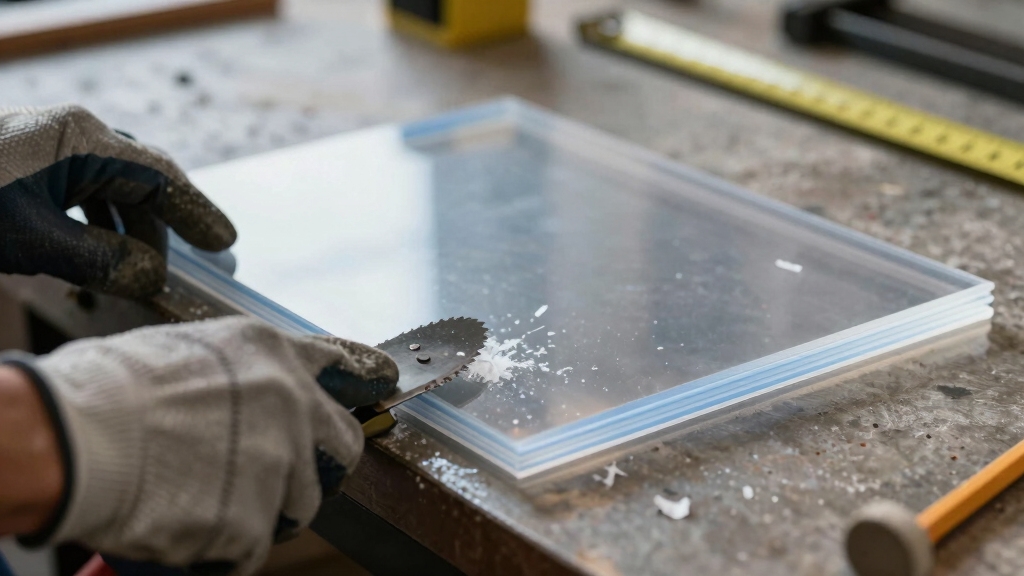
Start by scoring the polycarbonate sheet lightly with a sharp utility or box knife along the marked cutting line.
Use steady, controlled pressure to avoid cracking or chipping the material. Score repeatedly over the same groove to deepen the cut, ensuring a clean break.
Secure the sheet firmly on a flat, stable surface to prevent movement during scoring. Once the groove is sufficiently deep, position the sheet so the scored line aligns with the edge of your work surface.
Then apply downward force to snap it cleanly along the scored line. This method works best on thin single sheets, generally under 1/8 inch thick.
Always use a fresh blade to maintain a sharp edge and reduce the risk of jagged cuts or surface damage.
For best results, ensure your workspace is well-ventilated and you use personal protective equipment when handling cutting tools and materials.
Shear Tool Options
Trim thin polycarbonate sheets efficiently using shear tools designed for clean, controlled cuts. For single thin sheets, utility or box knives provide straightforward cutting.
When you need more precision or to trim edges, handheld metal shears or Malco air-powered vinyl shears excel. These shears apply uniform force, reducing distortion and minimizing edge chipping.
Hollow ground panel blades also work well for sheets between 0.0625 and 0.0937 inches thick, offering smooth, accurate cuts.
When selecting a shear tool, ensure it matches the sheet thickness and provides a stable cutting platform to prevent cracking.
Secure the sheet firmly on a flat surface, and always maintain a steady, controlled motion to achieve clean edges. Proper tool choice and technique enable you to cut thin polycarbonate sheets accurately without requiring complex equipment. Using tools with precision and material durability ensures consistent performance and longer tool life during cutting tasks.
Using Laser Cutters for Precise Polycarbonate Cuts
Harnessing laser cutters allows you to achieve highly precise and clean cuts on polycarbonate sheets, especially those 1 mm thick or less. Using a 50 W laser, you can create sharp edges with minimal mechanical stress.
For thicker sheets up to 3 mm, high-wattage lasers (up to 150 W) deliver glass-like finishes but require multi-pass techniques to reduce charring. Key parameters include a 50.8 mm lens, 160 PPcm resolution, 50 kHz frequency, and 400 kPa assist gas pressure. These factors minimize discoloration and expel melted material efficiently.
You’ll appreciate that laser cutting eliminates tool wear and guarantees repeatable accuracy, making it ideal for intricate patterns. However, laser power and speed must be optimized to balance cut quality and thermal effects for each sheet thickness.
Essential Preparation Steps Before Cutting Polycarbonate
Before you begin cutting polycarbonate, you’ll need to measure and mark your cutting line accurately. Typically, use masking tape to reduce splintering along the edge. This foundational step guarantees precision and protects the material’s integrity during cutting.
Next, secure the sheet firmly on a flat, stable surface to prevent movement that could cause uneven cuts or damage.
To optimize results, follow these preparation steps:
- Choose a fine-toothed blade compatible with polycarbonate thickness.
- Adjust blade depth to just exceed sheet thickness for clean penetration.
- Confirm measuring tools and markings align exactly with your design.
- Remove any debris or dust from the sheet surface to avoid interference.
These steps set the stage for accurate, clean cuts while minimizing waste.
Safety Tips to Prevent Chipping, Melting, and Injury
When you cut polycarbonate, controlling your saw’s speed and pressure is crucial to prevent chipping or melting along the edges. Maintain a steady, moderate feed rate. Too fast causes jagged chips; too slow generates heat, leading to melting.
Use fine-toothed blades designed for polycarbonate to minimize mechanical stress. Always secure the sheet firmly on a flat, stable surface to avoid vibrations that cause uneven cuts and potential injury.
Wear appropriate safety gear: goggles to shield eyes from debris, gloves for hand protection, and hearing protection if using power saws. Keep your workspace clean and free of obstructions to maintain focus and control.
Avoid forcing the blade; let it cut naturally to reduce tool wear and prevent hazardous kickbacks. These measures guarantee safe, precise cuts without damaging the material or risking injury.
Finishing and Cleaning Cuts for Professional Results
After ensuring your cuts avoid chipping and melting through controlled speed and proper blade choice, focus shifts to refining the edges for a professional finish. Proper finishing removes burrs and smooths surfaces, improving fit and aesthetics.
Start by carefully deburring with a fine file or sandpaper suited for polycarbonate. Next, use progressively finer grits to polish the edges, reducing micro-scratches. Finally, clean the sheet with a mild detergent and soft cloth to remove residual particles without scratching.
Begin by deburring, then polish with finer grits, and finish by cleaning gently to preserve clarity.
Key steps to achieve clean, professional edges:
- Deburr immediately after cutting to prevent hardened edges.
- Sand edges with fine-grit abrasive (320–600 grit) in linear motion.
- Polish with ultra-fine abrasives or buffing pads for clarity.
- Clean with non-abrasive solutions to maintain surface integrity.
Frequently Asked Questions
How Should I Store Polycarbonate Sheets Before Cutting?
You should store polycarbonate sheets flat on a stable, clean surface to prevent warping or bending.
Keep them away from direct sunlight and extreme temperatures to avoid thermal expansion or discoloration.
Cover sheets with protective film and avoid stacking heavy objects on top to prevent scratches or deformation.
Make certain storage areas are dry and dust-free, maintaining consistent environmental conditions.
This preserves sheet integrity and ensures precise, clean cuts when you’re ready to work.
Can Polycarbonate Sheets Be Recycled After Cutting?
Yes, you can recycle polycarbonate sheets after cutting. Remarkably, polycarbonate has a recycling rate of about 30%, which is lower than other plastics but still feasible.
You should collect all scrap pieces, clean them of contaminants, and send them to specialized recycling centers equipped to handle thermoplastic recycling.
Proper sorting guarantees the material can be reprocessed into pellets for manufacturing new products, reducing waste and environmental impact efficiently.
What Is the Best Way to Handle Dust and Debris From Cutting?
You should control dust and debris by using a dust extraction system or vacuum attachment directly at the cutting point.
Always wear a respirator mask and safety goggles to protect your respiratory system and eyes from fine particles.
Additionally, work in a well-ventilated area or outdoors to disperse airborne debris.
Clean the workspace regularly with a HEPA-filter vacuum to prevent accumulation of hazardous dust and maintain a safe cutting environment.
How Does Temperature Affect Cutting Polycarbonate Sheets?
Temperature markedly impacts your polycarbonate cutting process. High temperatures cause melting and chipping, compromising edge quality.
You should manage heat buildup by using sharp, fine-toothed blades and controlling your cutting speed to prevent excessive friction.
For laser cutting, cooling with assist gas and multi-pass methods reduce discoloration and thermal damage.
Maintaining moderate temperatures guarantees clean, precise cuts without warping or cracking, preserving the material’s structural integrity.
Are There Specific Adhesives Suitable for Joining Cut Polycarbonate Pieces?
You’ll find that solvent-based adhesives, like methylene chloride or methyl methacrylate, offer the strongest bonds for polycarbonate. They achieve up to 90% of the material’s original strength.
These adhesives chemically weld the pieces, providing durability and clarity. For lighter applications, UV-curing adhesives provide fast, clean joins with minimal stress.
Avoid standard epoxies, as they often cause crazing. Always make sure surfaces are clean and dry for peak adhesion.
From Preparation to Precision: Your Polycarbonate Cutting Success
Cutting polycarbonate is like steering a precise dance. Each tool and technique moves in harmony to shape your material perfectly.
Choose your saw or blade wisely, prepare thoroughly, and move methodically to avoid missteps like chipping or melting. Whether carving sharp lines or gentle curves, your careful approach guarantees a clean, professional finish.
Master these steps, and you’ll cut through polycarbonate like a skilled conductor leading a flawless performance.