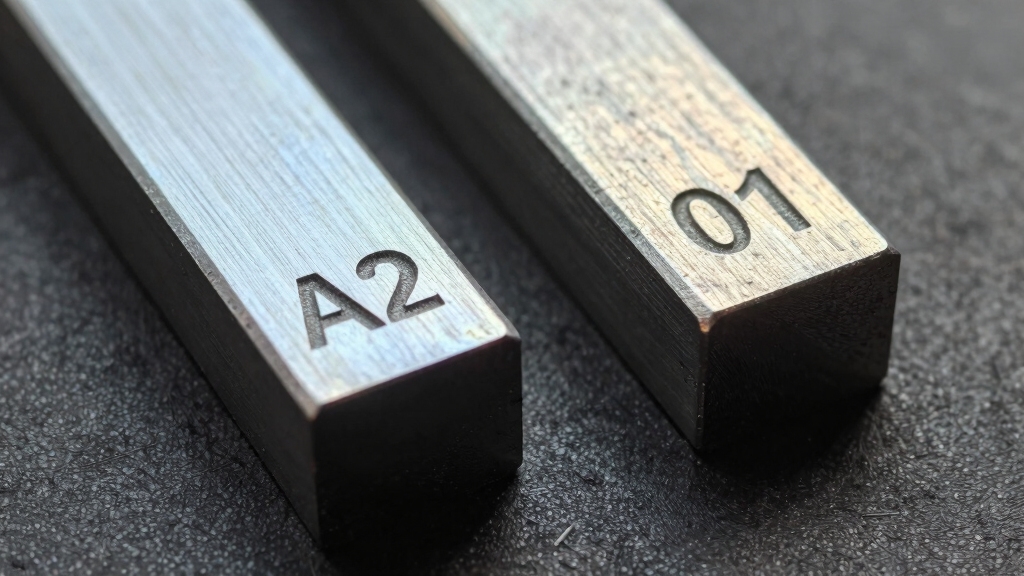
A2 vs 01 Steel: Choosing the Right Tool Steel for Your Work
If you need a steel with better wear resistance and dimensional stability, A2’s higher chromium and molybdenum content give you superior hardness (up to HRC 62) and chipping resistance. This makes it ideal for heavy-duty tools.
O1, with simpler alloying, offers easier machinability and a keener initial edge but less wear life. Both require different heat treatments: A2 air hardens, while O1 oil quenches.
Keep exploring to uncover how these differences impact your specific tooling applications.

- Tool Steel
- A2
- 0.750 (3/4 inch)

- Machinability: High
- Corrosion Resistance: Low
- Weldability Medium
Key Takeaways
- A2 steel contains higher alloy content (Cr, Mo, V) offering superior wear resistance and dimensional stability compared to O1’s simpler composition.
- O1 steel is easier to machine and sharpen, providing a finer initial edge but dulls faster under abrasive use than A2.
- A2 achieves higher hardness (56–62 HRC) with air-hardening and deeper hardening capacity, while O1 hardens to 58–60 HRC with shallower depth via oil quenching.
- A2’s air-hardening process reduces distortion and enhances toughness; O1 requires rapid oil quenching, increasing residual stresses and distortion risk.
- A2 suits heavy-duty, impact-loaded tools needing tight tolerances; O1 is preferred for applications needing easier fabrication and better impact resistance in shallow sections.
Side-by-Side Tool Steel Comparison for A2 & O1 Steel
| Property | A2 Steel | O1 Steel |
|---|---|---|
| Steel Type | Air-hardening tool steel | Oil-hardening tool steel |
| Alloy Content | Higher alloy with chromium, molybdenum, vanadium | Low alloy, mostly carbon steel |
| Typical Hardness | 56–62 HRC | 58–60 HRC |
| Wear Resistance | Excellent, long edge retention | Moderate, dulls faster |
| Toughness | Balanced toughness with low chipping | Good impact toughness in thin sections |
| Dimensional Stability | Very high, minimal distortion | Lower, more quench distortion |
| Machinability | More difficult to machine and grind | Easier to machine and sharpen |
| Best Use Cases | Dies, punches, precision tools | Knives, hand tools, simple cutters |
Chemical Composition Comparison

When comparing A2 and 01 steels, you’ll notice that their chemical compositions fundamentally influence their performance characteristics.
A2 contains approximately 0.95–1.05% carbon, 4.75–5.50% chromium, 0.90–1.40% molybdenum, and 0.15–0.50% vanadium, making it a medium-alloy air-hardening tool steel. This grade typically achieves a hardness after heat treatment of 57–62 HRC, contributing to its suitability for cold work tooling.
A2 steel features medium alloying with carbon, chromium, molybdenum, and vanadium for air-hardening tool performance.
In contrast, 01 steel has a similar carbon content (~0.90–1.00%) but lacks intentional chromium, molybdenum, and vanadium additions, categorizing it as a low-alloy, oil-hardening tool steel.
The alloying elements in A2 promote finer carbide formation and enhanced hardenability, whereas 01 primarily forms iron carbides. Manganese and silicon levels are comparable but play minor roles in differentiation.
These compositional differences dictate A2’s superior wear resistance, tempering stability, and hardenability, while 01’s simpler chemistry results in differing processing and microstructural characteristics.
Mechanical Properties and Hardness Differences
Although both A2 and O1 steels achieve similar hardness ranges after heat treatment, their mechanical properties and hardening behavior differ markedly due to their alloying and quenching methods.
A2 targets HRC 56–62 via air quenching, offering superior dimensional and hardness consistency compared to O1’s HRC 58–62 after oil quenching, which can vary more due to quench severity. Its low distortion during hardening makes it ideal for precision applications.
A2’s modest chromium and molybdenum additions enhance toughness and wear resistance by forming hard carbides. O1, with simpler composition, provides good toughness but is more susceptible to quench-induced stresses and microcracking.
You’ll notice O1 attains a keener initial edge and better machinability, but it dulls faster under abrasive conditions. Ultimately, A2 balances higher toughness and longer edge retention, making it preferable for impact-loaded tools requiring dimensional stability.
Heat Treatment Processes and Effects
Understanding the distinct heat treatment protocols for A2 and O1 steels clarifies the differences in their mechanical behavior and performance. A2 requires higher austenitizing temperatures (~1015–1035 °C) to dissolve alloy carbides, while O1 austenitizes at lower temperatures (~780–820 °C).
A2’s air-hardening nature allows slower, uniform cooling, reducing distortion. O1 demands rapid oil quenching, increasing residual stresses and distortion risks. The quench response drives divergence in heat treatment practice and mechanical behaviour.
Tempering also diverges: A2 withstands higher tempering temperatures (520–540 °C) maintaining hardness and toughness. O1’s tempering at lower temps (150–220 °C) prioritizes hardness retention. Cryogenic treatment benefits A2 by transforming retained austenite without hardness loss.
Wear Resistance and Toughness Evaluation
You’ll find that A2 steel really shines when it comes to wear resistance, thanks to its chromium content. This added element enhances edge retention, and the best part? It doesn’t compromise toughness at all. This balance makes A2 ideal for applications demanding both durability and low maintenance through scratch resistance.
Both A2 and O1 steels show similar toughness profiles, but A2 has the upper hand with its alloying, which boosts chipping resistance and dimensional stability. Additionally, A2 steel undergoes air hardening, which contributes to its high hardenability and toughness.
Now, let’s talk about edge holding. A2 really stands out here, too. It manages to maintain sharpness for a longer period, which means that your sharpening efforts pay off with extended durability compared to O1.
Comparative Wear Resistance
When comparing A2 and O1 steels, you’ll find that A2’s wear resistance outperforms O1 due to its 5% chromium content and added molybdenum. These elements enhance abrasion resistance without compromising sharpenability.
A2 is also an air-hardening steel, while O1 requires oil hardening, influencing heat treatment approaches and final properties. Proper heat treatment and surface preparation are crucial to maximizing the bond strength in applications using these steels, similar to best practices in surface preparation for adhesives.
A2’s Rockwell hardness of 57-62, bolstered by cryogenic treatment, supports prolonged edge life and superior wear endurance. Although O1 offers excellent initial hardness and a fine grain structure aiding wear resistance, it dulls faster under abrasive stress.
O1’s softer profile allows keener edges but accelerates wear progression. A2’s modest chromium level improves abrasion resistance substantially over O1, making it ideal for extended production runs and wear-heavy applications like stamping dies.
Its lower distortion and chipping resistance further enhance durability. Overall, A2 provides a balanced combination of hardness and abrasion resistance that surpasses O1 in demanding wear conditions.
Toughness and Edge Holding
Evaluating toughness and edge holding reveals key distinctions between A2 and O1 steels. A2 offers a superior balance, boasting higher impact resistance (up to 1200 MPa) and enhanced fatigue limits, especially when cryogenically treated.
O1 excels in sharpness and impact toughness for hand tools, though it dulls faster. When contemplating edge retention, A2’s 5% chromium and air-hardening abilities enable it to maintain a durable edge longer, reaching 60-62 HRC.
O1 sharpens easier but requires frequent maintenance. Key points to contemplate: A2 delivers better fatigue resistance and longer edge life. O1 achieves keener edges but dulls quicker.
A2’s depth of martensite transformation surpasses O1’s, reducing soft cores. Cryogenic treatment enhances A2 toughness without sacrificing hardness.
Machinability and Fabrication Considerations
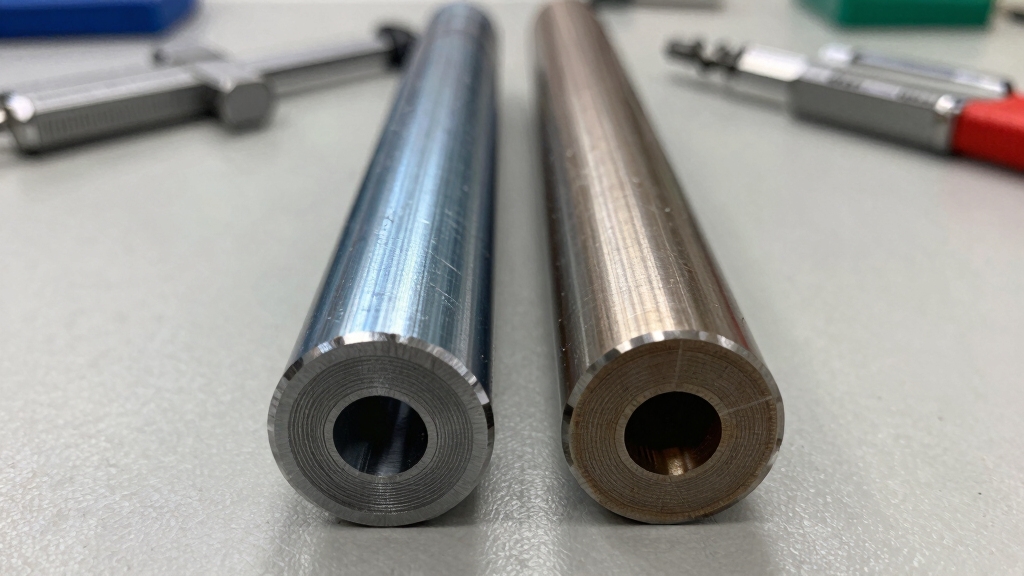
Machining A2 steel calls for careful attention to surface finish, tolerances, and tooling choices to optimize performance. You should use carbide tooling with rigid setups to minimize chatter and achieve repeatable results.
Expect to remove 0.001–0.005 in material allowance before final heat treatment and grinding for precision. This is important because A2 is air-hardening, which influences heat-treatment considerations.
Additionally, selecting the appropriate underlayment can help reduce vibrations during machining, improving surface quality and tool life through enhanced sound dampening.
Annealed A2 offers better surface finish than D2 but requires fine grinding for mirror finishes.
| Operation | Recommended Speed (m/min) | Tooling Tips |
|---|---|---|
| Turning | 155–210 | Carbide inserts, positive geometry |
| Milling | 95–130 | Rigid fixturing, balanced cutter |
| Drilling | 65–85 | Peck drilling, pilot holes |
| Finishing Pass | Light depth-of-cut | Tougher grades, edge prep |
Typical Applications for Each Steel Grade
Although both A2 and O1 steels serve diverse industrial needs, their distinct properties guide you toward specific applications.
A2’s high wear resistance and dimensional stability make it ideal for tools requiring toughness and precision after heat treatment. This is largely due to its air-hardening class designation, which enhances dimensional stability.
Its consistent performance under stress also parallels the stability found in heat-treated blades used in hardwood cutting tools. O1’s excellent machinability suits cutting and forming tools needing sharp edges and moderate wear resistance.
Consider these typical applications:
- Blanking and fine-blanking dies where A2 maintains tight tolerances and resists chipping.
- Industrial knives and slitters benefiting from O1’s edge retention with impact resistance.
- Precision gauges and fixturing components relying on A2’s minimal distortion and high compression strength.
- Mold tooling parts where O1 provides ease of fabrication alongside adequate wear resistance.
Selection Criteria Based on Performance Needs
When you’re deciding between A2 and O1 steel, it’s really all about balancing hardness and toughness to fit your specific needs. A2 is known for its higher hardness and wear resistance, which is great if you need something that can handle a lot of wear and tear.
However, keep in mind that it can be a bit of a challenge to machine and sharpen. Choosing the right material hardness can significantly impact the durability of your project.
On the other hand, O1 steel is much easier to work with when it comes to machining. It also gives you a sharper edge right from the start, making it a popular choice for some. But, just a heads up, it does sacrifice a bit of durability when put under heavy use.
Additionally, A2 provides better dimensional stability during heat treatment, ensuring precision in finished parts dimensional stability. So, think about what’s most important for your application and choose accordingly!
Hardness and Toughness Comparison
Because hardness and toughness directly impact tool performance and longevity, you need to carefully weigh these properties when selecting between A2 and O1 steels.
A2 achieves higher hardness (60-62 HRC) with deeper hardening (~40 mm) than O1 (58-60 HRC, ~12 mm), making it ideal for heavy-duty applications. Its enhanced hardness also contributes to improved wear resistance in demanding conditions.
Meanwhile, O1 excels in impact resistance at shallower depths and sharp edge honing due to its fine grain structure. Consider these:
A2’s air-hardening reduces cracking, improving toughness in thick sections. O1 offers superior toughness for hand tools handling repeated shocks.
Cryogenic treatment enhances A2’s hardness retention without brittleness. O1 sharpens to finer edges but softens markedly at depth.
Choosing depends on whether you prioritize wear resistance and size stability or ease of sharpening and impact toughness. Additionally, O1 steel is known for its easy machining and heat treatment process, which benefits tool manufacturing and maintenance.
Machinability and Wear Resistance
Selecting between A2 and O1 steel requires balancing not only hardness and toughness but also machinability and wear resistance, which directly influence manufacturing efficiency and tool lifespan. Understanding the impact of material composition on these properties is crucial in making an informed choice.
A2’s higher chromium and molybdenum content improves hardenability and dimensional stability, aiding interrupted cut machinability and reducing post-heat-treatment distortion. However, its abundant alloy carbides increase abrasive wear on tools and complicate grinding compared to O1.
Additionally, A2 responds well to cryogenic treatment, which can enhance toughness and wear resistance without reducing hardness, making it favorable for demanding applications requiring consistent performance. This cryogenic treatment benefit can be a deciding factor in industrial settings.
Conversely, O1’s simpler composition yields a finer, uniform martensitic structure, allowing easier hand sharpening and cleaner edge finishes. In wear resistance, A2 outperforms O1, offering superior abrasion resistance and longer edge retention due to carbides and hardenability.
Consequently, if you prioritize production throughput and edge durability, A2 is preferable. For easier machining and sharper initial edges, O1 suits better.
Frequently Asked Questions
Can A2 or O1 Steel Be Safely Welded Without Cracking?
You can safely weld both A2 and O1 steels if you follow strict preheating and interpass temperature controls to minimize cracking risks.
Preheat annealed A2 to 700-900°F and O1 to 400-600°F, maintaining these during welding. For hardened conditions, keep interpass temps above 300°F.
Use appropriate filler metals and perform post-weld tempering or annealing to relieve stresses. Ignoring these steps increases the chance of cracks substantially.
What Are the Environmental Impacts of Producing A2 Vs O1 Steel?
You should know producing A2 steel emits markedly more CO2 due to its higher alloy content, especially chromium, molybdenum, and vanadium, which demand energy-intensive mining and refining.
Compared to O1, A2’s upstream emissions rise sharply, sometimes doubling, driven by these alloying elements and lower scrap use.
Also, manufacturing waste and water use increase for A2 due to more complex heat treatments and machining, amplifying its overall environmental footprint versus O1 steel.
How Do A2 and O1 Steels Respond to Cryogenic Treatment?
You’ll see that cryogenic treatment markedly improves A2 by reducing retained austenite, promoting fine carbide precipitation, and enhancing hardness, wear resistance, and toughness.
O1’s response is less consistent; benefits like increased wear resistance are modest and vary by process. Both steels require tempering after cryo to optimize properties.
Are There Notable Differences in Corrosion Resistance Between A2 and O1?
You’ll notice A2 steel contains about 5% chromium, giving it a slight corrosion edge over O1, which has minimal chromium.
This means A2 resists light surface oxidation better, especially in dry conditions, while O1 rusts faster, particularly in moisture. However, both require diligent maintenance since neither is stainless.
What Are Typical Cost Differences Between A2 and O1 Steel Grades?
You’ll find O1 steel generally costs less than half of A2, thanks to its simpler alloy composition and lower processing needs.
While A2 demands a higher upfront price due to added alloy elements and optional cryogenic treatment, it justifies this with enhanced durability and edge retention.
If you’re balancing budget against performance, O1 suits short-term, machineable applications. A2 represents a long-term investment with superior toughness and wear resistance.
Choosing Between A2 & O1 Steel for Your Application
When choosing between A2 and 01 steel, picture a precise tool in your hand. A2 offers balanced hardness and wear resistance, ideal for demanding, fine-edge tasks.
Meanwhile, 01’s superior toughness shines in heavy-duty cutting and impact scenarios. Your selection hinges on whether you need steadfast durability or sharper edge retention.
Understanding their chemical makeup and heat treatment effects lets you tailor your choice to exact performance needs. This ensures every cut feels deliberate and controlled.

- MATERIAL GRADE: A2 Tool Steel Rectangular Bar known for excellent wear resistance and dimensional…
- APPLICATIONS: Ideal for making cutting tools, dies, punches, and other industrial tooling components…
- CHARACTERISTICS: Features good machinability in the annealed condition and uniform hardness in…
- Machinability: High
- Corrosion Resistance: Low
- Weldability Medium
Last update on 2026-04-05 / Affiliate links / Images from Amazon Product Advertising API