What Causes a Floor to Buckle and How to Stop It?
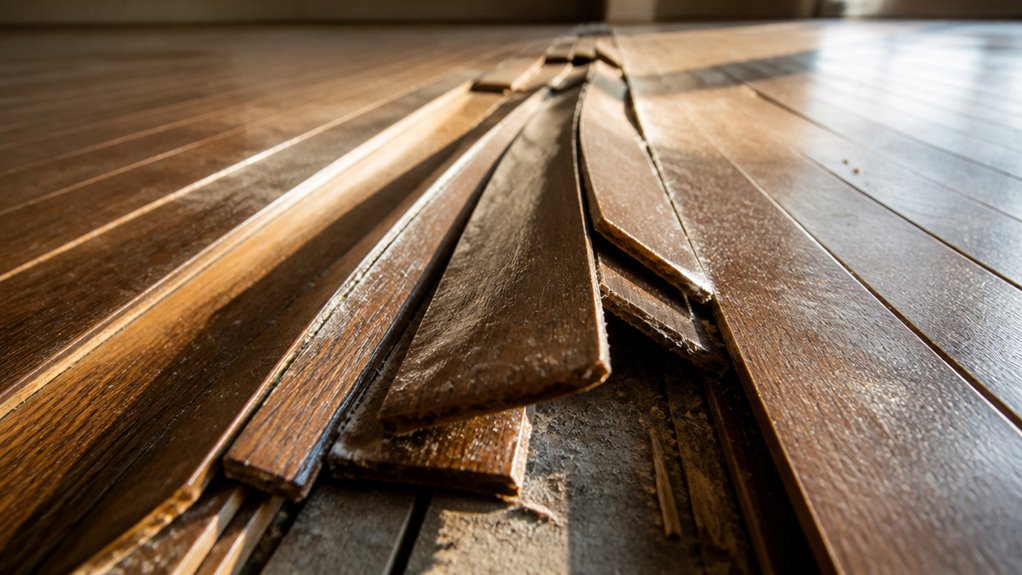
You cause floor buckling when excess moisture saturates subfloors or wood planks, forcing boards to swell and warp. Missing or insufficient expansion gaps leave no room for natural wood movement, creating compressive stress that lifts flooring.
Installation errors like skipped acclimatization or poor fastening compound instability. Structural issues and indoor humidity spikes further intensify pressure on boards. Temperature swings add repetitive stress that displaces flooring too.
Understanding these factors can help you prevent costly buckling problems.
Key Takeaways
- Excess moisture from leaks or crawl space humidity causes wood to swell and buckle.
- High indoor humidity and temperature swings create expansion and contraction stresses in wood flooring.
- Missing or insufficient expansion gaps trap swelling wood, forcing boards to lift and warp.
- Improper acclimatization and fastening methods cause internal stresses and floor instability.
- Structural issues and uneven subfloors transfer stress, leading to localized buckling and warping.
How Excess Moisture Causes Hardwood Floor Buckling?

Understanding how excess moisture causes hardwood floor buckling starts with recognizing how water interacts with wood fibers.
When water infiltrates through leaks, flooding, or persistent drips, it saturates both subfloors and floorboards, causing wood fibers to swell. This swelling increases the dimensional volume of the wood beyond its normal tolerance, resulting in upward displacement.
Additionally, high ambient humidity allows wood to hygroscopically absorb moisture, further expanding board width. Even localized wetting from standing water or wet mopping penetrates the wood surface, creating uneven swelling pressures.
These combined effects generate compressive forces within the flooring system that exceed its structural limits, forcing the boards to buckle. Without intervention, continued moisture exposure destabilizes the wood’s dimensional integrity and triggers progressive floor deformation.
Maintaining indoor relative humidity within the recommended 30–50% range is critical to preventing these moisture-related issues.
Why Missing Expansion Gaps Cause Floor Buckling?
When wood flooring lacks proper expansion gaps at room edges, the natural swelling caused by humidity and temperature changes has nowhere to go. This results in compressive forces that push boards upward. Without these gaps, wood boards press tightly against walls, generating stress that causes buckling. The absence of manufacturer-recommended spacing guarantees floor deformation during seasonal changes.
| Cause | Effect | Result |
|---|---|---|
| No edge gaps | Restricted wood expansion | Compressive pressure |
| Tight board spacing | Lateral swelling containment | Lifting and warping |
| Skipped manufacturer specs | Uncontrolled moisture swell | Structural deformation |
| Swelling wood vs walls | Force buildup | Floor buckling |
| No room for expansion | Increased board stress | Mountain-shaped boards |
You must make sure gaps accommodate wood’s dimensional changes and prevent buckling. Proper acclimation of engineered hardwood floors is essential to adjust to the room’s humidity and temperature conditions and minimize installation problems like buckling.
Installation Mistakes That Cause Hardwood Floor Buckling
You really can’t overlook how important proper acclimatization is. When the wood isn’t allowed to adjust to the room’s moisture levels before installation, it can lead to problems down the line. The wood may expand or contract after you’ve installed it, and that’s not something you want to deal with.
Then there’s the issue of fastening techniques. If the boards aren’t secured correctly, they can shift or even lift under pressure. This not only makes your floor feel unstable but can also lead to more serious issues later on.
And let’s not forget about the subfloor. If it’s not prepped right—maybe it’s uneven or has leftover moisture—it just creates the perfect storm for buckling to happen over time. Taking these factors into account can save you a lot of headaches in the future!
Additionally, failing to check for moisture and stability in the existing hardwood before installation can increase the risk of floor buckling.
Improper Acclimatization Process
Since wood flooring reacts markedly to moisture content, failing to properly acclimate hardwood before installation often leads to dimensional mismatches. You must expose the flooring to the site’s ambient temperature and humidity for several days.
This allows moisture levels to equilibrate between wood and environment. Skipping or shortening this process causes boards to expand or contract excessively post-installation, generating internal stresses.
These stresses create compressive forces that push boards upward, resulting in buckling. Additionally, improper acclimatization impairs the wood’s ability to adjust naturally to seasonal humidity fluctuations.
This makes the floor vulnerable to warping. To avoid this, measure moisture content of both subfloor and hardwood, ensuring they fall within manufacturer-recommended ranges before installation.
Neglecting this critical step undermines structural stability and directly contributes to premature floor failure. Maintaining consistent indoor humidity levels is crucial for minimizing expansion and contraction issues.
Incorrect Fastening Techniques
Mastering proper fastening techniques is essential to ensuring hardwood floors remain securely in place and resist buckling over time.
If you skip recommended nailing patterns or use inadequate fasteners, boards can shift under environmental stresses, causing gaps or lifts.
Incorrect nail placement weakens the floor’s structural integrity, allowing movement that initiates buckling.
You must also avoid loose fasteners, which fail to hold boards firmly against the subfloor.
Additionally, neglecting manufacturer guidelines for adhesive application compromises bonding strength, increasing vulnerability to moisture-induced swelling.
By not fastening boards correctly, you allow lateral and vertical displacement when wood expands, which generates compressive forces leading to deformation.
Consequently, precise fastening with appropriate tools and methods is critical to maintaining dimensional stability and preventing hardwood floor buckling.
Using flooring cleats designed to allow wood movement can significantly reduce the risk of buckling caused by moisture changes.
Subfloor Preparation Failures
When installing hardwood floors, neglecting thorough subfloor preparation sets the stage for buckling issues. You must ensure the subfloor is completely dry. Residual moisture, especially in concrete, will migrate upward, causing wood swelling.
Uneven or unstable subfloor surfaces transfer stress to floorboards, promoting lifting and warping. Loose fasteners or debris beneath the flooring reduce structural integrity, allowing movement under load.
Additionally, failing to follow manufacturer guidelines for adhesive application or fastening patterns compromises board stability and increases the risk of buckling. Proper acclimatization of wood to ambient conditions before installation prevents mismatched moisture content that triggers expansion or contraction. Installing a properly sealed moisture barrier is essential to prevent ground moisture from damaging the hardwood floor.
How Subfloor Moisture and Structural Problems Lead to Buckling?
Although subfloor conditions often go unnoticed, moisture intrusion and structural issues beneath your flooring play critical roles in causing buckling.
When subfloors retain moisture due to leaking pipes, floodwater, or improperly dried concrete, water migrates upward. This saturates hardwood and causes wood fibers to swell beyond tolerance limits.
This swelling generates compressive forces that lift floorboards. Additionally, structural settling or shifting of your building’s foundation applies uneven pressure, warping localized areas of the floor.
Insufficient ventilation in crawl spaces traps humidity, maintaining elevated moisture levels in subfloors and exacerbating wood expansion.
These factors combine to compromise subfloor stability and the dimensional integrity of the hardwood layer.
To prevent buckling, you must address both moisture sources and structural integrity under your flooring. Ensure proper drying, ventilation, and foundation support before installation.
Using moisture meters to monitor subfloor moisture levels helps detect problems early and guides effective drying strategies.
How Indoor Humidity Imbalance Damages Hardwood Floors?
Addressing subfloor moisture and structural problems sets the stage, but controlling indoor humidity plays an equally significant role in preserving hardwood floors.
When indoor relative humidity consistently exceeds the ideal 30%–50% range, wood fibers absorb excess moisture, swelling beyond their designed tolerances.
This hygroscopic expansion generates compressive forces that disrupt the floor’s dimensional stability, leading to buckling.
High ambient humidity, especially above 70%, accelerates this process by saturating wood more rapidly.
Without effective dehumidification, moisture accumulates continuously in both the air and wood, trapping the flooring in a state of expansion.
Over time, these conditions cause irreversible deformation.
You need to monitor and regulate indoor humidity precisely to prevent wood fiber oversaturation, which accounts for over half of all documented hardwood floor buckling incidents.
Implementing proper ventilation systems ensures continuous moisture removal and helps maintain stable indoor humidity levels to protect hardwood flooring.
How Temperature Swings Affect Wood Flooring Stability?
You mightn’t realize it, but rapid temperature swings can really impact your wood flooring.
What happens is that the wood expands and contracts at different rates than the subfloor. This difference can create a lot of stress on the flooring.
When that thermal expansion kicks in, it generates compressive forces. These forces can actually displace the boards, leading to issues like buckling.
Maintaining a stable indoor temperature and humidity is essential to prevent buckling or gaps caused by these stresses.
Thermal Expansion Effects
Understanding the impact of thermal expansion is essential when evaluating wood flooring stability under varying temperature conditions.
As temperatures rise, wood fibers expand in length and width, exerting pressure on adjacent boards and fixed boundaries. You’ll notice that without adequate expansion gaps, this pressure accumulates, forcing boards to buckle upward.
Conversely, cooler temperatures cause contraction, which can create gaps and compromise floor integrity.
Since wood and subfloor materials expand and contract at different rates, mismatched thermal responses generate compressive stresses that displace flooring components.
When temperature fluctuations occur rapidly or unevenly, these stresses intensify, increasing the likelihood of buckling.
To maintain stability, you must accommodate thermal expansion through proper installation practices and controlled indoor climate management. This minimizes the mechanical forces that compromise wood flooring systems.
Using an appropriate underlayment can further help absorb these stresses and support floor stability during thermal changes.
Temperature-Induced Wood Stress
When temperature swings rapidly, wood flooring undergoes significant dimensional changes that generate internal stresses.
You’ll see wood fibers expand during heat and contract in cold, causing cyclical movement.
This repeated swelling and shrinking creates compressive and tensile forces within the flooring system.
If your subfloor and wood expand at different rates, these thermal stresses intensify, increasing the risk of board displacement and buckling.
Inconsistent indoor temperatures prevent wood from reaching dimensional equilibrium, leading to continuous stress buildup.
Without proper acclimatization or adequate expansion gaps, you’ll find the flooring lacks room to accommodate these changes, causing pressure to push boards upward.
To maintain stability, you must control indoor temperature fluctuations and ensure installation allows for thermal movement.
This minimizes temperature-induced wood stress that compromises floor integrity.
Preventing Buckled Floors by Managing Moisture and Installation
Since moisture is the primary culprit in floor buckling, controlling it meticulously during installation is essential to preserving floor integrity.
You must make certain subfloors are completely dry and free from leaks before laying flooring.
Acclimatize wood planks to the environment to match moisture content, preventing dimensional mismatch.
Install proper expansion gaps around the perimeter and between boards to allow natural wood movement without stress buildup.
Avoid trapping moisture by sealing crawl spaces and using vapor barriers under concrete slabs.
Follow manufacturer guidelines precisely for fastening patterns and adhesive application to secure boards firmly yet flexibly.
Maintain indoor humidity between 30% and 50% using dehumidifiers or HVAC adjustments.
These technical measures collectively minimize swelling forces, reducing buckling risk caused by moisture intrusion and installation errors.
Frequently Asked Questions
Can Certain Wood Species Resist Buckling Better Than Others?
Yes, certain wood species resist buckling better due to their dimensional stability and moisture tolerance.
You’ll find denser hardwoods like oak, maple, and hickory less prone to swelling and warping because they absorb less moisture and expand minimally.
Conversely, softer woods like pine absorb more water, increasing buckling risk.
When selecting flooring, prioritize species with low hygroscopic properties and high stability to reduce buckling potential in variable environments.
How Long After Installation Can Buckling Typically Appear?
You can typically expect buckling to appear anywhere from a few days to several months after installation.
Immediate buckling often indicates installation errors or existing moisture issues.
Delayed buckling usually signals ongoing environmental factors like humidity fluctuations or subfloor moisture.
Monitoring conditions closely during the first 3 to 6 months is critical.
Wood needs time to acclimate and stabilize; any persistent moisture or lack of expansion gaps will reveal problems within this period.
Does Underfloor Heating Increase the Risk of Hardwood Floor Buckling?
Yes, underfloor heating can increase the risk of hardwood floor buckling.
The heat causes wood to expand and contract more frequently and rapidly than usual, stressing the boards and subfloor interface.
If the wood isn’t properly acclimated or expansion gaps aren’t sufficient, thermal fluctuations from heating systems create compressive forces, leading to warping or lifting.
You must carefully control temperature and moisture levels to minimize this risk with heated floors.
Can Furniture Placement Contribute to Floor Buckling?
You might think furniture placement can’t cause floor buckling, but it actually can. When heavy furniture restricts wood’s natural expansion, it creates pressure points that force boards to lift.
If furniture presses tightly against floor edges or covers areas needing ventilation, it traps moisture and heat, accelerating swelling.
Is Floor Buckling Covered by Standard Home Insurance Policies?
Standard home insurance policies generally don’t cover floor buckling unless it results from a covered peril like sudden water damage or fire.
You’ll want to carefully review your policy’s exclusions, as gradual moisture intrusion or wear-and-tear typically isn’t covered.
If your buckling stems from plumbing leaks or flooding, coverage might apply, but damage from humidity or installation errors usually isn’t.
Consult your insurer for specific terms and potential endorsements.
Prevent Buckling with Better Flooring Care
You might think floor buckling is just a cosmetic issue, but it signals deeper moisture or installation problems. Ignoring excess moisture, missing expansion gaps, or improper installation only worsens structural integrity.
By understanding how humidity, temperature swings, and subfloor conditions interact, you can prevent costly damage. Managing these factors precisely guarantees your hardwood floor remains stable and durable.
So, don’t underestimate buckling. It’s a technical warning demanding your immediate attention.