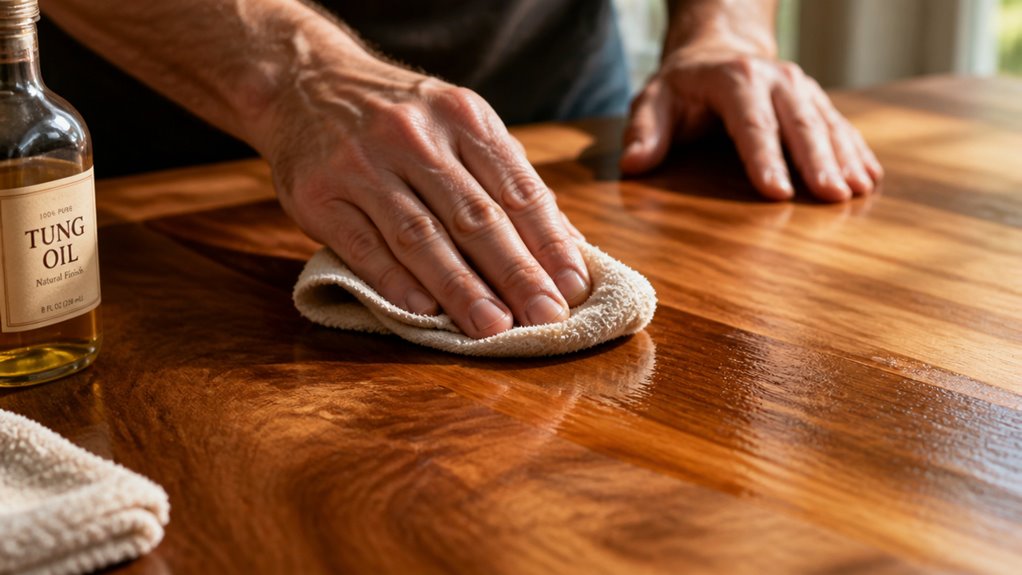
Best Way to Apply Tung Oil for a Smooth Finish
To achieve the best tung oil finish, start by thoroughly preparing your wood. Remove old finishes and sand to about 150-grit for optimal absorption.
Flood the surface generously on the first coat to guarantee deep penetration, especially on end grain. Wipe off excess oil within 10–45 minutes to prevent tackiness.
Apply multiple thin coats with proper drying intervals, typically overnight for the first coat and 12–24 hours thereafter. Using lint-free cloths or brushes guarantees even coverage.
Following these steps enhances durability and appearance, with key techniques and timing to perfect your finish.
Key Takeaways
- Remove old finishes and sand wood uniformly to 150-grit for optimal oil penetration before applying tung oil.
- Flood the bare wood surface generously with tung oil, especially on end grain, and work it in until evenly saturated.
- Wipe off excess oil after 10–45 minutes to prevent tackiness and ensure even curing.
- Allow 12–48 hours drying time between coats; apply multiple thin coats for better saturation and durability.
- Use lint-free cloths or foam pads for smooth, controlled application and buff lightly after recoating to enhance gloss.
How To Prepare Wood For The Best Tung Oil Absorption?

Preparing wood properly is essential for achieving ideal tung oil absorption and a flawless finish.
First, remove any old varnish, wax, grease, or contaminated finishes using appropriate solvents or sanding to expose clean bare wood.
Sand the surface uniformly to about 150-grit, which optimizes oil penetration without overly closing pores.
After sanding, thoroughly remove dust using a vacuum or a lint-free cloth to prevent surface defects.
Make certain the wood is completely dry and free from moisture, as dampness hinders oil absorption and causes blotching or cloudy cure marks.
If applying maintenance coats to an existing tung oil finish, avoid sanding when only cleaning and recoating.
Proper surface prep guarantees the oil soaks evenly and cures correctly, setting the foundation for a durable, smooth, and visually consistent finish.
For best results, choose oils with deep penetration and natural ingredients to enhance the wood grain and prevent drying or cracking, which is key to lasting protection and shine. penetration depth
How To Apply Tung Oil Coats For Even Coverage?
When applying tung oil, start by generously flooding the wood surface on your first coat to assure deep penetration, especially on bare wood and end grain which absorb more oil.
Begin by thoroughly saturating the wood surface on the first coat for deep, even absorption.
Use a lint-free cloth or brush, working the oil into the wood until wet spots disappear and the surface remains evenly saturated. Avoid applying thick films; instead, make certain thin, uniform coats.
Pay close attention to end grain, applying slightly more oil to prevent uneven absorption. Allow the oil to soak in for 10–45 minutes, observing when the wood stops absorbing and a glossy sheen begins to form.
After this period, you’ll know the coat is even and ready for the next step. Repeat with subsequent thin coats for consistent build and saturation.
To control the level of darkening, it is recommended to thin pure tung oil with mineral spirits or citrus solvents before application.
Removing Excess Tung Oil To Avoid Stickiness
Wipe off excess tung oil promptly once the wood stops absorbing it to prevent stickiness and uneven curing. Use a clean, lint-free cloth to gently remove any pooled oil left on the surface, especially in low spots or grain depressions.
Leaving thick layers results in tacky patches and cloudy finish areas due to slow oxygen exchange and incomplete polymerization. After waiting the recommended absorption time, typically 10–45 minutes, check the surface for gloss retention.
Any shiny, wet-looking areas indicate excess oil. Carefully wipe these down without disturbing the oil that has penetrated the wood. This “wipe on, wipe off” method guarantees a thin, even film that cures uniformly.
Neglecting this step compromises durability and leads to prolonged drying, so be diligent and thorough during this stage. Proper surface preparation, including cleaning and sanding, is essential to ensure durability and enhances the finish’s appearance.
Recognizing Tung Oil Saturation Before Recoating
You’ll know your wood has reached tung oil saturation when it stops soaking up the oil and keeps a consistent gloss after about 40 minutes.
Pretty straightforward, right? Usually, you’ll want to wait anywhere from 10 to 45 minutes before checking how much it’s absorbed. This timing can really depend on the strength of the oil and the porosity of the wood.
Keep an eye on these signs! They help ensure you’re timing your recoating just right, so you don’t end up trapping any excess oil beneath the surface.
It’s all about getting that perfect finish!
Applying multiple coats can increase protection and durability while allowing for easier maintenance and repair.
Saturation Indicators
Frequently, recognizing tung oil saturation before recoating is essential to guarantee peak finish quality and durability. You’ll know saturation occurs when the wood no longer absorbs the oil, and the surface remains glossy after the typical wait period, usually about 30 to 40 minutes.
A practical indicator is when roughly 80% of the surface shows a consistent sheen without dry patches or dull spots. After initial coats fill the pores, subsequent applications will soak in less oil, signaling nearing saturation.
Avoid applying thick films; excess oil causes tackiness and uneven curing. You should wipe off excess oil once absorption ceases to prevent defects. Monitoring these saturation indicators assures each coat bonds properly, building a uniform, durable finish without over-application or prolonged curing issues.
Proper drying and avoiding excess moisture during application are crucial to prevent damage and ensure a lasting finish, as outlined in recommended drying procedures.
Timing Between Coats
Although timing between coats varies with wood type and oil formulation, allowing adequate absorption and drying is essential to avoid trapping excess oil beneath subsequent layers.
Typically, you’ll wait 10–45 minutes to check absorption after application. For the first coat, an overnight rest is common before recoating. Subsequent coats may require shorter intervals.
Watch for the wood’s surface: once it stays glossy and no longer soaks in oil, it’s time for the next coat. Cooler temperatures slow drying, so adjust timing accordingly.
Choosing oils with appropriate drying times helps ensure an even, durable finish and reduces the risk of dust or debris settling on wet surfaces.
| Coat Number | Typical Wait Time | Surface Condition |
|---|---|---|
| 1st | Overnight to 2 days | Wood absorbs oil fully |
| 2nd–3rd | 10–45 minutes | Surface glossy, no absorption |
| Final | 24+ hours | Fully saturated, tack-free |
When And How To Recoat Tung Oil For Lasting Protection?
You know, it’s a good idea to recoat tung oil once the surface feels dry to the touch.
This can usually happen anywhere between 10 minutes to 2 days, depending on things like the wood’s porosity and the temperature.
Keep an eye out for signs of saturation, such as a consistent glossy sheen.
That’s when you know the wood isn’t absorbing any more oil.
Before you go ahead and recoat, just make sure the surface is nice and clean—free of dust and debris.
If you’re just doing a maintenance coat, it’s best to skip the sanding.
You want to preserve that existing finish, after all!
Drying times can be significantly influenced by temperature and humidity, so controlling these factors helps ensure optimal recoating conditions.
Ideal Recoat Timing
When applying tung oil, timing your recoats precisely guarantees peak absorption and curing for lasting protection. You want to avoid recoating too soon, which traps oil on the surface, or too late, which reduces adhesion.
Typically, wait 10–45 minutes after applying a coat to check absorption. For the first coat, allowing overnight to 2 days before recoating guarantees proper curing. Keep ambient temperature in mind; warmer conditions accelerate drying and recoating intervals.
Follow these steps for ideal recoat timing:
- Assess surface dryness by touch and appearance after 10–45 minutes.
- Wipe off excess oil once absorption slows to prevent tackiness.
- Wait overnight or up to 48 hours after the first coat before applying the next.
- Repeat recoating every 12–24 hours depending on wood porosity and temperature.
For best results, applying thin, even coats and allowing proper drying time between layers helps avoid common issues such as tackiness and uneven finishes, a principle shared with polyurethane application.
Signs Wood Is Saturated
Often, determining when wood is saturated with tung oil hinges on observing its absorption behavior and surface appearance.
You’ll notice saturation when the wood stops absorbing oil and the surface remains glossy after waiting 30–40 minutes. Typically, about 80% of the surface should retain this gloss, indicating the pores are filled and oil uptake has plateaued.
As you apply successive coats, absorption slows because the pores become saturated, so the surface gloss is a reliable indicator.
Avoid pooling oil, which signals oversaturation and risks a tacky finish. When the wood no longer darkens or feels wet beyond the initial wipe-on, it’s time to recoat or allow curing.
This approach guarantees lasting protection without buildup or uneven curing.
Proper surface preparation, including cleaning and light abrasion, is essential for ensuring optimal oil penetration and finish durability, as seen in similar finish applications like surface preparation.
Preparing Surface Between Coats
After the wood shows signs of saturation and the surface maintains its gloss, preparing the surface properly before applying additional coats guarantees peak adhesion and curing.
You want to make certain the tung oil bonds well and cures evenly between layers.
Follow these steps to prep between coats:
- If recoating bare wood, lightly sand with 150-grit to open pores. Avoid sanding maintenance coats on sealed surfaces.
- Remove any dust thoroughly using a vacuum or lint-free cloth to prevent finish defects.
- Wipe the surface with a clean, dry cloth to eliminate grease, wax, or contaminants that block absorption.
- Confirm the wood is completely dry before applying the next thin coat to avoid trapping moisture.
This method makes certain your tung oil finish cures to a durable, smooth, and even protective layer. Proper sanding and wiping techniques are essential to maintain penetration depth and ensure long-lasting protection.
Picking The Best Tools For Tung Oil Application
Choosing the right tools can make or break your tung oil application, directly impacting absorption, finish smoothness, and overall durability.
Use lint-free cloths or rags for even, controlled application to avoid lint contamination and maximize oil penetration.
Brushes with natural bristles can apply oil efficiently on textured or intricate surfaces but risk leaving streaks or excess buildup.
Foam pads provide smooth, thin coats and help work the oil into grain uniformly, especially on flat panels.
For larger areas or floors, a roller or pump sprayer can speed coverage but requires skill to prevent pooling.
Always select tools that allow you to flood the surface generously initially, then wipe off excess oil, assuring thin coats and preventing tacky finishes.
Proper tool choice guarantees consistent absorption and a flawless tung oil finish.
Maintaining Tung Oil Finishes For Longevity And Sheen
Regular maintenance guarantees your tung oil finish retains its protective qualities and attractive sheen over time.
To preserve longevity and luster, clean the surface with a soft cloth to remove dust and debris without sanding, which can disrupt the cured layer.
Apply thin maintenance coats using a diluted tung oil mix to penetrate partially closed pores, preventing buildup.
Lightly buff the surface after recoating to enhance gloss and remove any excess oil.
- Clean with a lint-free cloth; avoid abrasive cleaners.
- Use a thinner oil mix for maintenance coats to improve penetration.
- Apply thin, even layers; wipe off excess to prevent tackiness.
- Buff lightly after drying to maintain sheen and smoothness.
Consistent care extends finish durability and maintains your wood’s natural beauty.
Frequently Asked Questions
How Should I Safely Dispose of Oil-Soaked Rags?
You should never just toss oil-soaked rags in the trash because they can spontaneously combust.
Instead, spread them out flat on a non-flammable surface in a well-ventilated area until fully dry.
Alternatively, submerge the rags in water inside a metal container with a tight lid.
Then dispose of them according to local hazardous waste guidelines.
Always check your area’s regulations for safe disposal to prevent fire hazards and environmental damage.
Can Tung Oil Be Used on Outdoor Wood Surfaces?
Imagine your outdoor wood as a thirsty traveler under the sun.
Yes, you can use tung oil on outdoor wood, but pure tung oil alone isn’t fully weatherproof.
It penetrates and seals wood well but needs reapplication and often a protective topcoat to resist moisture, UV rays, and temperature changes.
For lasting outdoor use, apply multiple thin coats, allow full curing, and consider blending tung oil with additives designed for exterior durability.
What Temperature Range Is Ideal for Tung Oil Curing?
You’ll want to cure tung oil within a temperature range of about 60°F to 80°F (15°C to 27°C) for ideal drying and hardening.
Warmer temperatures speed up curing by enhancing polymerization, while cold or freezing conditions slow it dramatically, potentially causing tackiness or cloudy finishes.
Maintain good airflow and avoid extreme humidity.
Staying within this range guarantees the oil fully cures in 15–30 days, achieving a durable, protective surface.
Is Tung Oil Food-Safe for Cutting Boards?
Yes, pure tung oil is considered food-safe once fully cured, making it suitable for cutting boards.
You’ll want to use 100% pure tung oil without additives or dryers, as these can be toxic.
After applying multiple thin coats and allowing complete curing, often 15–30 days, the finish creates a durable, water-resistant, non-toxic barrier.
Always make certain the oil has fully polymerized before food contact to avoid any health risks.
How Long Does Tung Oil Take to Develop Full Hardness?
Think of tung oil curing like a slow-setting glue, gradually stiffening over time.
It typically takes 15 to 30 days for tung oil to develop full hardness, depending on factors like coat thickness, temperature, and humidity.
While light use might be possible after 7 to 10 days, you should avoid heavy wear until the finish fully cures.
Warmer conditions speed the process, but cold slows down polymerization and hardening markedly.
Final Tips for a Smooth Tung Oil Finish
Now that you know how to prepare, apply, and maintain tung oil, are you ready to achieve that flawless, durable finish?
Proper surface prep guarantees deep absorption, while careful coating and timely recoating prevent stickiness and unevenness.
Using the right tools makes application efficient, and routine maintenance preserves the wood’s luster.
Master these steps, and your tung oil finish won’t just protect, it’ll enhance your wood’s natural beauty for years to come.