
Maple vs Poplar Wood Comparison for Furniture and flooring
When choosing between maple and poplar wood, consider your project’s needs: maple, especially hard maple, offers greater hardness, density, and durability. This makes it ideal for heavy-use furniture and flooring, though it demands sharper tools and more effort to work.
Poplar, being softer and lighter, excels in ease of machining, intricate carving, and smooth painted finishes. It is perfect for budget-friendly, decorative applications. You’ll find differences in stability, grain, and finishing that affect your final result, revealing which wood suits your specific goals.
Key Takeaways
- Maple is significantly harder and denser than poplar, offering superior durability and impact resistance for heavy-use furniture and flooring.
- Poplar is softer, easier to machine, and ideal for detailed carving, making it better suited for painted furniture and intricate designs.
- Soft maple provides better dimensional stability and lower shrinkage than poplar, reducing warping in humidity-sensitive applications.
- Maple features a fine, tight grain with smooth finishes, while poplar has a straight grain and uniform texture that excels under paint.
- Poplar is more budget-friendly and widely available, whereas hard maple is costlier due to slower growth and higher demand.
Maple vs Poplar Wood: Key Differences at a Glance
| Feature | Maple Wood | Poplar Wood |
|---|---|---|
| Hardness | Harder and more durable, especially hard maple | Softer wood, easier to dent |
| Janka Rating | 950–1450 depending on type | Around 540 |
| Workability | Requires sharper tools and more effort | Very easy to cut and carve |
| Grain & Appearance | Tight, fine grain, ideal for natural finishes | Straight, uniform grain, great for paint |
| Weight & Density | Heavier and denser | Lightweight and easier to handle |
| Stability | Soft maple offers better stability | Higher shrinkage with moisture changes |
| Cost | More expensive, especially hard maple | Budget-friendly option |
| Best Uses | Furniture, flooring, cabinets | Paint-grade furniture, trim, carvings |
Maple or Poplar: Matching Wood to Your Design
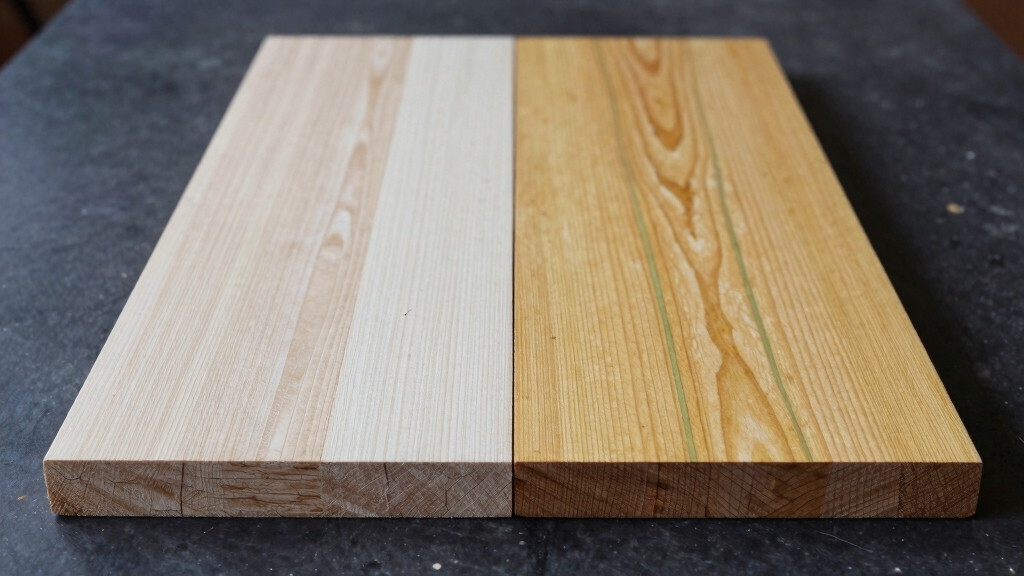
When comparing maple and poplar wood, you’ll notice clear differences in:
Hardness: Maple Vs Poplar For Your Project
When you’re deciding between maple and poplar for your project, it’s important to look at the Janka hardness ratings. Did you know that hard maple scores a solid 1450 lbs? Soft maple is a bit lower at 950 lbs, while poplar comes in at just 540 lbs. That really highlights the differences in how each wood can handle impact.
Maple is definitely the go-to choice if you’re after durability, especially for heavy-use applications. But, let’s not overlook poplar! Its softer nature makes it easier to work with, and that means less wear on your tools. So, when you’re weighing your options, think about what you need most: strength or detail.
Finding that balance will help you choose the right wood for your project! Additionally, the grain structure of maple typically features a fine, even texture which enhances its finish and durability compared to poplar’s more open grain.
Janka Hardness Comparison
Although both maple and poplar are popular choices in woodworking, their Janka hardness ratings reveal significant differences that directly impact your project’s durability and suitability.
Poplar registers a Janka hardness of 540 lbs, classifying it as a softer wood ideal for projects where ease of cutting and shaping matter more than surface durability.
In contrast, soft maple scores 950 lbs, almost double poplar, offering enhanced resistance to dents and wear for furniture and cabinetry. Hard maple excels further at 1450 lbs, making it suitable for heavy-duty applications like flooring or sports equipment.
Selecting between these woods depends on the expected stress your piece will endure: poplar suits lighter, decorative tasks, while maple’s superior hardness supports structural integrity and longevity in high-traffic or impact-prone settings.
Maple’s high Janka rating also contributes to its excellent resistance to dents and scratches, making it a preferred choice for areas subject to heavy use.
Impact Resistance Differences
Since impact resistance largely depends on hardness, choosing between maple and poplar requires understanding their material properties under stress.
Maple, with a Janka hardness ranging from 950 lbs (soft maple) to 1450 lbs (hard maple), offers markedly higher resistance to dents and impacts than poplar, which rates at 540 lbs.
This means maple can better withstand sudden force without deforming, making it ideal for applications involving frequent contact or potential shocks.
Poplar’s lower hardness reduces its impact resistance, but its resistance to splitting during cutting compensates somewhat in construction contexts.
However, if your project demands superior impact durability, maple’s dense cellular structure and greater hardness make it the more reliable choice, especially where longevity and surface integrity under impact stress are critical.
Additionally, maple’s fine, straight grain patterns contribute to its smooth texture and enhanced durability compared to poplar.
Workability And Durability
Choosing between maple and poplar for your project hinges on balancing workability with durability, particularly considering their hardness differences.
Poplar’s Janka hardness of 540 lbs makes it softer and easier to cut, ideal for intricate designs and detailed joinery. It resists splitting well, maintaining sharp edges during construction.
However, its higher shrinkage (9.9) demands careful moisture control. Maple, with soft maple at 950 lbs and hard maple at 1450 lbs, offers superior durability for heavy-use items.
It requires sharper blades and more effort to work. Soft maple provides a balance: easier to machine than hard maple, yet denser and more stable than poplar.
Your choice depends on whether you prioritize ease of shaping or long-term wear resistance, factoring in the wood’s density, stability, and finishing requirements.
Using the right tools, such as a miter saw with a fine-tooth blade, can help achieve clean cuts and preserve the wood’s integrity during shaping.
Weight And Density: Maple Vs Poplar Compared
Did you know that poplar is quite a bit lighter than maple? With a specific gravity of just .42, poplar really stands out when you compare it to soft maple, which sits at .54, and hard maple, coming in at .63. This difference in density means that poplar typically weighs around 28-29 lbs per dried cubic foot.
On the other hand, soft maple can weigh anywhere from 30-38 lbs, while hard maple can reach up to 40 lbs! When choosing wood for projects requiring precision and stability, considering the dimensional stability of the species can be just as important as weight and density.
Density Differences Overview
While both maple and poplar serve as popular hardwood choices, their density and weight differ markedly, impacting their suitability for various applications.
Poplar exhibits a specific gravity of 0.42, making it the lightest among these woods, with a dried weight of about 28-29 lbs per cubic foot.
In contrast, soft maple‘s specific gravity is around 0.54, approximately 29% denser than poplar, weighing between 30-38 lbs per cubic foot. Hard maple tops the scale with a specific gravity of 0.63 and a weight near 40 lbs per cubic foot.
These density differences influence your choice depending on whether you prioritize lightness for ease of handling or density for strength and durability in heavy-duty projects.
Due to its higher density and cellular structure, hard maple generally offers greater durability and resistance compared to poplar.
Weight Comparison Insights
Understanding the density differences between maple and poplar sets the stage for evaluating their weight characteristics in practical applications.
Poplar, with a specific gravity of 0.42, weighs approximately 28–29 lbs per dried cubic foot, making it the lightest option. Soft maple’s density rises to 0.54, translating into a weight range of 30–38 lbs per cubic foot, roughly 29% heavier than poplar.
Hard maple is the densest, at 0.63 specific gravity, and can weigh up to 40 lbs per cubic foot. These weight variations directly influence handling and transportation.
When you choose between these woods, consider poplar’s lighter mass for ease of maneuvering, whereas maple’s greater weight correlates with increased strength and durability, essential for applications demanding resilience.
Additionally, the anisotropic mechanical properties of wood like maple and poplar affect how their weight relates to bending strength and flexibility in woodworking projects.
Impact On Application
When selecting wood for your project, you’ll want to weigh the implications of density and weight on performance and handling.
Poplar’s lighter density (.42 specific gravity) and weight (28-29 lbs/ft³) make it easier to maneuver and ideal for intricate designs or painted finishes.
Conversely, soft and hard maple’s higher densities (.54 and .63) and weights (30-40 lbs/ft³) offer greater structural strength and durability, suitable for heavy-use items.
| Wood Type | Density (Specific Gravity) | Weight (lbs per ft³) |
|---|---|---|
| Poplar | 0.42 | 28-29 |
| Soft Maple | 0.54 | 30-38 |
| Hard Maple | 0.63 | 40 |
Choosing maple means enhanced durability; poplar favors ease of handling and fine detail. For projects where natural beauty and grain enhancement are priorities, applying a penetrating oil finish can significantly improve the walnut’s appearance and longevity.
Stability And Shrinkage: Which Wood Performs Better?
Because moisture-related movement can compromise woodworking projects, evaluating stability and shrinkage is essential when choosing between maple and poplar.
Poplar exhibits a shrinkage rating around 9.9, indicating higher dimensional changes with moisture fluctuations.
Soft maple outperforms poplar in stability, showing shrinkage values between 7.2 and 8.2, which means less expansion and contraction. Curiously, hard maple shares poplar’s 9.9 rating despite its greater density.
However, you should prioritize maintaining proper moisture content over species selection, as it critically reduces warping and cracking risks.
While poplar is lighter and easier to work with, its higher shrinkage means it may require more careful environmental control.
In contrast, soft maple’s superior stability makes it a more reliable choice for applications sensitive to humidity changes. Maintaining a consistent indoor environment is crucial to minimize expansion and contraction in wood materials.
Grain Patterns And Appearance: Choosing Your Style
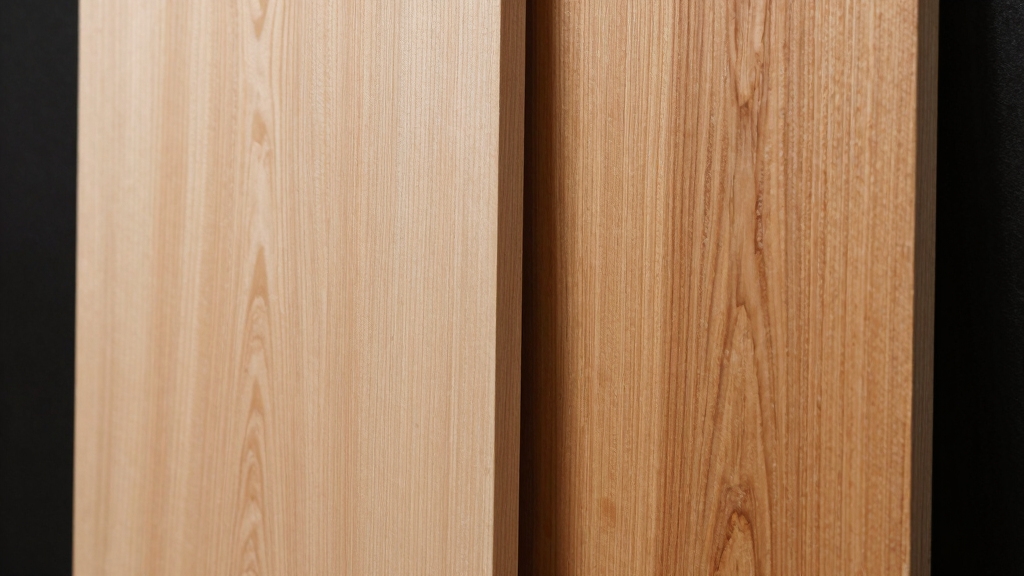
Grain pattern and surface texture markedly impact both the visual appeal and finishing approach for maple and poplar woods.
Poplar exhibits a straight grain with a smooth, uniform texture that minimizes visible wood grain, especially under paint. This makes it ideal if you want a consistent, flat finish but requires more effort to mask grain through staining.
Maple, particularly soft maple, features a tight, close grain that resists indentation and abrasion, enhancing durability and glaze retention. Hard maple can display distinctive burl or bird’s-eye patterns, adding natural character and visual complexity.
When choosing your style, consider that maple’s varied grain patterns allow for both subtle and intricate finishes. Poplar offers a more uniform canvas suited for painted surfaces. Your choice hinges on the desired aesthetic and finishing technique.
Maple Vs Poplar: Which Costs Less?
When you’re looking at costs, you’ll usually find that poplar is the more budget-friendly option. This is mainly because it’s more readily available and grows faster than maple. So, if you’re keeping an eye on your expenses, poplar might be the way to go.
Now, if you’re considering soft maple, it’s priced somewhere between poplar and the more expensive hard maple. Hard maple tends to cost more due to its density and the fact that it takes longer to mature. Understanding these pricing dynamics can really help you choose the right kind of wood without breaking the bank.
Price Comparison Overview
Although both maple and poplar offer distinct benefits, you’ll find that poplar generally costs less due to its higher availability and lower demand for heavy-duty applications.
Poplar’s lower density and softer wood structure reduce harvesting and processing costs, making it ideal for budget-conscious projects. In contrast, hard maple’s slower growth and higher density elevate its price, reflecting its durability and strength.
| Wood Type | Approximate Cost per Board Foot | Common Use Cases |
|---|---|---|
| Poplar | $1.50 – $2.00 | Paint-grade furniture, moldings |
| Soft Maple | $2.50 – $3.50 | Cabinets, paneling |
| Hard Maple | $4.00 – $6.00 | Heavy-use furniture, flooring |
Understanding these costs helps you select the best wood for your specific project budget and requirements.
Availability Impact On Cost
The cost differences between maple and poplar closely tie to their availability in the market. Poplar’s widespread growth and faster replenishment rates mean you’ll find it more readily and at lower prices.
In contrast, hard maple’s slower growth and higher demand for heavy-duty applications limit supply, pushing costs upward. Soft maple, sitting between these extremes, offers moderate availability and pricing.
If you require cost efficiency without sacrificing quality, poplar’s abundant presence reduces procurement expenses.
Conversely, sourcing hard maple demands higher investment due to its scarcity and superior density. Consequently, when budgeting for projects, consider that poplar’s plentiful availability directly lowers material costs.
Maple’s limited supply and specialized use justify its premium pricing. This availability-cost relationship is critical for informed material selection in woodworking.
Best Uses For Maple And Poplar Wood In Furniture And Cabinetry
Choose poplar if your project demands intricate designs and painted finishes, as its straight grain and smooth texture allow for fine detail work and minimal grain visibility under paint.
Poplar’s lighter density and softness enable crafting delicate features without excessive tool wear. For cabinetry and furniture requiring durability and resistance to abrasion, soft maple is ideal.
Its tighter grain and higher hardness provide strength and stability, making it suitable for kitchen tables, desks, and molding.
Hard maple excels in heavy-use items due to superior hardness and density but demands sharper tools. While poplar favors painted applications, maple’s natural grain supports clear finishes and glazing.
Selecting between these woods depends on balancing design complexity, finish type, and wear resistance for cabinetry and furniture tailored to specific functional needs.
Workability And Carving Detail: Maple Vs Poplar
When working with poplar, you’ll find it excels in carving intricate details due to its softer nature and straight grain. This reduces tool wear and allows for precise, delicate cuts.
Maple, especially hard maple, demands sharper blades and more effort due to its density and hardness, making detailed carving more challenging. Soft maple offers a middle ground, balancing workability and strength.
Consider these points when choosing between the two:
- Poplar’s lower Janka hardness (540 lbs) makes it ideal for fine, detailed carving.
- Hard maple’s high density (specific gravity 0.63) requires more force and tool maintenance.
- Soft maple provides better stability and workability than hard maple but is less detailed than poplar.
- Poplar’s straight, uniform grain enhances the precision of intricate cuts.
Finishing Tips: Painting And Staining Maple And Poplar
Understanding how poplar and maple respond to finishing techniques builds on their differing grain patterns and hardness.
Poplar’s straight grain and softer nature make it prone to uneven stain absorption, requiring a wood conditioner before staining to prevent blotchiness.
When painting, its smooth texture allows paint to cover the surface evenly, but you should sand lightly to promote adhesion.
Maple, especially hard maple, has a tighter grain and higher density, which resists stain penetration. Pre-treating with a conditioner helps achieve uniform coloration.
Maple’s hardness demands finer grit sanding for a smooth finish, particularly before painting.
Both woods benefit from sealing with a clear topcoat to enhance durability and moisture resistance.
Ultimately, precise surface preparation tailored to each wood’s characteristics guarantees a professional finish.
Choosing Between Maple And Poplar: Which Wood Is Right For You?
Selecting the ideal wood for your project hinges on balancing factors like hardness, stability, appearance, and cost.
To determine whether maple or poplar suits your needs, consider these key points:
- Hardness: Maple, especially hard maple (1450 Janka), offers superior durability for heavy-use items. Poplar (540 Janka) suits lighter applications.
- Stability: Soft maple provides better dimensional stability than poplar, reducing shrinkage risks during environmental changes.
- Appearance: Poplar’s straight, smooth grain is ideal for painted finishes. Maple’s tight, sometimes figured grain enhances natural stains.
- Cost: Poplar generally costs less and is more available. Maple’s higher price reflects its density and slower growth.
Assess your project’s functional demands and visual goals to choose the wood that best aligns with your technical and budgetary requirements.
Frequently Asked Questions
Are Maple and Poplar Sustainably Harvested Woods?
Yes, you can find sustainably harvested maple and poplar, but it depends on the source and certification.
When you choose wood certified by organizations like FSC or SFI, you guarantee responsible forest management practices that protect biodiversity and promote regeneration.
Sustainable harvesting minimizes environmental impact, so always verify the certification to confirm the wood’s eco-friendly origin.
Without certification, sustainability claims are less reliable, so prioritize documented sources for your projects.
How Do Maple and Poplar React to Outdoor Weather Conditions?
You might find it surprising, but both maple and poplar aren’t ideal for outdoor use without treatment.
Maple’s density and hardness offer moderate resistance to moisture, yet it’s prone to warping and cracking under prolonged exposure.
Poplar, being softer with higher shrinkage rates, swells and contracts more in weather changes.
To protect either, you’ll need sealants or finishes designed for outdoor durability to prevent deterioration effectively.
Can Maple or Poplar Cause Allergic Reactions During Woodworking?
Yes, both maple and poplar can cause allergic reactions during woodworking. You might experience skin irritation, respiratory issues, or eye discomfort from their dust.
Maple’s dust is known to cause contact dermatitis and nasal allergies in sensitive individuals, while poplar dust often triggers mild irritation but can still provoke allergies.
Always wear protective gear like masks and gloves, and make sure proper ventilation to minimize exposure and safeguard your health.
Which Wood Is Better for Children’s Toys, Maple or Poplar?
You should choose hard maple for children’s toys because its high Janka hardness (1450 lbs) offers superior durability and resistance to wear, ensuring the toy withstands rough handling.
Maple’s tight, smooth grain reduces splinter risks, making it safer.
Poplar is softer and less dense, so it dents and scratches more easily, which isn’t ideal for long-term use.
Maple’s strength and safety features make it the better, more reliable option.
Do Maple and Poplar Woods Require Different Maintenance Routines?
Yes, maple and poplar require different maintenance.
You’ll need to be more vigilant with maple due to its hardness.
Regular inspections for dents or scratches help maintain its surface.
Poplar, being softer, demands more careful handling to avoid dents but is easier to refinish or repaint.
Both need proper moisture control to prevent warping.
However, poplar’s higher shrinkage means you’ll want to monitor humidity levels more closely to maintain stability.
Choosing the Right Material After Comparing Maple & Poplar Wood
When choosing between maple and poplar, consider that maple rates around 1450 on the Janka hardness scale. This is nearly twice as hard as Poplar’s 540. This significant difference affects durability and wear resistance, making maple ideal for heavy-use furniture.
However, poplar’s lighter weight and smoother grain offer easier workability and finishing options. Understanding these technical distinctions guarantees you select the best wood tailored precisely to your project’s demands and aesthetic goals.